
Bubble and Shadow
- Designer: Kai Zu
- Publisher: Broadway Toys LTD
- Players: 2-5
- Age: 10+
- Time: 30 mins
- Preorder link: https://forms.gle/RqukaTumiF9zULs1A
- Played with review copy provided by publisher
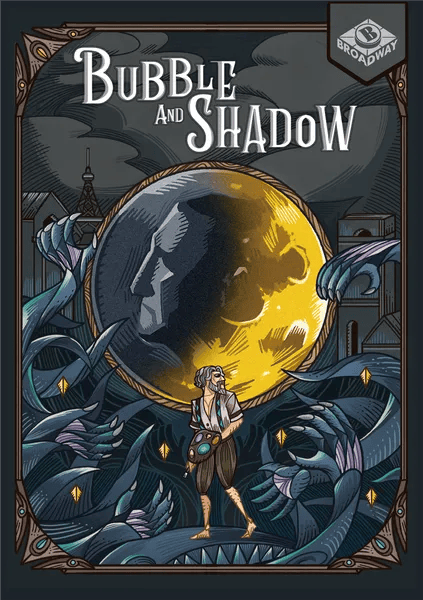
Bubble and Shadow is a light strategy board game with a literary fantasy theme.The game is mainly centered on the core mechanics of ‘I-cut-you-choose,’ risk-based trading. In the game, players will alternately appear as either an emissary of the Magician or a Mortal of the earthly realm, signing pacts with each other and engaging in transactions centered around different prices. Through mutual speculation and probing, you will approach a delicate balance-everything you possess will determine the final outcome.

To start, prepare the price tokens for the player count. There are 3 basic types: Moons, Silver Coins and Bubbles. At higher player counts, and for more advanced players, the Special Price tokens can also be used. The Price Tokens are all mixed in the bag and each player then draws out 11 at random and hides them behind a player screen. Then shuffle the two decks of cards. Place 3 Special Pact cards face up on the table and then set the rest aside. Deal each player a hand of 6 Regular Pact cards.

The game is played over a number of rounds. In each, one player is the Magician, and he will choose one pact to enact. This card can either come from the player’s hand or be one of the three face-up on the table. Once chosen, the Pact card is then presented to any other player so long as that player has the fewest Pact in front of them.

That player, called the Mortal, now decides which end of the Pact they want in front of them. They will have to pay the full cost on their side, and the Magician will pay the cost on the other. Mortals must choose a side which they can fully pay if possible.

If they cannot pay either side, they can choose either end. The two players now pay as much of the cost of their card as possible. The current Mortal becomes the next Magician and the dealing resumes. This continues until all players have 4 Pacts in front of them.

At this point, the Round ends. Players who have more than 6 Coins treat the excess as Bubbles. Then, the player with the most Bubbles (and ties) is eliminated from scoring this round. Next, the player(s) with the fewest Silver Coins score 1 Soul Token and are out of the rest of scoring. The remaining player with the most Moons now scores 3 Soul tokens and everyone else left in the round gets 2 Soul Tokens.

Check to see if the game is over – either the end of the third round OR if someone has 5 or more Soul Tokens. The player with the most Soul Tokens wins.
My thoughts on the game
So when I first read the rules, my brain didn’t see the “I-cut-you-choose” part of the game, but now that I’ve played it, Bubble and Shadow presents the players with a very interesting version of this mechanism. Here, each Pact is a fixed “I-cut-you-choose” deal. The card pre-determines the sides of the deal (i.e. the cut), and the opponent chooses which end they want out of the deal. The catch here being that if they cannot fully pay either side of the deal, they still get to choose what they want and stiff you. Or, if they choose poorly, you might not be able to pay them the full price of the deal.
As the game starts, everyone’s bank roll is a mystery as players have all 11 tokens behind their screen. However, starting from the first deal, the result of all trades is open knowledge and part of each player’s bank is kept in front of the screen. If you have a good memory, you might even be able to remember when players were unable to fulfill a deal, thus telling you indirectly what they DON’T have behind their screen.
Once started, the game just organically moves around the table as each Mortal becomes the next Magician. However, timing can be inequitable. It’s definitely advantageous to be the Magician earlier in the round. As you must offer your deal to a player who has the fewest Pact cards in front of them, the options of who to trade with diminish as the round continues. This can be extremely important in the game because depending on what trade outcome you’re hoping for, different players might be better suited for them than others – so, you’d like to have the most chance to offer the deal to the desired player.
Once the game is complete, then you get to the scoring. Trust me, it might take a game or two to get the hang of it. Especially if you use the Special tokens. The player aids unfortunately do not help out the game at all. Players are actually given two aids – one in card form (which doesn’t include all the information) and another miniature one on the inside of their screen (which uses icons that aren’t particularly helpful).

Just pull out the rules and go thru the steps one at a time. First, if you’re playing with the special tokens, you have to do all the conversions – this is one of the things I wish the player aid had on the card. There are a lot of things to remember here other than just the order of operations. Next, figure out your purple bubble status and eliminate the player with the most. Move on to the elimination of the player(s) with the least coins – though they score a point. (Why is this not indicated on the player aid card?!). Then, everyone who is left scores based on their yellow Moons.
It all works out, and the elimination hoops in the scoring make each type of resource valuable in its own way. Everyone wants to ditch their purples, but if you ditch too early, you might be forced to accept a deal where you can pay the other side and must take a bunch of purples in return. Next, you want some silver, but not too many – because each extra silver you have is one less moon that you can use towards getting max points.
The art is really gorgeous, but can be a bit distracting. There are a lot of colors and shapes going on, and you end up only needing the smallest icons in the edges of the cards. That being said – I stand by my usual opinion that I’d rather have a game’s function be primary over beauty.

The pace of the game is moderate, and there is a fair bit of watching the two players in the deal think things out. There really isn’t much to do when it’s not your turn – you really need to wait to see the board state to figure out what deal is best to try to broker. If you are new to the game, I’d definitely NOT recommend playing with 5. The downtime issue is obviously worse, but also, when playing with the max player count, you are obligated to use some of the special tokens in order to have enough to play – and the game is complicated enough to start without having to also grok a few of the special tokens. I would think it best to wait a few games before you get into all those new rules.
If you’re in the market for a trading game where the outcome of the deal is never really foreseeable; this is one to try…
Until your next appointment,
The Gaming Doctor


