
Chang’an
- Designers: Nestore Mangone, Carlo Camarotto
- Publisher: Arcane Wonders
- Players: 1-4
- Age: 14+
- Time: 45 minutes
- Amazon affiliate link: https://amzn.to/4voZVs7
- Played with review copy provided by publisher
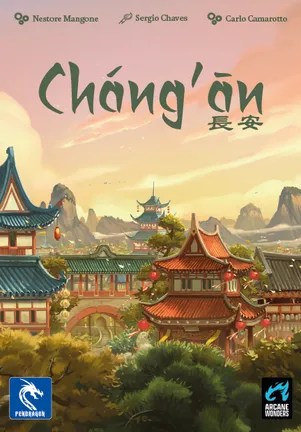
During the Tang dynasty, Chang’an was one of the largest cities in the world. It was a cosmopolitan urban center with thousands of travelers exploring it. As an important urbanist, compete against other players to build the best districts of Chang’an and to get the favors of the court.
Players will carefully project their plans by placing cards on the top part of their personal boards (the gates). Then they will move them into the city districts to build amazing buildings and to welcome influential characters in the neighborhood. Every new card built into the districts will provide players with different types of privileges and a certain number of victory points.
During your turn, you perform only one of the three main actions: research, play and/or move cards on the gates to produce resources and activate character effects, or build. The game ends as soon as a player gets nine or more cards built in the districts of their City board (cards at the gates are not considered). The player with the most victory points will be declared the best urbanist of Chang’an.
To set up, the players must first choose which City Card decks to play with. There are five different decks (Production, Trade, Science, Politics and Military). Each game will only have three or four of these decks in play. The chosen decks are all shuffled together to form a single City deck. The top 3 cards of this deck are revealed in a market. Players also get a starting hand of four cards. Players also get a city board, a coin and a single wheat token. The city board has four columns on it, with four gates found at the top of each column.

On a turn, the active player takes one of three possible actions: Research, Produce, Build. In addition, once a turn, a player can buy a resource and steal a card from another player.
Research – take a face up card from the Market or the facedown card from on top of the deck. Additionally, spend 2 wheat tokens for each extra card drawn.

Produce – Players can play new city cards and/or rearrange their city cards at a single gate. If you play cards, you can play 1,2 or 3 cards from your hand to a single Gate. A gate can only ever hold 3 cards at a time. The player can also move cards from one or more Gates to this single activated gate. Cards can either be moved one at a time or can be moved as a group. This is important as the player can choose which card is on top of the stack at a Gate. Finally, look at the cards at this particular gate, and collect the gate’s resources based on the number of icons in the stack, including the one printed on the gate itself. Finally, players can activate the effects of any Character cards already built into the column directly below the Gate.

Build – Take the topmost card from any Gate on their board and build it on the topmost available space on ANY district in their city, paying the resources shown on the space that was built upon. You cannot have two copies of the same card in any district. Once built, you immediately trigger the effect of the newly built card if it is a Character card or an Immediate effect. Other cards may provide an ongoing benefit while others give an end-game bonus scoring opportunity.
Buy A Resource – spend 2 coins to buy any one resource (stone, wood, wheat)
Steal a Card – Take the topmost card from any player’s Gate – though you can never take a solitary card. If you take a second card, you must pay 2 Stone to the supply, and if you take a third card, you must pay 1 Stone. The player who was stolen from does get a single Wheat token as compensation. The stolen card is placed in your hand.

The game ends at the end of any round when a player has 9 or more cards built into their City. Players then score points:
- Buildings in the first (top) row of each District – 2VP
- Buildings in the second row of each District – 4VP
- Buildings in the third (bottom) row of each District – 8VP
- 3VP for full first row and three different card types
- 5VP for full second row and three different card types
- VP per city cards built in your City (upper right corner)
- VP for game end bonus City cards
- 1VP for each set of 5 unused resources and cards in your hand

The player with the most points wins. Ties broken in favor of the player with the most card in the third row of their districts.
My thoughts on the game
There are a lot of interesting decisions to make in Chang’an as you place and move cards to best achieve your goals. There is an interesting decision each turn as you have to decide which card to leave unprotected at the top of a column – because any cards at the top (unless directly next to the player board) are liable to be stolen by an opponent.
Of course, unless you play only a single card (which then limits how much you are able to produce), you’ll have to take that risk – or do a multi-step maneuver where you play cards on a turn, leaving the desired one at the bottom, and then on a later turn, moving the cards that are on top of it somewhere else (for production), and then on a third turn, building the safe card next to your board. It’s definitely possible, but time consuming. You’re probably better off just trying to read what your opponents are doing and playing the card at a time when they’re not likely to want to steal it..
The column action system is reminiscent of another game we recently reviewed, Gunsen – Battle for Toshi Ranbo. It definitely encourages intelligent placement of your built cards so that you can trigger the particular actions.
The game definitely plays differently based on the decks that are used in each game – and this is a strength of the game for me. Of course, the difference seems more pronounced at lower player counts as you only use three of the five decks then. Regardless, you’ll have to deal with different card power interactions based on the cards you have in your particular game.
The game also includes five modules to expand the game, and these can be added piecemeal or all together:
- Silk Road – adds a new deck of cards and boards
- Empress – allows players to discard cards from their hand to score VPs
- Progress Cards – A Progress Deck is added that allows for combos within your City Districts
- Event Cards – A deck of 10 Event cards, 2 each of five types. Seven are added to the City Deck. When an Event card is seen first, a positive thing happens. If an Event card is seen a second time, catastrophe strikes.
- Decree Tiles – Each player gets a Decree Tile at the start of the game, and players will score points if they can build cards of particular effect types in their City by the end of the game
So far, we’ve had enough variety with just swapping in the five base decks, so we haven’t even explored these extra options; but it’s nice that they’re all included in the base game – you get all the options without having to buy anything extra. The vac tray for the game is well done with space for all the different bits.

Chang’an offers a little bit of engine building, a little bit of tactical card play, a little bit of resource management and the possibility of a lot of different modules to keep each game varied. I’ve enjoyed my plays so far, and I certainly have lots of room for exploration in this box.
Ratings from the Opinionated Gamers
- I love it!
- I like it. Dale Y
- Neutral.
- Not for me…
Amazon affiliate link: https://amzn.to/4voZVs7


