Patrick Brennan: Game Snapshots – October 2018 (Part 1)
When I returned to Sydney in early 2000 with the gaming bug in tow (picked up during a one year sojourn in Auckland), it felt like there were only a handful of gamers across all of Sydney. I was lucky enough to be made welcome, and I’ve been gaming with that group on Sundays ever since.
Recently we had our Sydney-wide mass auction no-ship trade night. It’s similar to a maths trade but in an auction format, where trading games before deadline is encouraged. Anyone can sell or trade games throughout the auction, as long as you turn up on trade night to hand over the games so no one has to pay for shipping. Works great, easy to organise, easy to manage.
With a mass of gamers descending on our home Chatswood turf, welcoming back and playing with gamers from all over Sydney reminded me of how far our gaming scene has come. I used to think nothing of travelling far across the city to meet up and play some new stuff. Nowadays the riches abound. There are active public gaming groups on every week night (barring maybe Mondays?) in a 20 minute ring around my home, and there are any number of local gaming buddies I can call on to get a longer game to the table on a weekend if needed. Gone is the need to ever long haul again!! Riches indeed. Sometimes you just have to sit back and count your blessings.
The mass auction means there’s a ton of new games coming in the weeks ahead, but before that, this all happened …

BLUE LAGOON (2018)
Race to put out your pieces all over the board, anywhere you like really, to score across as many categories as possible – be on many islands, be the most on an island, collect lots of one good, collect sets of different goods, dance on one foot, dance on both feet, you get the idea. Put out 5 permanent start spots, and then do it all again from those, and score again. It doesn’t feel like Durch die Wuste. There you set up five tightly defined races which define your game. Here you simply grab as much as the other players let you and hope they’ve screwed up enough by concentrating on themselves and the other players to let you sneak a mass of points and the win. It doesn’t feel overly clever. Nor does it feel tense. Someone beat you somewhere? There’s plenty of other ways to score in lieu. However it’s perfectly pleasant enough for a 30min game, and has the upside of easy rules and fast game play. (review here)
Rating: 7

CENTURY: EASTERN WONDERS (2018)
Each island has a conversion market, and you move around plopping down outposts and using the markets to convert your goods into (less but better) goods or (more but worse) goods. You eventually use those resources to build more outposts (for points) or to fulfil one of the open contracts. The game starts at a good pace because it’s cheap to place outposts and do your trades, but it gradually gets slower and slower, and then grinds even slower, becoming a chore just to obtain enough goods to get another outpost out (they get more expensive the more there are out there) or to re-start your collection after fulfilling a contract. I also wasn’t keen on the amount of accidental collateral damage in the game, with others being where you want to go or sneaking a contract from you unawares (getting the required goods takes quite a few turns, and you have little idea on whether others are going for the same as you, or will get there first). The final downer was the swinginess of the final round, where one player gets a fifth of their score again and others can miss out on gaining similar by a single turn. Too much. As such, I wasn’t as enamoured with this implementation of the system as others might be. (review here, similar opinion)
Rating: 6

COLONISTS, THE (2016)
The game’s subtitle of “the epic strategy game” could easily have been “the epic resource conversion game”. Each turn you’re spending actions to collect resources, convert resources, and spend resources on buildings that allow you to collect and convert faster. The actions are hexes around which you move, and the game is often a tradeoff between “finding efficient paths and building stuff you know you’ll want eventually” vs “taking inefficient paths to build stuff that will be really useful right now”. If offers fuel for ponderous contemplation and downtime (which means the game leans better towards solo and low-player counts). It also means each game will offer different efficiencies and lead to different paths being explored. Each era really is its own 90 minute game with its own action set. Each subsequently played era adds its action hexes around the edges, broadening the decision tree. While there’s much to like, the game does begin to grind given it’s one of repeated “collect/convert/build” iterations. Doing that for 90 min is fine, and I’d happily play single era (or double era) games in the future, but longer than that and I’m wanting more than just introducing more new buildings that require more and more resources (but where I’ve hopefully built the infrastructure to be able to do that at roughly the same pace). But that’s where it lies. Its ambition to be so all-encompassing across its theme is to be applauded however, and that’s the one thing that would pull me back. (review here from a few years ago)
Rating: 7
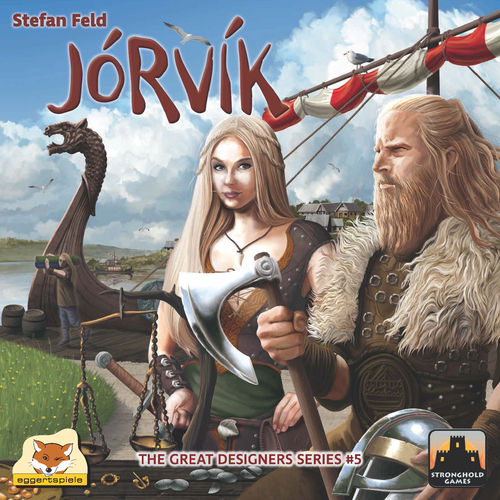
JORVIK (2016)
I gave a Speicherstadt a 6 when it came out, being an exercise in extortion and not much fun. This re-themes it and incorporates the expansion, which simply adds another pus-your-fellow-player mechanic. It then lost a ratings point for daft iconography which slowed the game down numerous times. What a joyless affair. It’s a dressed-up auction game, competing each round to acquire cards to earn you victory points. With limited income meaning you can’t buy much on any turn, half your placements are simply king-maker moves – do I ramp up the price on player A because they have the most money, or on player B because I wouldn’t mind that card, or player C because I think they’re winning? Your strategy is to be left alone as much as possible, maybe going for card combinations less favoured by others. Results are sensitive to both card order and the pus decisions of others. The game is round after round of this auction mechanic, acquiring VP cards and the means to satisfy them, with an unsatisfactory fragile dependency on how cards emerge and who people decide to pus. Not a lot of love here. (hey more old reviews!)
Rating: 5
JUST ONE (2018)
It’s more a co-op activity than a game, but at least it’s a fun one where people can be clever. The guesser reveals a word to the other players, but doesn’t see it themselves. Everyone writes a one-word clue to that word. Before they’re revealed, all identical clues nullify each other. If everyone goes for obvious clues, those obvious clues aren’t going to be revealed. But if no one goes for obvious clues, the guesser might not guess the word! We collectively want it guessed as the aim is to get 13 correct guesses in the 13 rounds (or otherwise the best you can). There’s definitely reward for cleverness – with enough clever clues, the word is guessed and everyone feels good about themselves. While not much of a “game”, it’s something nice to pass the time with as an opener, taking up to 7 players as it does, and where people can join in at any time.
Rating: 7

LOST CITIES: RIVALS (2018)
It’s what you get when you Franken-cross the Ra auction mechanism (either add a new card to the cards being auctioned, or start the auction) with the cards and scoring mechanics from Lost Cities. While it’s always fun calling Ra, this loses out in comparison as there are no disaster cards and not a lot of variation in value – most group of cards are worth roughly the same to a few of the players (until you’re well into the game anyway). Which makes for a less interesting game. It also makes for a bit of a lottery in the scoring – for instance if card(s) you want to finish off a suit are bundled with cards that another player must have, who happens to have more money than you, there’s not much you can do about it, and there are few alternative scoring routes as a makeup. To me it’s lost much of the majesty of Ra, and neither does it maintain the fast pace and charm of Lost Cities. It’s fine and playable in its 30-minute niche though, and provides some nice mechanic-nostalgia, but the sum of its parts seems less than its parts in the end. (other thoughts here)
Rating: 7
MERLIN (2017)
Not one of Feld’s best. Use dice to move your meeple around an action track to eat point salad. Landing on actions that allow you to collect cubes / build manors and place influence early seems to give disproportionate benefit (as they stick around between scoring turns), and despite there being lots of action options to get things, you can be really hamstrung by your dice roll at times with not a lot of dice manipulation alternatives on offer. You can often feel like you’re choosing between second rate options because there’s little choice, and if you fall behind on the manor / influence investments it doesn’t feel like there’s a lot you can do to catch up. That frustration passes between various players from round to round (there’s 6 rounds, 4 actions per round) so the game struggles to win everyone over. It’s an ok euro if you’re looking for a bit of variety in your Euro-ness but it’s not something I need to explore.
Rating: 6

RAJAS OF THE GANGES (2017)
A worker placement where there’s only a few things to do, but turn order makes those things more expensive the further into the round you go so your race is on. Mostly you spend your workers to get more dice, and then spend workers to trade those dice in to acquire tiles. Those tiles will either get you fame VPs or will provide markets with which you use workers to get money ongoing. In a nice twist, money gets tracked anti-clockwise around the board and fame clockwise; the winner being the first to have them crossover. Like most of this ilk, you build a competitive edge somewhere and hammer it to accumulate advantage. It all fits like a comfortable shoe. There’s unfortunately no true strategic variation between players so games are going to feel a bit same-same. At least it’s a slightly new format, with dice conversions to explore rather than another game of resource conversions, and it’s all pretty enjoyable if you like this sort of thing. (Review here)
Rating: 7
WEREWORDS (2017)
Everyone’s playing 20+ questions trying to guess the word. Well the villagers are anyway. The werewolves know the word and want a fail, but can’t be too obvious with stupid questions or deliberate misleads for being called on it at the end. The mayor says yes/no to each question. The seer knows the answer and will try and get the villagers to the right answer without obviously being a seer to the werewolves. In other words, the standard werewolf setup but replacing the role-play with 20 questions. Which makes for an ok activity for a bit of fun (play as many rounds as you like), but going through the 20 questions routine for round after round can become wearisome, so it’s not one I need to go looking for either. Pulling off a great seer job and getting away with it can be very satisfying though!
Rating: 6
SPOTLIGHT ON: WEB OF POWER (2000)
43 plays: We really like this as a closer. It plays fast and has a nice combination of luck and scoring mechanics. There’s plenty of neat decision making on what you’re going to do this and next turn given the cards in your hand, those in the draft, and the opportunities currently on the board. It seems to play best with 3, which is luckily what we regularly close with, as your crafty plans have a better chance of not being gazumped between turns. After this many games, we still have no clear consensus on when’s the best time to invest in cloisters vs furthering the development of the easy points in roads, but knowing it’s a rare game you’ll win without cloister points. It’s this opaqueness that allows us to continue to enjoy each new playing,
Rating: 9
Thoughts of other Opinionated Gamers:
Mark Jackson: The Colonists was my “I’ve got money after Christmas & it’ll play solo” gift to myself this last year… and, despite my reputation for loving fluffy games, I’ve found it compelling and really enjoyable. We don’t play the 4 era game in one sitting – we break it into multiple nights. (Also, I don’t play with more than 3 players.)
Web of Power is still a brilliant design for all the reasons Patrick outlines… and he’s correct: it’s best with 3. (The two player variant created by the designer works pretty well, but it’s still better with 3.)
Larry: Various thoughts on Patrick’s games this month.
The Colonists – Absorbing game, but I so rarely have the opportunity, or even the inclination, to play something that runs this long. All of my games have been with two, for only two eras. I think skipping the first era (and using the rules in the box for jumpstarting the beginning of Era 2) makes sense for me, as the later eras are more interesting. So a game I enjoy, but probably no more than once a year, or even less.
Jorvik – I’m a much bigger fan of Speicherstadt than Patrick is. I love all the things he dislikes–the auction tricks, getting in an opponent’s way, taking advantage of money issues, anticipating combos, and so on. What I do not like at all, however, is the expansion, as I think it destroys the elegance and basic concept of the game. If it’s incorporated in Jorvik, than I need to stay far away from it, particularly since the Viking retheme does little for me.
Merlin – While this may not be Feld at the top of his game, I still think it’s a fine design, with more scope for cleverness with your actions than Patrick seems to acknowledge. I’ve been schooled by my opponents every time I’ve played, so I’m pretty sure the skill factor is high (or I’m just unusually bad at it).
Werewords – I’m one of the small number of people who prefer Insider to Werewords, although I acknowledge the need for culling the target words in the former game. Neither is an essential experience for me, though, as I’m not a social deduction junkie.
Web of Power– While I’m not sure I’d use the word “brilliant” to describe this game, it has definitely stood the test of time (my God, almost 20 years now) and remains our go-to game when we have 3 players who want to play something short and fun while waiting for the other table to finish up. It’s consistently enjoyable. In short, the original “super filler” still fills that niche very well.
Joe Huber: I agree wholeheartedly with the brilliance of Web of Power – but for me, it’s a very enjoyable game with four or even five as well. I was not nearly so impressed as Patrick was with Blue Lagoon, Merlin, or River (sic) of the Ganges.
Simon Neale:
The Colonists: I agree with Patrick’s comments on this game. I am not averse to long runtime games provided that something exciting is developing during the game which holds my interest and provides an enjoyable experience overall. I feel that The Colonists is very much a wash, rinse, repeat style of game – yes, there are new things introduced as the game progresses but the mechanics stay the same. As a 90 minute game this would work for me, but longer and my interest wanes rapidly.
Merlin: I really enjoy this game even though it falls short of my favourite Feld games of Luna and Trajan. With the multitude of dice based games being released at the moment, I think that it stands up well and offers something different.
Rajas of the Ganges: I think Patrick has nailed it with his comments that this is a dice conversion game and not a resource conversion game. That said, it is a race game and the pace accelerates towards the end. I really like the twin tracks which act as the game timer and overall the game is different enough to warrant further table time.
Erik Arneson: Web of Power is a classic, for sure. And Werewords has quickly become one of my favorites for larger groups. Mixing a word game with Werewolf and 20 Questions works amazingly well.
Mitchell Thomashow: I’ve played Blue Lagoon, Century:Eastern Wonders, Lost Cities: Rivals, and Raja of the Ganges
I’m impressed with Knizia’s upgraded designs. Blue Lagoon is an excellent abstract game that scales very well. It may lack clarity as there are so many ways to score points. If you’re an abstract game purist it may not work for you. But if you don’t get obsessed with counting points, you want to blend analysis with intuition, and you play it reasonably quickly, it’s a lot of fun. I’ll give it a tentative 8. Lost Cities:Rivals is very interesting. I think it brings new life to the Lost Cities/Keltis family. It’s neat how just a few rules tweaks results in a very different game. That gets an 8 as well.
My wife and I played Raja of the Ganges ten times and derived great enjoyment. The race element is fun, and the dice manipulation/conversion is an intriguing puzzle. It’s a clever game with a neat fun factor. I’m not sure I’d want to play it with more than two. I’ll give out a third 8.
We found Eastern Wonders a disappointment, adding complexity, time and fiddliness to the sharp and crisp Spice Road. It’s a 5.
Tery:
I love The Colonists and generally prefer to play the full game because I love how each round builds on the next and the challenge of setting yourself up so what you need is within reach. There are so many interesting decisions and things to think about that I haven’t found down time to be a problem, although most of my games have been two player with a couple of three player games thrown in.
I wanted to love Merlin. I’m generally a Feld fan, and the theme grabbed my attention, but it fell short for me. I often felt like I had far too little control and was choosing between two mediocre options; I had hoped playing with the expansions would fix that feeling for me, but it didn’t.
I am really enjoying Rajas of the Ganges. I agree with the previous notes that it is a dice conversion game and a race game, and the puzzle of using the dice and laying out buildings to maximize your scoring continues to interest me.
I have only played Werewords a couple of times as it is not my favorite style of game, but it is popular with several members of my game group and I can see this being a good choice to play with a larger group or with more casual gamers.
Web of Power is probably highest on the list of “games I do not own but wish I did”. It has intrigued me since the first time I played it, and continues to hold up well after dozens of play and twenty year.
Like this:
Like Loading...



Patrick Brennan: Game Snapshots – October 2018 (Part 1)
Patrick Brennan: Game Snapshots – October 2018 (Part 1)
When I returned to Sydney in early 2000 with the gaming bug in tow (picked up during a one year sojourn in Auckland), it felt like there were only a handful of gamers across all of Sydney. I was lucky enough to be made welcome, and I’ve been gaming with that group on Sundays ever since.
Recently we had our Sydney-wide mass auction no-ship trade night. It’s similar to a maths trade but in an auction format, where trading games before deadline is encouraged. Anyone can sell or trade games throughout the auction, as long as you turn up on trade night to hand over the games so no one has to pay for shipping. Works great, easy to organise, easy to manage.
With a mass of gamers descending on our home Chatswood turf, welcoming back and playing with gamers from all over Sydney reminded me of how far our gaming scene has come. I used to think nothing of travelling far across the city to meet up and play some new stuff. Nowadays the riches abound. There are active public gaming groups on every week night (barring maybe Mondays?) in a 20 minute ring around my home, and there are any number of local gaming buddies I can call on to get a longer game to the table on a weekend if needed. Gone is the need to ever long haul again!! Riches indeed. Sometimes you just have to sit back and count your blessings.
The mass auction means there’s a ton of new games coming in the weeks ahead, but before that, this all happened …
BLUE LAGOON (2018)
Race to put out your pieces all over the board, anywhere you like really, to score across as many categories as possible – be on many islands, be the most on an island, collect lots of one good, collect sets of different goods, dance on one foot, dance on both feet, you get the idea. Put out 5 permanent start spots, and then do it all again from those, and score again. It doesn’t feel like Durch die Wuste. There you set up five tightly defined races which define your game. Here you simply grab as much as the other players let you and hope they’ve screwed up enough by concentrating on themselves and the other players to let you sneak a mass of points and the win. It doesn’t feel overly clever. Nor does it feel tense. Someone beat you somewhere? There’s plenty of other ways to score in lieu. However it’s perfectly pleasant enough for a 30min game, and has the upside of easy rules and fast game play. (review here)
Rating: 7
CENTURY: EASTERN WONDERS (2018)
Each island has a conversion market, and you move around plopping down outposts and using the markets to convert your goods into (less but better) goods or (more but worse) goods. You eventually use those resources to build more outposts (for points) or to fulfil one of the open contracts. The game starts at a good pace because it’s cheap to place outposts and do your trades, but it gradually gets slower and slower, and then grinds even slower, becoming a chore just to obtain enough goods to get another outpost out (they get more expensive the more there are out there) or to re-start your collection after fulfilling a contract. I also wasn’t keen on the amount of accidental collateral damage in the game, with others being where you want to go or sneaking a contract from you unawares (getting the required goods takes quite a few turns, and you have little idea on whether others are going for the same as you, or will get there first). The final downer was the swinginess of the final round, where one player gets a fifth of their score again and others can miss out on gaining similar by a single turn. Too much. As such, I wasn’t as enamoured with this implementation of the system as others might be. (review here, similar opinion)
Rating: 6
COLONISTS, THE (2016)
The game’s subtitle of “the epic strategy game” could easily have been “the epic resource conversion game”. Each turn you’re spending actions to collect resources, convert resources, and spend resources on buildings that allow you to collect and convert faster. The actions are hexes around which you move, and the game is often a tradeoff between “finding efficient paths and building stuff you know you’ll want eventually” vs “taking inefficient paths to build stuff that will be really useful right now”. If offers fuel for ponderous contemplation and downtime (which means the game leans better towards solo and low-player counts). It also means each game will offer different efficiencies and lead to different paths being explored. Each era really is its own 90 minute game with its own action set. Each subsequently played era adds its action hexes around the edges, broadening the decision tree. While there’s much to like, the game does begin to grind given it’s one of repeated “collect/convert/build” iterations. Doing that for 90 min is fine, and I’d happily play single era (or double era) games in the future, but longer than that and I’m wanting more than just introducing more new buildings that require more and more resources (but where I’ve hopefully built the infrastructure to be able to do that at roughly the same pace). But that’s where it lies. Its ambition to be so all-encompassing across its theme is to be applauded however, and that’s the one thing that would pull me back. (review here from a few years ago)
Rating: 7
JORVIK (2016)
I gave a Speicherstadt a 6 when it came out, being an exercise in extortion and not much fun. This re-themes it and incorporates the expansion, which simply adds another pus-your-fellow-player mechanic. It then lost a ratings point for daft iconography which slowed the game down numerous times. What a joyless affair. It’s a dressed-up auction game, competing each round to acquire cards to earn you victory points. With limited income meaning you can’t buy much on any turn, half your placements are simply king-maker moves – do I ramp up the price on player A because they have the most money, or on player B because I wouldn’t mind that card, or player C because I think they’re winning? Your strategy is to be left alone as much as possible, maybe going for card combinations less favoured by others. Results are sensitive to both card order and the pus decisions of others. The game is round after round of this auction mechanic, acquiring VP cards and the means to satisfy them, with an unsatisfactory fragile dependency on how cards emerge and who people decide to pus. Not a lot of love here. (hey more old reviews!)
Rating: 5
JUST ONE (2018)
It’s more a co-op activity than a game, but at least it’s a fun one where people can be clever. The guesser reveals a word to the other players, but doesn’t see it themselves. Everyone writes a one-word clue to that word. Before they’re revealed, all identical clues nullify each other. If everyone goes for obvious clues, those obvious clues aren’t going to be revealed. But if no one goes for obvious clues, the guesser might not guess the word! We collectively want it guessed as the aim is to get 13 correct guesses in the 13 rounds (or otherwise the best you can). There’s definitely reward for cleverness – with enough clever clues, the word is guessed and everyone feels good about themselves. While not much of a “game”, it’s something nice to pass the time with as an opener, taking up to 7 players as it does, and where people can join in at any time.
Rating: 7
LOST CITIES: RIVALS (2018)
It’s what you get when you Franken-cross the Ra auction mechanism (either add a new card to the cards being auctioned, or start the auction) with the cards and scoring mechanics from Lost Cities. While it’s always fun calling Ra, this loses out in comparison as there are no disaster cards and not a lot of variation in value – most group of cards are worth roughly the same to a few of the players (until you’re well into the game anyway). Which makes for a less interesting game. It also makes for a bit of a lottery in the scoring – for instance if card(s) you want to finish off a suit are bundled with cards that another player must have, who happens to have more money than you, there’s not much you can do about it, and there are few alternative scoring routes as a makeup. To me it’s lost much of the majesty of Ra, and neither does it maintain the fast pace and charm of Lost Cities. It’s fine and playable in its 30-minute niche though, and provides some nice mechanic-nostalgia, but the sum of its parts seems less than its parts in the end. (other thoughts here)
Rating: 7
MERLIN (2017)
Not one of Feld’s best. Use dice to move your meeple around an action track to eat point salad. Landing on actions that allow you to collect cubes / build manors and place influence early seems to give disproportionate benefit (as they stick around between scoring turns), and despite there being lots of action options to get things, you can be really hamstrung by your dice roll at times with not a lot of dice manipulation alternatives on offer. You can often feel like you’re choosing between second rate options because there’s little choice, and if you fall behind on the manor / influence investments it doesn’t feel like there’s a lot you can do to catch up. That frustration passes between various players from round to round (there’s 6 rounds, 4 actions per round) so the game struggles to win everyone over. It’s an ok euro if you’re looking for a bit of variety in your Euro-ness but it’s not something I need to explore.
Rating: 6
RAJAS OF THE GANGES (2017)
A worker placement where there’s only a few things to do, but turn order makes those things more expensive the further into the round you go so your race is on. Mostly you spend your workers to get more dice, and then spend workers to trade those dice in to acquire tiles. Those tiles will either get you fame VPs or will provide markets with which you use workers to get money ongoing. In a nice twist, money gets tracked anti-clockwise around the board and fame clockwise; the winner being the first to have them crossover. Like most of this ilk, you build a competitive edge somewhere and hammer it to accumulate advantage. It all fits like a comfortable shoe. There’s unfortunately no true strategic variation between players so games are going to feel a bit same-same. At least it’s a slightly new format, with dice conversions to explore rather than another game of resource conversions, and it’s all pretty enjoyable if you like this sort of thing. (Review here)
Rating: 7
WEREWORDS (2017)
Everyone’s playing 20+ questions trying to guess the word. Well the villagers are anyway. The werewolves know the word and want a fail, but can’t be too obvious with stupid questions or deliberate misleads for being called on it at the end. The mayor says yes/no to each question. The seer knows the answer and will try and get the villagers to the right answer without obviously being a seer to the werewolves. In other words, the standard werewolf setup but replacing the role-play with 20 questions. Which makes for an ok activity for a bit of fun (play as many rounds as you like), but going through the 20 questions routine for round after round can become wearisome, so it’s not one I need to go looking for either. Pulling off a great seer job and getting away with it can be very satisfying though!
Rating: 6
SPOTLIGHT ON: WEB OF POWER (2000)
43 plays: We really like this as a closer. It plays fast and has a nice combination of luck and scoring mechanics. There’s plenty of neat decision making on what you’re going to do this and next turn given the cards in your hand, those in the draft, and the opportunities currently on the board. It seems to play best with 3, which is luckily what we regularly close with, as your crafty plans have a better chance of not being gazumped between turns. After this many games, we still have no clear consensus on when’s the best time to invest in cloisters vs furthering the development of the easy points in roads, but knowing it’s a rare game you’ll win without cloister points. It’s this opaqueness that allows us to continue to enjoy each new playing,
Rating: 9
Thoughts of other Opinionated Gamers:
Mark Jackson: The Colonists was my “I’ve got money after Christmas & it’ll play solo” gift to myself this last year… and, despite my reputation for loving fluffy games, I’ve found it compelling and really enjoyable. We don’t play the 4 era game in one sitting – we break it into multiple nights. (Also, I don’t play with more than 3 players.)
Web of Power is still a brilliant design for all the reasons Patrick outlines… and he’s correct: it’s best with 3. (The two player variant created by the designer works pretty well, but it’s still better with 3.)
Larry: Various thoughts on Patrick’s games this month.
The Colonists – Absorbing game, but I so rarely have the opportunity, or even the inclination, to play something that runs this long. All of my games have been with two, for only two eras. I think skipping the first era (and using the rules in the box for jumpstarting the beginning of Era 2) makes sense for me, as the later eras are more interesting. So a game I enjoy, but probably no more than once a year, or even less.
Jorvik – I’m a much bigger fan of Speicherstadt than Patrick is. I love all the things he dislikes–the auction tricks, getting in an opponent’s way, taking advantage of money issues, anticipating combos, and so on. What I do not like at all, however, is the expansion, as I think it destroys the elegance and basic concept of the game. If it’s incorporated in Jorvik, than I need to stay far away from it, particularly since the Viking retheme does little for me.
Merlin – While this may not be Feld at the top of his game, I still think it’s a fine design, with more scope for cleverness with your actions than Patrick seems to acknowledge. I’ve been schooled by my opponents every time I’ve played, so I’m pretty sure the skill factor is high (or I’m just unusually bad at it).
Werewords – I’m one of the small number of people who prefer Insider to Werewords, although I acknowledge the need for culling the target words in the former game. Neither is an essential experience for me, though, as I’m not a social deduction junkie.
Web of Power– While I’m not sure I’d use the word “brilliant” to describe this game, it has definitely stood the test of time (my God, almost 20 years now) and remains our go-to game when we have 3 players who want to play something short and fun while waiting for the other table to finish up. It’s consistently enjoyable. In short, the original “super filler” still fills that niche very well.
Joe Huber: I agree wholeheartedly with the brilliance of Web of Power – but for me, it’s a very enjoyable game with four or even five as well. I was not nearly so impressed as Patrick was with Blue Lagoon, Merlin, or River (sic) of the Ganges.
Simon Neale:
The Colonists: I agree with Patrick’s comments on this game. I am not averse to long runtime games provided that something exciting is developing during the game which holds my interest and provides an enjoyable experience overall. I feel that The Colonists is very much a wash, rinse, repeat style of game – yes, there are new things introduced as the game progresses but the mechanics stay the same. As a 90 minute game this would work for me, but longer and my interest wanes rapidly.
Merlin: I really enjoy this game even though it falls short of my favourite Feld games of Luna and Trajan. With the multitude of dice based games being released at the moment, I think that it stands up well and offers something different.
Rajas of the Ganges: I think Patrick has nailed it with his comments that this is a dice conversion game and not a resource conversion game. That said, it is a race game and the pace accelerates towards the end. I really like the twin tracks which act as the game timer and overall the game is different enough to warrant further table time.
Erik Arneson: Web of Power is a classic, for sure. And Werewords has quickly become one of my favorites for larger groups. Mixing a word game with Werewolf and 20 Questions works amazingly well.
Mitchell Thomashow: I’ve played Blue Lagoon, Century:Eastern Wonders, Lost Cities: Rivals, and Raja of the Ganges
I’m impressed with Knizia’s upgraded designs. Blue Lagoon is an excellent abstract game that scales very well. It may lack clarity as there are so many ways to score points. If you’re an abstract game purist it may not work for you. But if you don’t get obsessed with counting points, you want to blend analysis with intuition, and you play it reasonably quickly, it’s a lot of fun. I’ll give it a tentative 8. Lost Cities:Rivals is very interesting. I think it brings new life to the Lost Cities/Keltis family. It’s neat how just a few rules tweaks results in a very different game. That gets an 8 as well.
My wife and I played Raja of the Ganges ten times and derived great enjoyment. The race element is fun, and the dice manipulation/conversion is an intriguing puzzle. It’s a clever game with a neat fun factor. I’m not sure I’d want to play it with more than two. I’ll give out a third 8.
We found Eastern Wonders a disappointment, adding complexity, time and fiddliness to the sharp and crisp Spice Road. It’s a 5.
Tery:
I love The Colonists and generally prefer to play the full game because I love how each round builds on the next and the challenge of setting yourself up so what you need is within reach. There are so many interesting decisions and things to think about that I haven’t found down time to be a problem, although most of my games have been two player with a couple of three player games thrown in.
I wanted to love Merlin. I’m generally a Feld fan, and the theme grabbed my attention, but it fell short for me. I often felt like I had far too little control and was choosing between two mediocre options; I had hoped playing with the expansions would fix that feeling for me, but it didn’t.
I am really enjoying Rajas of the Ganges. I agree with the previous notes that it is a dice conversion game and a race game, and the puzzle of using the dice and laying out buildings to maximize your scoring continues to interest me.
I have only played Werewords a couple of times as it is not my favorite style of game, but it is popular with several members of my game group and I can see this being a good choice to play with a larger group or with more casual gamers.
Web of Power is probably highest on the list of “games I do not own but wish I did”. It has intrigued me since the first time I played it, and continues to hold up well after dozens of play and twenty year.
Share this:
Like this: