Review: Gunrunners

Gunrunners
Game designed by Steve Finn
Art by Rafaella Ryon
Graphic design by Filipe Cunha
Published by Doctor Finn’s Games

2 to 4 players
Ages 8+
20-45 minutes

Reviewed by Jonathan Franklin

Steve Finn has designed several clean elegant games in Biblios and Scripts & Scribes: the Dice Game. Can he do it again? Let’s see.

Image by Steve Finn

The players are running intelligence agencies deploying their agents to global hotspots in the hope of stopping the gunrunners by confiscating crates of weapons. Even if this theme is unengaging to you, keep reading, as the game itself should capture your interest. Just imagine that there is something in those crates that you want and you want to keep others from getting.

Each player starts with an identical deck of cards. Of your deck of 14, you draft 5 randomly. These cards represent agents you have available to send to the field to stop the bad guys from selling guns. The goal of the game is to confiscate the most crates of guns. You do this by having superiority during a bust. After 7 busts or everyone runs out of cards, the game ends and crates are counted.

Continue reading

Posted in Reviews | Leave a comment

Dale Yu: Essen Preview of the new games from Lookout Games

I’ll make no bones about it. I’m a Lookout fanboy.  Not because I have worked with the company before on games.  Not because I regularly kick Hanno’s butt in fantasy football.  Not because they have yummy beer at their Essen stand from time to time…  But because they make good games that I love to play. I cannot remember the last year that I didn’t find a good/great Lookout design. Taking a quick peek at my game shelves – there is an inordinately high number of Lookout games still in the collection – a collection which is constantly being trimmed as I’m out of space!

  • 2012: Agricola: All Creatures Big and Small
  • 2011: Ora et Labora, Walnut Grove
  • 2010: Merkator, Railroad Barons, Agricola Forest Deck
  • 2009: Agricola – Farmers of the Moor
  • 2008: Le Havre, Agricola X-deck
  • 2007: Agricola
  • 2005: The End of the Triumvirate
  • 2004: Zepter von Zavandor

That’s not too bad. The only year I’ve missed was 2006 – otherwise, the list above is a pretty darn group of games.  Thus, it’s no surprise that I’m excited about this year’s set of releases.  Though I don’t know for sure, I’m expecting there to be the usual panopoly of small expansions for the mainstays (Agricola, Le Havre, Suburbia, etc) as well as some sort of Bohnanza deck… What I do know for sure is that there will be three full releases.

I’ve had a chance to read through the rules, and since there isn’t much other info available on them, I thought this would be a good time to talk about the new games.  (This is one preview in a series of reports on the blog – check out this page for a listing of our other Essen Preview pieces this year: http://opinionatedgamers.com/category/essen-2013/


pic1547100_md

Bremerhaven

Designer: Robert Auerochs

Players: 1-4

Time: 75 mins

Continue reading

Posted in Essen 2013 | 2 Comments

2012: The Year of Perfect Information

A few weeks ago, I got in my first play of Urbanization, a city-building game from Queen released last Essen.  This is a title that has largely flown under the radar, possibly because of some questionable physical design decisions by the publisher which can lead players to play by the incorrect rules.  I enjoyed it quite a bit and it made me realize that four of my favorite designs from last year are games of perfect information.  By perfect information (which I’ll abbreviate as PI from now on), I mean a game with no random factors or hidden elements.  All of the players know the exact game state at all times and can plan and react accordingly.

The other three 2012 titles I’m talking about are:

  • Terra Mystica, the hit fantasy-themed building game, that currently sits at #8 on the Geek’s list of top-rated games;
  • Agricola: All Creatures Big and Small, a 2-player spinoff of Uwe Rosenberg’s magnum opus, which is nevertheless its own, independent game; and
  • Le Havre: The Inland Port, another 2-player spinoff of a hit Rosenberg game, which is even further removed from its parent game than the previous example.

The Agricola game won the IGA award for best 2-player game last year and the other two games have been nominated this year.  In addition, Terra Mystica made the SdJ recommended list.  So clearly this is a group of well regarded games.

Then I realized that another 2012 game I’ve played, Splotter’s The Great Zimbabwe, is also a PI game.  (I actually thought TGZ would be a personal favorite after my first game, but my opinion soured considerably after my second game.)

All of this got me wondering if having this many notable PI games in one calendar year is an unusual thing or a typical one.  It’s hard to create a PI design, since with so much information available, it can be difficult to make the game challenging to play; without random factors, replayability is also a concern.  So it seemed like five games was a lot, but I wasn’t sure. Continue reading

Posted in Commentary | 11 Comments

Review: Septikon – Uranium Wars

septikonDesigner: Konstantin Seleznev
Publisher: Hobby Games USA
Players: 2
Ages: 10+
Playing Time: 45 minutes
Review by Mark Jackson (5 plays w/a review copy provided by Hobby World USA)

“Thank you for calling Klondike Industries, the internationally recognized experts in asteroid mining stations. You have reached our 24/7 Help Desk… this is Viktor. How may I be of assistance to you?”

[transmission garbled]

“We here at Klondike Industries are pleased that you chose to purchase a Septikon class space station for uranium mining & processing… and we will work diligently to find a solution to any problems that you are having.”

[transmission garbled]

“Sir, I’m having trouble hearing you over the background noise of explosions & warehouse depressurization. Could you possibly move to a quieter part of your station so I can expedite a response to your call?”

[transmission garbled]

“No, sir, I do not recommend engaging the hostile BioDrones directly unless you have armed your Clones with Drills and/or Vibracannons. You might, of course, choose to use the Sensor Cabin to eliminate hostile BioDrones.”

[transmission garbled]

“Sir, there is no need for harsh language. We here at Klondike Industries share your frustration with the belligerent nature of the mining station on the nearby asteroid and hope that the various weapons & defensive systems we’ve installed will help you to repel his attack.”

[transmission garbled]

“Sir, yelling at me is not going to magically make the inbound Nuclear Warhead-tipped Rockets disappear. You had the option of launching Satellites or placing Energy Shields. You could have also moved your Gunner Clones into place and used Laser fire in order stop the attack.”

[transmission garbled]

“No, sir, I am not reading from a script. [sound of pages ruffling] Since you insist on continuing in rude behavior, I will be ending our conversation now. Klondike Industries would like to wish you success & good luck and hopes you have many victories on the hard & noble path of a uranium miner.”

[*&$#%*!!]

“War is a series of catastrophes that end in victory.”

Septikon – Uranium Wars is a two-player war game. (Yes, I realize that “war game” can be a dirty word for some of you – hang with me just a minute.) This isn’t your standard “buckets’o’dice” war game… or the newest variation of “dudes on a map.” In fact, one of the reasons this review is going to be incredibly positive is that I have a hard time slotting this game into a particular game mechanic “box”. Continue reading

Posted in Essen 2013, Reviews | Tagged | Leave a comment

Review: Kosmonauts

Kosmonauts
designed by:
Nadezhda Penkrat
Yury Yamshchikov
2 – 4 players
60 minutes
published by MESAboardgames
reviewed by Jonathan Franklin

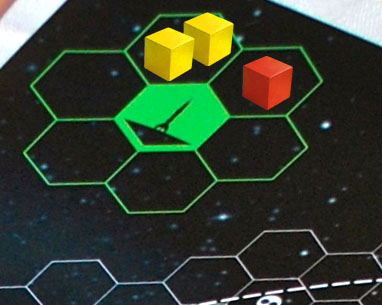
Kosmonauts is a race around the solar system using a vector-based movement system, much like Bolide the car racing game and many others that preceeded Bolide. Each player controls a spaceship that has to leave Earth, visit seven of the eight planets, and return to Earth. Your speed and direction on the hexagonal grid is determined by your engine thrust. In the case illustrated below, the cubes are fuel pushing your ship toward the camera. In this case, you will be pushed two spaces in one vector and other one space on the red vector in the image below. If you want to slow down, you place a cube opposite one you have already placed – that way they cancel out and you remove one cube from each side, thereby slowing down.

Image by Yury Yamshchikov

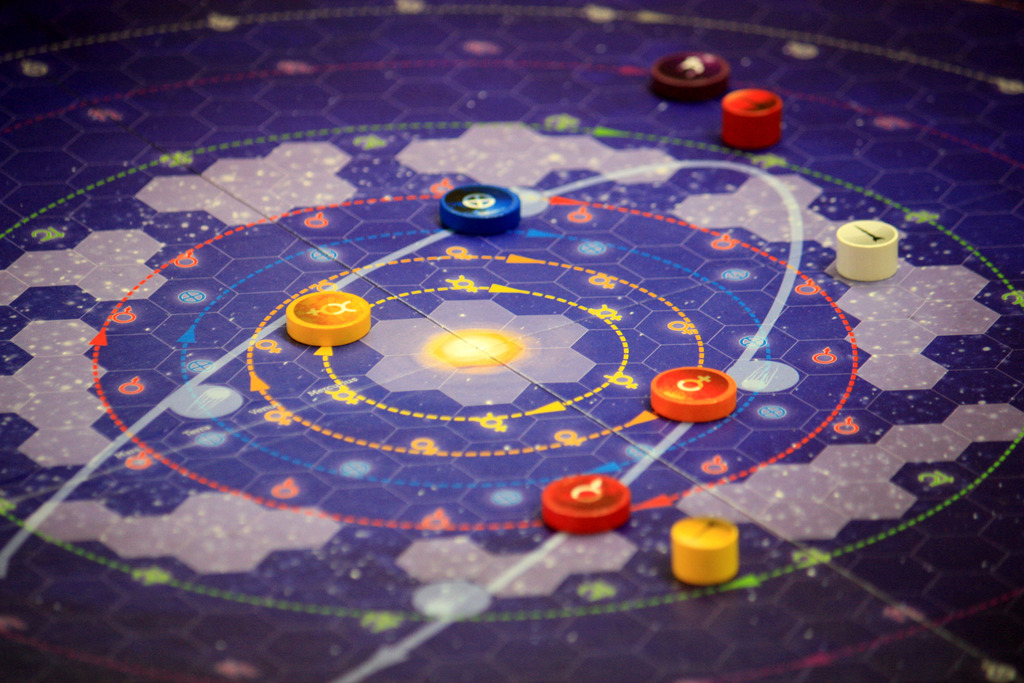
Now that you have a vague sense for how your ship moves on the grid, we get to the point of the game. You are travelling around the solar system, landing on planets, taking off again, and heading to the next one. Well, here is the second cool part. The planets are all orbiting. You cannot aim for where the planet is now if you expect to arrive there in two turns. You must aim for where the planet will be.

Photo by Henk Rolleman

I really like this system. It is clean, elegant, and pleasantly puzzly.

The rest of the game is built around this vector movement system. Your ship carries fuel and has shields. At the start of the game, you load up your ship with fuel and shields and gain your objective cards. Objective cards give you bonuses for visiting those planets.

Continue reading

Posted in Reviews | Leave a comment

Opinionated Gamers prepare for Essen, part 4

Dale: Finally started to look at games in earnest… The Essen Preview geeklist at BGG has been read-through and subscribed.  A spreadsheet has been made noting games that I am interested/not interested in.  I use a 5 point scale for the games. 1=must have, 2=want, 3=need to see how much baggage space I have left, ?=need more info (i.e. booth demo), X=DO NOT WANT.

I make my own spreadsheet to organize myself in Essen.  There are too many games to see in the 3-4 days that I’m there, so it really helps me to already have a list of games that I know I want to pick up / see / learn more about / avoid / etc…  I will shrink it down and print up a copy that fits on the inside cover of my reporter’s notebook that I carry around.

Each entry has:

  • Game Name
  • Desire Level
  • Publisher
  • Location
  • Cost
  • Whether I’ve read the rules or not
  • Notes – usually a one sentence description of what the game is
  • appointment – if i’ve set up a time to see the game, I want to make sure I don’t miss it!

Continue reading

Posted in Essen 2013 | 9 Comments