
Guilty Houston 2015
- Designer: Yohan Servais
- Publisher: IELLO
- Players: 1+
- Age: 18+
- Time: 3-4 hours
- Played with review copy provided by publisher

Someone has died in the county women’s prison — and not just anyone, but Senator Kowalsky’s daughter.
You’re heading to the prison now with a press conference scheduled for tomorrow at which you have to explain what happened, so you need to find answers over the next few hours.
To start Guilty: Houston 2015, you’ll read the introduction, then place the specified cards on the table. Choose a card, then turn it over and read it. What will you find there? Time will keep passing, possibly leading to surprises before you face the journalist pack at game’s end to answer their questions as best as you can.
To set up the game, open the box, and do nothing else other than removing the rules from the box. There is a warning on the rules not to look at anything else until you’re ready to play lest you spoil things accidentally.
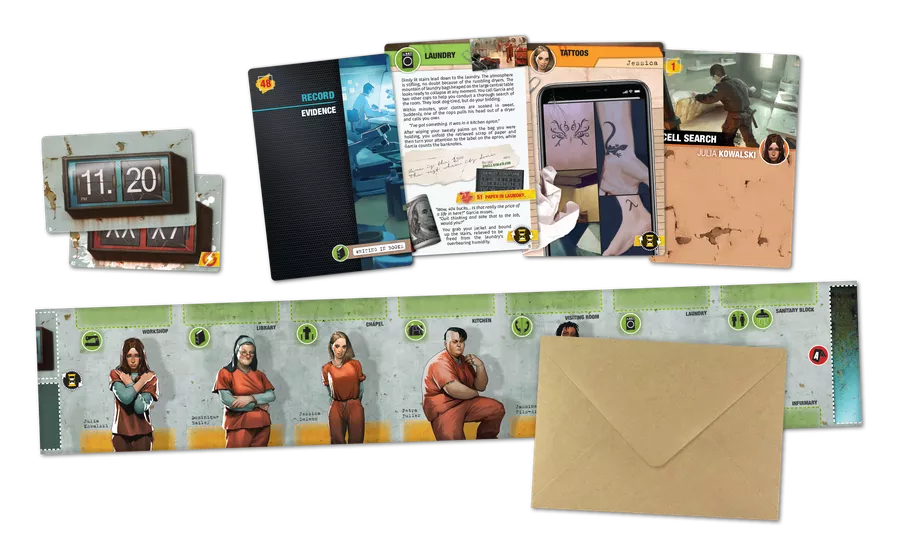
When you are ready to start, pull out the Investigation area which gives you a placed to store cards for your reference. Then, take out the 62 card deck and the 44 card Time deck (smaller cards). There is other stuff in the box, but you don’t need to know about those things yet.

Read the introduction on the backside of the rules. This will set up the story, giving you the background information you will need. You will find out about the crime, and your investigation starts at 10pm. You only have until 11am the next morning to solve the case.
You are then instructed to take cards 1-24 off the deck and place them on the matching areas of the Investigation area (you can use the icons to tell you where to put them). Any cards in your investigative area are available to you, and you can refer to them at any time. Generally there is text or an illustration on the backside of the card. As you flip over some cards, there will be a time cost associated with the card. You’ll have to draw a card or cards from the Time deck to represent this. The rules tell you that you won’t have enough time to read all of the Story cards in the deck, so as you play through the game, be sure to plan carefully as to which leads you wish to follow.

As you read the cards, you will encounter actions in a yellow banner – as soon as you see these, you must immediately resolve those actions: collecting cards, placing cards into the Time deck, reveal more Time cards, etc.
If you’re playing with other people, be sure to slow down and discuss the case as you go. Talking through the different theories is a big part of the game, and careful discussion may help you make better choices in which cards to examine next. You may even want to keep written notes as there is a lot of information in the game.
When you get to the final Time card in the deck, the investigation is over, and it’s time for you to present your findings. You’ll flip over the Investigation Area sheet and the follow the instructions there to finish the game. The game will provide you a way to determine how well you did, and then it’s time to pack up the game.
My thoughts on the game
Wow, what an immersive game.- I wasn’t sure if the time on the box would be accurate, but this game definitely took around four hours to play (it was really six or so in real time as I had to take a break in the middle for dinner and to do some errands). If possible, I’d definitely recommend trying to play this in a single sitting as I also spent a bit of time when I came back to the game reviewing some of the things which I wasn’t entirely sure of.
The game is rated for 18+ and I think this is a good recommendation. The theme (murder) and some of the language (vulgar/profane) would definitely not be ideal for younger audiences. Also, the story is fairly complex with many branching points. You’ll have to pay close attention to the story to follow it. You’ll also have to pay close attention to the varied story cards in the game, as sometimes you’ll only reveal a clue after a second or third read! (Or maybe you’ll learn a half-fact from a later card which then gives new meaning to a card you saw earlier).

The rules are pretty easy to understand, and honestly, most of the game flows from the cards. There are only a few icons you need to know, and the rules have them clearly explained. I’d definitely recommend keeping notes somewhere, and be sure that you have a large table to play on – there are a lot of cards in the game, and you’ll want to keep your cards organized on the table as well as being able to see most of them at one time.
The components are well done and the box is nicely packed to prevent you from spoiling things. Well, with one exception. The bottom of the story deck doesn’t have a cover card (like in the Exit games which have a card telling you that you are looking at the bottom of the deck, and you should look elsewhere). Sure, it’s easy enough to flip over the deck as it’s obvious that you shouldn’t be looking at that card, but well, it wouldn’t be that much more expense to add a 63rd card to that deck to prevent any possible peeking. Same goes for the time deck.
I played the game on my own, and I think it would have probably been better with a team of 2 or even 3 people – I think there are plenty of times when a group would be able to talk things out and each person might bring a new perspective onto the facts seen on the cards.
If you like murder mysteries, Guilty Houston 2015 puts you in the driver’s seat to develop the story as you see fit. It’s an engrossing adventure that will take you the majority of an afternoon or evening, and I’d recommend giving this one a go if you like story telling games.
Until your next appointment,
The Gaming Doctor


