
Pandasaurus has been on a bit of a run this year reprinting classic games. Earlier this year, we reviewed Gulo Gulo and Hacienda. Now, they have come out with two card games: Bohnanza and 6 nimmt! Baron Oxx.

Dale Yu: Review of 6 nimmt! Baron Oxx
6 nimmt! Baron Oxx
- Designer: Wolfgang Kramer, Michael Kiesling
- Publisher: Pandasaurus
- Players: 2-10
- Age: 8+
- Time: 20-30 mins
- Played with review copy provided by publisher
6 nimmt! Baron Oxx features gameplay similar to 6 nimmt!, with players trying to avoid taking cards in order to keep their score low.

Each player has a hand of cards, and five rows of cards are started on the table with a single random card from the deck. Each card is numbered and features one or more colored bullheads. Each turn, players simultaneously choose a card from their hand, then reveal it.
Whoever revealed the lowest card adds it to a row in which the last card features a bullhead of the same color; if several rows feature a matching bullhead, the player chooses the row. As soon as a row has six cards or at least six bullheads of the same color, whoever added the most recent card to that row claims all other cards in it. Baron Oxx is a special character that shows all colors, meaning you can play it on any row…but it can also cost you many points.

Once all players have placed a card, from low value to high, you all reveal another card. After all the cards have been played, whoever has the lowest score wins.

This game feels very similar to the original 6 nimmt! – the difference here is in how you play the cards. It will take veterans a few games to wrap their head around the idea that the number is only used for play order, and then after that, it’s all just down to matching the color of the bull heads on the most recently played card in each row.
The strategy of the game remains similar – trying to take no cards or trying to take the row with the least points in it; but the disconnection between the number and the color gives a twist to the strategy.
Baron Oxx gives players a little more agency and the ability to actively screw over other players. In the original, once the cards come out, there is no choice over where to play if there is a legal place. Here, you might be able to choose between multiple options, and you might be able to force the next player into an undesirable play.
Ergonomically, I will say that I’m not a big fan of the cards. I don’t like the way that numbers are in the corner but the color of the bullhead(s) is in the center of the card – this makes it hard to see the color when you have a full hand of cards – though admittedly you’ll never have more than 4 cards in your hand..
The question that I think most people have asked me about this game is: If I already have 6 nimmt! (or Take 5 or any of the other versions of the game), do I need this one? The feel of Baron Oxx is much the same as the original but it is definitely not a straight copy. For now, I’m keeping both.
Thoughts from other Opinionated Gamers
Doug G. (Garrett’s Games Podcast): Shelley and I just got our copy in the mail and immediately sat down after lunch to get in a few plays. Since 6 Nimmt! is the game I have played the most in my collection, it was fun to see this new iteration that adds color as a limiter to the rows. With 5 rows instead of 4 and a hand of 4 that you must play out before drawing more from your personal deck, the choices can get tricky. The fact that this version ALSO plays to 10 (something that came in handy as a teacher), but also works great as a 2-player makes this a winner IMO. Does it replace the classic? No. Is it a new ‘go to’ when we have an extra large group? For sure! We plan to cover this on the podcast the week of October 4.
Ratings from the Opinionated Gamers
- I love it! Doug G.
- I like it. Dale Y
- Neutral.
- Not for me…
Bohnanza (2026)
- Designer: Uwe Rosenberg
- Publisher: Pandasaurus
- Players: 3-7
- Age: 8+
- Time: 20 minutes
- Played with review copy provided by publisher
In the game, you plant, then harvest chili cards in order to earn coins. Each player starts with a hand of random chili cards, and each card has a number on it corresponding to the number of that type of chilis in the deck. Unlike in most other card games, you can’t rearrange the order of cards in hand, so you must use them in the order that you’ve picked them up from the deck — unless you can trade them to other players, which is the heart of the game.

On a turn, you must plant the first one or two cards in your hand into the “fields” in front of you. Each field can hold only one type of chili, so if you must plant a type of chili that’s not in one of your fields, then you must harvest a field to make room for the new arrival. This usually isn’t good! Next, you reveal two cards from the deck, and you can then trade these cards as well as any card in your hand for cards from other players. You can even make future promises for cards received right now! After all the trading is complete — and all trades on a turn must involve the active player — all players who traded now have to plant those newly acquired chilis. Finally, you end your turn by drawing three cards from the deck and placing them at the back of your hand.

When you harvest chilis, you receive coins based on the number of chili cards in that field and the spice gauge for that particular type of chili. Flip over 1-4 cards from that field to transform them into coins, then place the remainder of the cards in the discard pile. When the deck runs out, shuffle the discards, playing through the deck two more times. At the end of the game, everyone can harvest their fields, then whoever has earned the most coins wins.
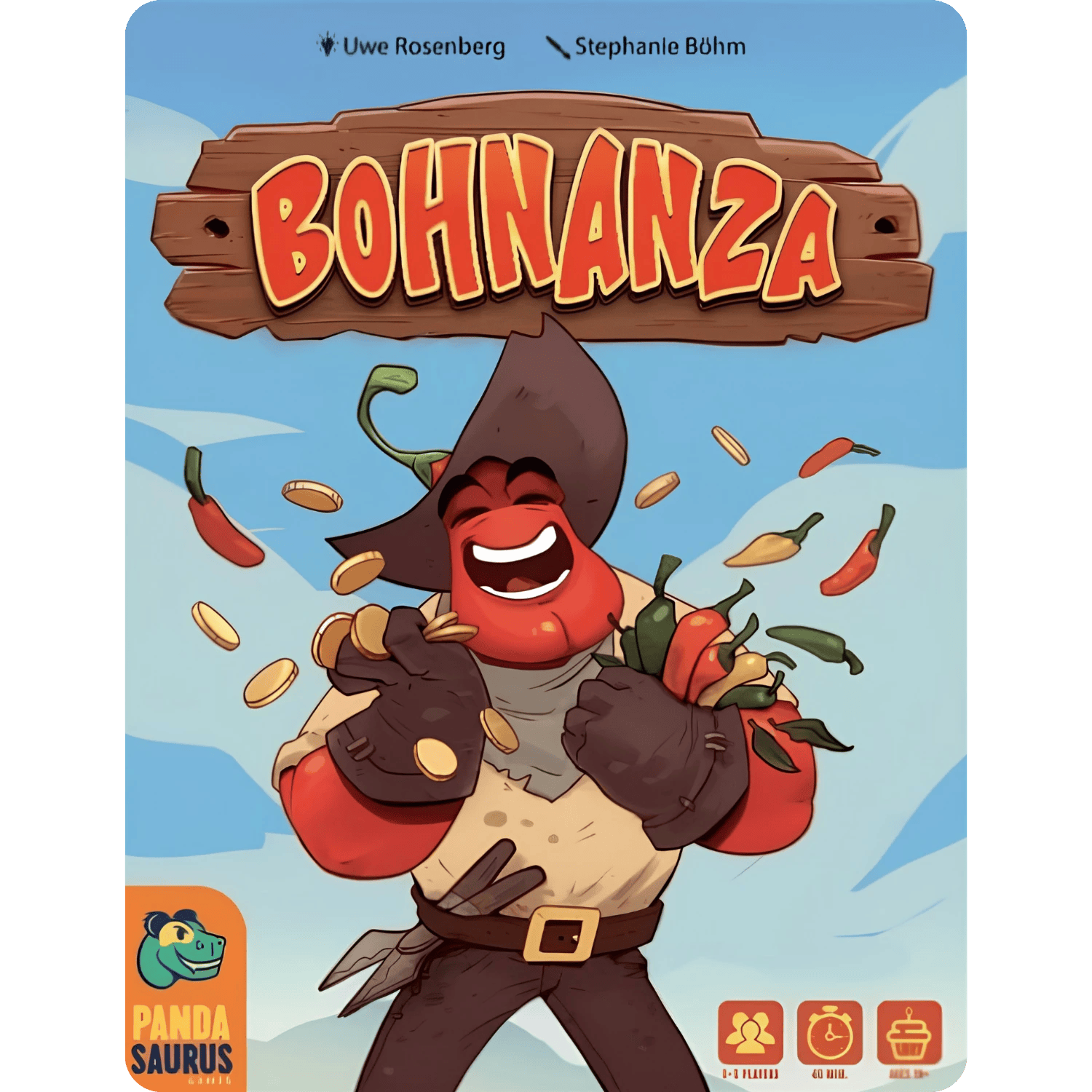
Bohnanza is a classic, and there have been many different versions of the game – I think I have at least three of them in my collection now. As far as I can tell, the rules and cards of the new Pandasaurus version are exactly the same as the original game. What is different is the theme – now, instead of being bean farmers, players are chili farmers?!
German games have a long tradition of having punny game titles, and Bohnanza is no exception. The explanation here is that the German word for “bean” is “bohne” – and that’s why it’s spelled Bohnanza instead of Bonanza. With the theme change, the pun is completely lost. I can see that keeping the same name makes sense as the rules are exactly the same; but the connection between the game itself and the title has been lost somewhere in translation.

The art on the cards is workable – a little less of a caricature style than the original, but still with distinctive art for each. Some of my gaming friends have expressed much displeasure at the names of the chilis – but I’m not too bothered by this. Regardless of the version of Bohnanza, I’ve always been one to refer to the cards by their number. So, while others are trying to spit out “Sheriff Pimento” or “Granny Peri Peri” – I’ll just be asking if you’ll trade me two “20s” for my “8”.
Bohnanza is a classic card game, and one that I think deserves to be in just about every game collection. If you don’t already have a copy, I’d highly recommend this one.
Ratings from the Opinionated Gamers
- I love it! Dale Y
- I like it.
- Neutral.
- Not for me…


