
Nijar
- Designer: David Bernal
- Publisher: Perro Loko / Devir
- Players: 1-4
- Age: 14+
- Time: 25 min/player
- Played with review copy provided by publisher
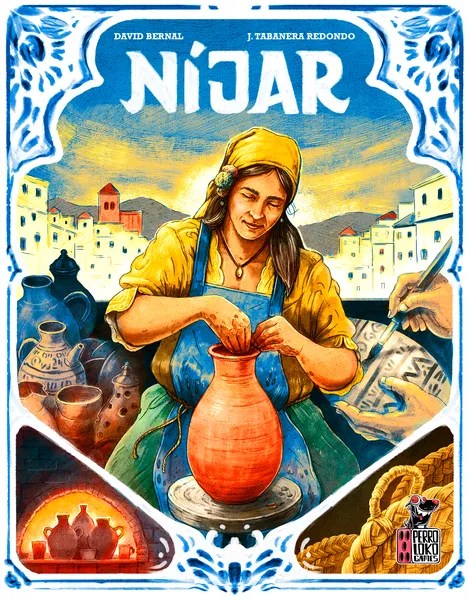
Bathed by the crystal-clear waters of Cabo de Gata and under the white light of Andalusia stands Níjar, a small town in the province of Almería, Spain, with a pottery tradition dating back to the Bronze Age and which gained great significance during the Muslim period (10th–15th centuries). In Níjar, we travel back to the 1920s, long before the tourism boom of the 1950s. The local economy revolved around ceramics, esparto weaving, and the making of jarapas, colorful textiles that remain a symbol of the region today.
Experience the charm of rural Andalusia: its narrow whitewashed streets, the rhythmic hum of pottery wheels at work, and skilled hands weaving esparto and jarapas, bringing color and life to the traditions of Níjar. Transform clay into art, fire into tradition, and your workshop into the soul of Níjar. Only those who master the rhythm of the wheel and the alchemy of color will be remembered as true master potters.

To set up the game, place the main board on the table and then randomly place the Action tiles on it. Demand Tiles and Bonus tiles are placed on the board as well. The three decks are shuffled and 5 cards from each deck are revealed to form the Draft Area. 4 Plates, 4 Jugs and 4 Pots per player are used to form the supply.

Each player gets a workshop board and extension as well as one starting card of each type (Cleanup, Firing Kiln, Glaze Kiln, Glazing Workshop) in addition to a Shop card. Markers are placed on the score track, clay track and Technology track. Each player receives a starting hand of 1 card from each of the 3 Game decks as well as 3 end-game bonus cards.
A starting player is chosen and players put their tokens on the player order track in clockwise fashion from this player. Sets of Potter’s Wheel cards and Starting Resource cards are made, and sets are chosen in reverse player order. Also in reverse order, one Donkey is placed on any unoccupied card in the Draft area.
In the game, each player expands their workshop by adding new wheels to produce more pieces. Extract clay, throw pots, fire them, paint them, and sell your creations at the market.
The game is played over three rounds, each with a decreasing number of action discs: 7 in round 1, 6 in round 2, and 5 in round 3. At the start of each round, the market is modulated based on the demand chits placed in setup as well as a die roll. Then players take their actions – On their turn, players may choose one of the following:
1.- Play craftswomen
Place one more craftswomen than currently present on an action space to perform it. Return all other craftswomens there to their owners. Actions include: Draw a card, play a card, extract clay, throw pots, fire pieces, paint, clean the workshop, sell esparto and claim the starting player marker. Depending on where you play your craftswomen, you may also gain bonus rewards which are found at the bottom of the column where you placed the craftswomen. Alternatively, there is a special action space at the bottom of the board which can hold any number of Craftswomen. Place your token here and take the three bonuses shown there in the order of your choosing.
The possible actions include:
- Acquire Cards – take up to 2 cards from the Draft Area; the cost for each is one coin per orthogonal space away from the location of your Donkey. If, before choosing, all the cards in a row are of the same type, you can remove them, shuffle them back into their deck, and deal out a new row of cards. After taking cards, move your Donkey to another available card and then refill the array. You may not buy a card that an opponent’s Donkey is on
- Play a Card – pay the cost shown in the upper left (coins, clay, glazes or cracks) then place it on a suitable space in your workshop. Depending on the type of card played, you can get new actions either on the card or shown on the space where you played the card.
- Extract Clay – add up to 3 clay to your supply, paying the shown cost
- Advance your Technology Marker – this determines how many spaces a Vase can advance when you perform a Throw action
- Throw – Move Wooden Vases on your Potter’s Wheel cards up to your Technology level. Gain the benefits shown in each space that a vase advances to. If you advance to the final space, score VP as shown.
- Shape – this action can only be found on a Potter’s Wheel – take Clay and shape it into a jug, plate or pot in your Drying area. You can shape 2 pieces, but you must take 2 Cracks if you choose to do so.
- Fire – move any number of Pieces from your Drying Area and Glazing Workshops to its corresponding Kiln. Each kiln can only hold one piece. Once a piece is in a Kiln, it is available for sale
- Paint – move a piece from a Firing Kiln to a Glazing Workshop (max 1 piece per Glazing workshop) paying the cost as shown on the card
- Clean – remove a number of Cracks equal to the number of Cleanup Cards plus one.
- Collect Esparto – choose one of the two rewards shown on each Esparto card on your board.
- First Player – place a token on the unused side of the turn order track, paying/gaining coins based on the space. You also get the bonus shown on the space that you cover.

2.- Discard a final scoring card
Discard one of your endgame scoring cards to perform an action of your choice.
3.- Sell pieces at the market (max 2)
Exchange up to two fired pieces (jugs, plates or pots) for victory points. Using the price chart on the right of the main board, figure out the price of your piece, which varies depending on whether it was painted or not. Either way, collect VP and then lower the price marker downward equal to the demand tile for that column for this round.
4.- Close your shop / take a bonus
If you have no more craftswomen, pass and close your shop for the round. Take a bonus (anything except for the Gain 1 Esparto). On your following turns, you may choose another bonus. Once your shop is closed, you will gain your choice of bonus printed on the card for each Craftswoman that is returned to you.
The round ends when all players have their Shop card on the closed side and all players have taken the same number of turns. If the game isn’t over, all players re-open their Shops and return one Craftswoman to the box. Players may also choose to play one of their endgame scoring cards facedown under their board, thus activating it for scoring at the end of the game. Update the turn order track by first using the priority based on the First Player action and then keeping the same order otherwise.
After the third round, the game ends and players calculate the final score:
- Points scored during the game
- All pieces still in Kilns score 2VP if painted, 1VP if not
- Endgame scoring cards are reckoned
- Players score for sets of different Esparto cards
- -1VP per crack
- 2VP for being first player at the end of the game
- 1VP per 5 remaining resources.
The player with the most points wins. Ties broken in favor of earliest turn order after the final round.

My thoughts on the game
Wow, Nijar is a serious brain-burner (in a good sense) that comes packaged in the smallest of boxes! At first glance, there doesn’t look to be enough time to do things – you only have 18 workers to place over the three rounds of the game, and there are so many different steps involved in the pottery process!
The unique worker placement grid here is the key to the game. You will place your workers on a particular spot to get a main action from the row you place in and then also hopefully trigger a useful bonus action from the column you placed in. Of course, there is always the chance that you’ll get workers given back to you if someone wants a place that you currently occupy; and you are then free to re-use those workers, thus generating additional actions.

There are many other ways to get actions – so much so that one of the guys I played with joked that this could have been called Ganz Schön Pottery. If you play a card, you might get actions from the space you played on or from the adjacent card. If you choose to throw clay, you’ll generate a bonus action for each step that you move. There are even some Esparto bonuses that turn out to be actions.
So, when trying to figure out what to do on your turn, you’ll have plenty of things to consider. Players should also not forget that some of the actions, such as Fire Pottery, are unlimited (well constrained by the number of Kilns) – so you’ll be more efficient if you wait to Fire until you have both enough unfinished pieces as well as empty Kilns for them.
While you’re figuring out the actions you want to do and the order you want to do them in – you still have to also juggle the engine building (via card playing) as well as resource management (as you have to pay for most of these things) aspects. Each type of card has its own function in your pottery manufacturing chain, and you will be motivated at times to play cards due to their basic function, at times because of the bonus actions you would generate from playing them, or at times even how they will affect your bonus scoring.
The bonus scoring system is well done and really gives you much to think about. You start the game with 3 of these cards, and you can commit one per turn for endgame scoring. If you do not, you could instead discard it to get essentially a bonus turn. I think it’s not always obvious at the start of the game which cards you’ll eventually want to score, so it can be a really tough decision, especially in the first round, to know which one to play (or even harder if you are considering discarding one for the action). There are two main types of bonus cards: payout for specific types of pieces and payout for cards of a certain type. I’m not yet sold that these two types are balanced as the card type bonuses feel like they have a much higher max payout than the pottery cards.

Finally, while you’re thinking about all of the above issues, there is also a mild race element to the game due to the market pricing for the finished pieces. While the rate changes for each type differently, the pieces most in demand will lose value with each sale of that type. This can make turn order especially important in the final two rounds of the game as it is possible to have finished pieces at the ready, and going first ensures that you can get maximum value on the first turn of the round. It really makes the turn order action an important and decisive one, and the action grid can become quite tight in the row for this action near the end of the game.
You’ll also have to be more efficient as the game progresses as you start with one fewer worker each round – sure you’ll have lots of things that you can still chain together, but you have to make each one count at the end. But, the reduced number of workers just ratchets up the tension to get the right action each turn and/or making a shrewd defensive play to make a particular combination more expensive for an opponent.
The components are great, and I’m quite surprised/amazed by how complex this game is for the small sized box that it comes in. The rules are well done – we had no issues learning the game from the rules, and when we had questions, we were always able to quickly find the needed information.
I’ve really enjoyed my games of Nijar so far. Games are coming in about 30 to 40 minutes per player, and it is a game where I’m actively working on my next play for almost all the time between turns. Yes, it could definitely be an AP sinkhole given the multitude of possible paths for each turn (and the fact that the cost of the main action can’t be guaranteed until the previous person has placed their worker for their turn). For me, this is the right level of complexity for a “complex” game – enough to keep me thinking the whole game (and also enough to have me replaying the game in my head for the next few days as I think about what I could have done different/better).
Ratings from the Opinionated Gamers
- I love it! Dale Y
- I like it.
- Neutral.
- Not for me…


Hi, just to report a little mistake. Publisher is Perro Loko, not Devir.
Big game in a small box – I think I last said that about The White Castle. I ultimately sold it because I didn’t feel the theme was working for me. I liked the decision-making, but it always felt like moving around dice and chits and not doing a thematically real action. I hope Nijar feels like making pottery to me, not that I know the first thing about pottery.