
Computer Junkyard
- Designer: Allen and Jared Pincus
- Publisher: Dream Egg Games
- Players: 2-4
- Age: 14+
- Time: 60-90 minutes
- Amazon affiliate link: https://amzn.to/3RoSJO4
- Played with review copy provided by publisher

You found a box of old computer games at a yard sale and can’t wait to play them with your friends. To your dismay, modern computers won’t run them. Instead, you each race to build your own vintage computer out of spare parts. Welcome to the Computer Junkyard, the perfect place to find all the components you will need! Scavenge for parts, sabotage your opponents, trade with your friends, and do it all with the cash in your pockets. Be the first to complete a computer good enough to run your game!
In Computer Junkyard, players assemble hardware tiles to construct a vintage computer. The first player to have a complete, bug-free computer, which meets the specifications necessary to run their unique computer game, is the winner. The primary mechanic of Computer Junkyard is the physical assembly of hardware tiles. Each player attaches their hardware together like puzzle pieces, connecting them up to a central motherboard tile to fit within a 9×9 chassis grid.
The game is set up by putting the price board, locks and bug sprays in the center of the table. The tiles are placed in the bag, and the Junkyard is made by drawing 2 tiles per player. Each player gets their own chassis board where they place their motherboard tiles. Players also get 3 starting tiles as well as a random software tile. The goal is to construct a computer with all the base parts as well as all of the requirements of your software. The first person to achieve this will win the game.
Games are played in rounds, each with three phases: Pre-Build, Build, System Check.
Pre-build: Draw 2 tiles from the pouch and add it to the Junkyard. If a bug tile is drawn, you may immediately play this on an opponent to any available port. Then, take one of three actions
- Visit the Junkyard where you can buy/sell hardware tiles or sell locks from your computer. The price of a tile is found on the price board, and it is related to the number of that type of tile in the junkyard. You can sell connected pieces of your computer, and if this causes loose pieces, those are moved to your workbench.

- Debug – remove bugs that have been connected to your computer. Roll the d10. If you roll a 10, move a bug to another player’s computer. If you roll added to the number of bug sprays owned is 5 or more, discard the bug from the game. If you roll 5 or less, take a bug spray and keep your bug.
- Theft – try to steal a tile from your opponent’s computer or workbench. To steal from the workbench, choose a tile you want to steal, roll a d10 and subtract the number of locks on the target player’s board. If the result is 7 or more, you steal the tile. If it is less, you may roll again but you must choose a different tile. You may repeat this until you either steal a tile or have failed on EVERY tile in that player’s workbench. If you steal from a computer, you only get a single chance. If you fail, your turn ends immediately. If a player is successfully stolen from, they get a lock from the supply to add to their motherboard (max 2 per player)
During this phase, you can also make any sorts of deals though there is nothing but your honor to enforce them.
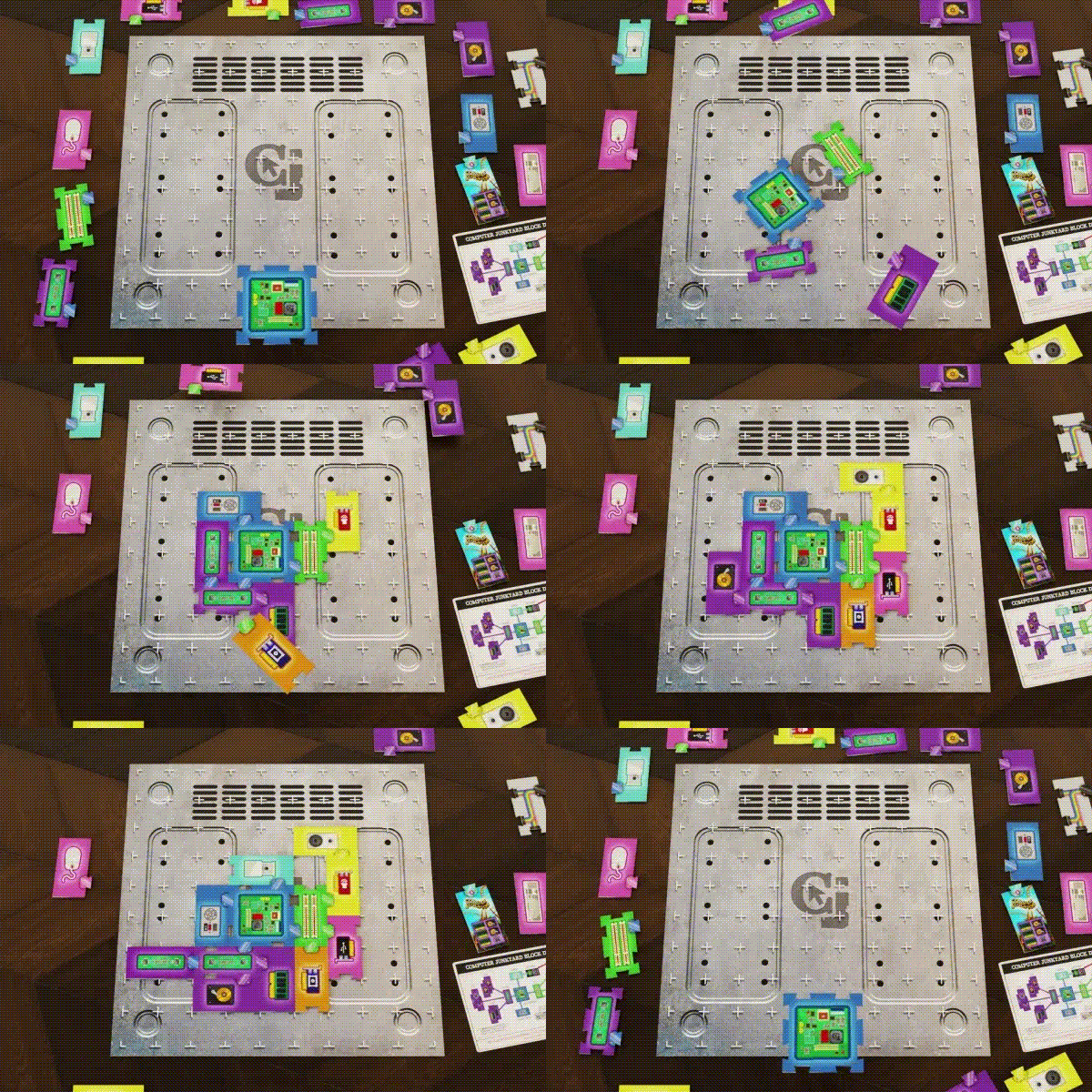
Build: Simultaneously, using the 2 minute sand timer, all players now can fuss with their computer bits. The tiles have color coded input and output ports so you know what goes together – with black ports being wild in color. Splitters can also be used to make chains of inputs of similar type. You cannot disconnect nor rearrange any bugged hardware – though you can slide or rotate bugged pieces around. You can also swap a tile for one of the same type from the Junkyard. At any point after the timer has run out, any player can yell Stop – and everyone must end this phase. Also, if your system is otherwise complete, you can install your software as a final action, yell out “Installed!” and the game ends..

System Check – see if someone has won the game by confirming that their computer has all the needed bits, all connected properly. If not, everyone checks their computer to make sure everything is aligned to the grid, connected to other parts and not hanging over the edge. Any incorrectly attached pieces are put back in the junkyard and all other non-compliant pieces are moved to the workbench. The start player moves clockwise and the game continues on.

The rules include a few modifications to make the game both easier or more difficult. As you get used to the game, you can incorporate any or all of these to modify the game to your liking.
My thoughts on the game
There is an interesting challenge here to gather the pieces you need for your computer and then arrange them all as best you can on your motherboard. Though I did once build a computer myself with a motley bunch of discount parts ordered from various ads in the thick Computer Shopper catalog – it had been a long time since doing that. This game let me relive my adventure from the 1990s.
While you’re building things, you are supposedly under time pressure with the sand timer. We’ve found that this is almost never an issue. The bits are nicely color coded so that you know which male end goes into which female slot, and more often than not, the arrangement of puzzle pieces is done quickly. There can be times when a bug freezes part of your computer, but that again seems to speed up the decision making process as there is literally nothing you can do with the bugged hardware.

As this game reminded me of building a computer in the 90s, the game also feels like one from the 90s. Much of the strategy comes from targeting people to steal from or targeting people to give them a bug. (Yes, there are cases when you might actually want to give yourself a bug, but this seems to be more of a corner case than anything else). You’ll probably already know if you like games with this sort of interaction.
Players will also need to do a bit of direct negotiating with other players to trade for tiles. Money can be quite tight in the game, so sometimes you can make a deal which mutually benefits the two players involved in the trade. If anything, this is the phase that should have a timer! The market pricing is a nice system that leverages the supply and demand seen within the market. There is definitely room to buy the things you want as well as making defensive plays to either deny other players of a particular piece or to drive the cost up for them.
Depending on the speed of your group and player count, this one will take about 45-90 minutes. The game itself is pretty light, and I would bristle a bit if it took up more than an hour of game night. For us, it plays quickly in 3p and 4p, and 45 to 60 minutes feels right for the complexity.
For me, the building of the computer is the most interesting part. The varied pieces connect together in a lot of different formations, and you’ll likely need a bit of advanced planning to get everything where you want it to be by the end of the game. Players may also need to swap when possible at the junkyard to get a different arrangement of ports on a particular tile type. Less interesting to me is the directed stealing of tiles and the random distribution of the bug tiles and the targeted placement of them. It’s not enough to overwhelm the warm sense of nostalgia that I get from the game and the enjoyment of working with the puzzle pieces, but it does keep me from loving the game.
Until your next appointment,
The Gaming Doctor
Amazon affiliate link: https://amzn.to/3RoSJO4


