|

September 2026
Games I played for the first time this month, from worst to best, along with my ratings and comments.

Tute – 5/10
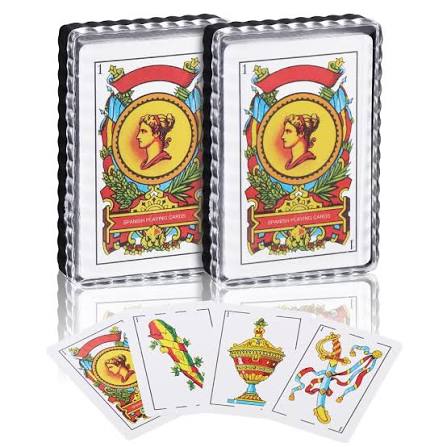
Like many traditional card games, Tute/Tutti has a variety of rules variants, only one of which I played. But the general principles are the same. Using a smaller-than-52 card deck, players try to win tricks containing point cards.
The most distinctive feature of the game is that there is a draw pile. Each time you play a card, you will replace it. During this phase of the game, there are no restrictions about following suit, so it’s very easy to not give away points and nearly impossible to force your opponents to give them to you through clever play.
Once the pile is empty, the rules change. From then on, not only is following suit required, but players are also required to beat the play before them whenever possible, including by trumping. Hopefully you’ve crafted a strong hand in the first phase, because at this point your decision space becomes very limited.
The scoring system unfortunately doesn’t provide strategic options either. All of the point cards are also the most powerful cards. So if you draw the highest trump, not only are you guaranteed to win a trick with it, it will also inherently give you the highest points of any card. Additionally, there are big bonus points if you reveal the King and Queen of the same suit from your hand. You have very little control over this and there is no tactical reason not to reveal it when you have it. So it just becomes another way in which randomness is injected and the powerful cards become even more important.
There are also design decisions here that are clearly the result of tradition, rather than in service of good gameplay. As an example, the ranks don’t proceed numerically, with the 3 being the highest card for no obvious reason. And even though there is no bidding and no way to control it, the trump suit randomly changes each round. These choices seem intended only to sow confusion, to the extent that they can be said to have any intent whatsoever.
Despite all of this, Tute feels relaxing and familiar, like a game that families and friends have played for generations. You’ll want to look elsewhere for trick-taking with meaningful player control, but it’s a fine diversion.

Trick to the Future – 7/10
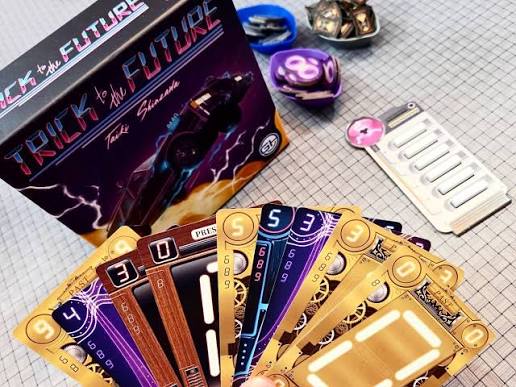
Trick to the Future is a very simple trick-taker with just a modicum of a twist. Once you’ve played your very first trick-taking game (maybe something like Marshmallow Test), this would be a nice half-step up. The gimmick is that you can change the numbers on the cards by overlaying them with wooden sticks, a la a digital clock.
These wooden sticks are called your “fuel rods”, and the unused ones serve an important scoring function. You get a point for every trick you take, so long as you have fewer tricks than your remaining fuel rods. If take more tricks than your remaining fuel rods, you score no points. But the best outcome is to take exactly the same amount of tricks as your remaining fuel rods, in which case you score two points per trick taken. This can lead to situations where you opt to spend some fuel rods to change a number that doesn’t even affect the outcome of the trick just so you can try to match perfectly.
That said, you have to be a bit careful when putting fuel rods out there, as each fuel rod you take in tricks you win is also a point. And those points are also doubled with an exact match. So it can be a no brainer to make your number into the highest possible one, since you’ll get points for those fuel rods anyway. But it feels bad to have to give them to someone else.
Finally, you also have the option to try to take no tricks at all. If you succeed, you will score 3 points per fuel rod you spent, for a maximum of 18 points (since you start with 6). This is a nice option when you are dealt a bad hand, but even the maximum of 18 points pales in comparison to the points that can be scored with a perfect match.
Trick to the Future only lasts three rounds, which is a good length, but this also means that a failed bid (zero points) on any of these three rounds will likely spell your doom. Try to manage this risk while also maximizing your points. This is one I’m happy to play, but it simply doesn’t have the depth of the very best trick-takers.

Size Wise – 7/10
Size Wise is a fast-playing party game in which players will estimate the sizes of objects using a bead on a string. The goal is to neither be the player who picks the longest nor the shortest length, as those players will each lose a token. When someone loses all their tokens, the game ends and the player(s) with the most tokens wins.
So yes, at some level, this is a game of estimating skill. But the objects being estimated are deliberately ambiguous. For example, when asked to choose the size of “a book”, which dimension is being considered? The height or width of the cover? The thickness? And what book are we talking about? The Berenstain Bears or War and Peace? These are all great questions, but the rules strictly prohibit discussing them. Until after points are scored, that is. So this actually ends up being an exercise in predicting what your opponents will do.
Size Wise is to be especially commended for the way in which it delivers on a concept that could easily have fallen flat had less care been taken in its production. The large, chunky beads are perfectly sized to move easily yet firmly on the the strings, ensuring both ease of use and no unintended movement. They’ve also taken the additional step of putting a ring on the end of each string, allowing them to simply be hung from the included wooden peg for fast and obvious size comparison. The cards, likewise, include an excellent assortment of objects sure to impel misinterpretation and amusing argument afterwards. These choices all make Size Wise a joy to play, in spite of its featherweight rules and simple conceit.

Lord of the Rings: Circle of Conflict – 8/10
There has been a trend lately of trying to elevate roll-and-write games from their lightweight reputation into something meatier. I think Twilight Inscription missed the mark a bit high on complexity, while Tend hit a nice sweet spot. If anything, Lord of the Rings: Circle of Conflict is probably a bit lighter than Tend, but I am similarly impressed with its execution.
Interaction in roll-and-writes tends to either be of the “do it before anyone else does” kind, or else non-existent altogether. Circle of Conflict’s means of distinguishing itself from this paradigm is right there in the title: players will attack to the left and defend to the right, managing the war on two fronts while generally ignoring any other players. These wars, building up armies and eventually triggering a final battle, are a primary source of points in the game as well as one of the endgame conditions.
But there are lots of other things going on as well. As in the source material, Frodo and Sam are taking a much stealthier approach. This takes the form of a hidden movement game in which you draw a path through your secret map of Middle Earth, hopefully avoiding detection by the player on your left. And simultaneously using your bad guys to detect the Frodo and Sam of the player to your right.
Otherwise, there are lots of familiar elements here. You’ll check boxes to progress towards large rewards. You’ll receive small rewards along the way, some of which will create chain reactions of bonuses. You’ll have to decide which elements to focus on based on your preferred strategy, tempered by the tactical considerations of how the dice roll and what your opponents do.
Circle of Conflict isn’t a perfect game. It can last a long time, especially on a first play. The all-or-nothing nature of a successful guess on the location of Frodo and Sam can make or break your score. And yet, the overall experience is so much fun that these things are forgivable, or maybe even an integral part of the experience.

A highly recommended game that I have most certainly played prior to this month, probably many times.

Vegas Showdown – 9/10
In the mid-2000’s, Hasbro (who was buying just about every board game company in existence at the time) decided to purchase Avalon Hill, a classic war game and board game company that had fallen on hard times. This allowed them to reprint some classic games under this new banner (“New” Avalon Hill) such as Acquire and Cosmic Encounter. But they also wanted to develop new games for the brand. The logical thing was to assign this task to their Wizards of the Coast division, who was responsible for Magic: The Gathering and Dungeons & Dragons, among other smaller “hobbyist” games. The people from the Milton Bradley and Parker Brothers divisions (yes, they owned these as well) didn’t really fit the bill. This resulted in several people who were barely known as game designers, but had spent years working on the development of Magic: The Gathering getting to try their hand at independent game design. The results ran the gamut, but there were two strong standouts: Charlie Catino with Nexus Ops and Henry Stern with Vegas Showdown.
There are plenty of games with a Las Vegas theme, but most of them lean into the dice rolling and gambling thematic aspects, putting you in the shoes of a casino patron. Vegas Showdown instead zooms out, putting you in charge of building and running a successful restaurant/casino in a downtown hotel. Sure, you use poker chips to keep track of your income, but dice rolling and card playing are nowhere to be found.
This is primarily an auction game. Players will outbid one another for tiles representing slot machines, lounges, fancy restaurants, and the like, with each player winning one tile per round at most. These tiles are then placed onto your personal board, where they begin generating additional income that you can use to purchase more expensive tiles. These elements are reminiscent of The Princes of Florence, but there is a bit more randomness here. The tiles are drawn from stacks and there is also a surprise event that shakes things up each round. Tactical adaptability is key.
I love how there are so many different approaches you can take to winning. You can build lots of cheap things or a few expensive things. You can focus on fame, or income, or population, or any mixture of those things. You can try to get bonuses for the positioning of your tiles or just race to fill your whole board. Everyone develops their own favorite tiles after a few games. And every play just seems to bring out more possibilities to win. There are so many paths to victory and the best one is always “what no one else is doing”. It’s remained a favorite through two decades and dozens of plays.
|



Like Josiah, I’m a big fan of both Vegas Showdown & Nexus Ops… glad to see that both of these “experiments” from H/AH are still available thanks to Renegade Game Studios.