Shamans arrived on my doorstep a few weeks ago, but it took awhile to get to the table because we have a surprisingly large backlog of new games to play right now – and because our group is taking the opportunity to play some campaign games which span weeks of our game sessions. But, we’re always up for trick taking games, and Shamans advertises itself as a trick-taker, and so I wanted to give it a try.
Per the publisher: in this game, “Shamans try to restore harmony in a world threatened by Shadows. You’ll need to pick a side.” That’s somewhat true, as there are some times where you might get to pick – but oftentimes, you end up on the side that you were randomly assigned to… In this game of shifting allegiances, players are assigned to either the Shamans or the Shadows. In a 4 player game, three players are secretly assigned to be Shamans and one player is a Shadow.
Today in Taiwan, one of my new-found favorite board game conventions is happening, 150BG.con, and I wanted to share with you some details about it from our friend, and one of the organizers of the convention, Smoox.
This is the fourth instance of the convention, which derives its name from the cost of each of the games that will be exhibited: 150 NT$!, around $5 USD. (Even a ticket to the event costs 150 NT$!)
Last year, I was able to play one of the games released at the convention, 矩陣謎語 (Lost in the Grids), a cooperative game where players attempt to arrange square cards in a grid such that no row or column has more than one card of any suit or number. It whetted my appetite to try more of these releases!
矩陣謎語 (Lost in the Grids) by BEta Ma from the @150bg convention. An engaging and compelling information processing coop. We played three times tonight! 16, 17, and 18 points. Looking forward to more. pic.twitter.com/dBSUEXQ1zz
It’s an intriguing premise, so join us below as we hear from Smoox about the background of this 5 hour convention.
What was the inspiration for starting the 150BG convention?
3 years ago Huei from Soso Studio approached me about this convention idea because he felt that a game takes so many efforts in all aspects to be ready to be released. But there are so many cool ideas that might never see the light in the public because the designers don’t have the resources to push their designs to the next step of publication. Besides that, both Huei and I are fascinated by the “500 Yen” games commonly seen in Tokyo Game Market which roughly equals to 150 NTD. So, boom! There is the 150BG.Con.
In looking over the release list for this year, I saw a few names of designers and publishers that I recognize, like Citie Lo (A Pleasant Journey to Neko) and Soso Games (Castle Crush, Dadaocheng). What is the range of participants? New voices? Established designers? A broad spectrum?
150BG.Con welcomes designers of all sorts, but mostly those who don’t mind cutting cards, applying stickers, and folding boxes for each copy of their 150-priced games.
It’s a great chance for rookie designers to test their game ideas and learn from this “production process.” Because they have to go through not only design and playtest, but also graphic, components (with limited budget in mind!), packaging, and promotion. It’s a practice of MVP (minimum viable product) oriented project. They can kind of have a feeling about if they enjoy “game publishing” or not. Although the scale (1k MOQ vs. 20 hand made boxers) is drastically different but the mental exercise teaches you some lessons.
For experienced designers, it’s a good way to experiment a bit on their crazy ideas or even get some feedback on their potential future releases (by making a 2-player version or Roll and Write version).
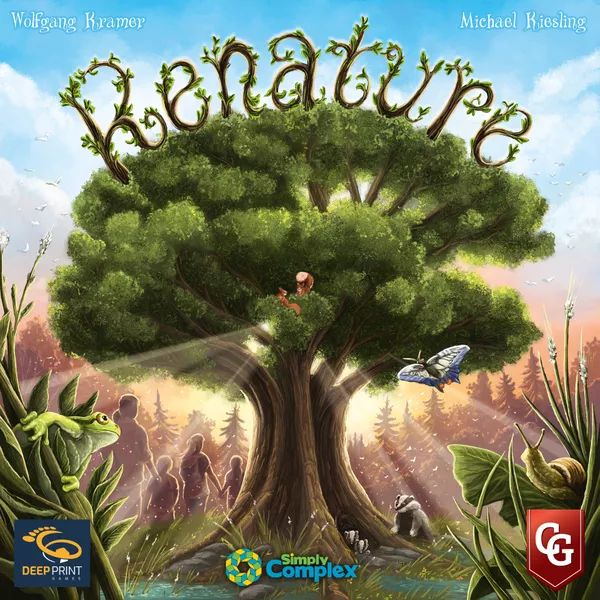
Who would have thought, an area majorities game about reclaiming nature? Apparently Michael Kiesling and Wolfgang Kramer and the fine folks at the newly established Deep Print Games, that’s who.
The premise of the game is simple, we are helping the woodland creatures reclaim a valley that has been ravaged, nature is gone and we aim to bring it back through the placement of wooden dominos with woodland creatures on them and plants to place in the areas where our woodland friends venture. While we definitely want to help the environment, we being human beings, do still have that natural urge to do it better than our fellow competitors.
Played with review copy provided by Ravensburger USA
In this game, players each get their own board which represents a Jubako box – that is a special sort of bento box where meals are organized. Jubako are normally used for New Year’s Day, but thankfully, in this game, you’ll use them every day of the year.
The jubako board has a 5×5 grid in the center with some preprintedj squares on them. There are 12 different foods in the game, and they are scattered amongst 78 different domino tiles. These are shuffled, and each player gets a starting hand of 2 domino tiles. The rest are placed face down on the table, and then a display of 4 domino tiles is revealed. There is a scoring track that runs along the outer border of the player board, and you put your marker on the 0 space to start.
This is part of the continuing series of articles in our Gaming Timeline series, in which we explore the historical significance of (and our personal experiences with) the most notable games from the past 120 years. This article will cover the period from 1910 to 1929.
The second and third decades of the twentieth century could scarcely have been more different. The teens were a dreadful ten-year period. Not only did they include a bloody and horrific world war, but that was no sooner ended when the world was once again rocked by a global pandemic (the so-called Spanish Flu), which actually killed more people than died in the war! Needless to say, this was not a period with a large number of gaming innovations. In response to this dark decade, the world seemed to decide to kick up its collective heels and party. The result was the Roaring Twenties, filled with fads, flappers, jazz, speakeasies, and a whole lotta dancing. It seemed as if the good times would last forever, but then at the end of the decade, right on cue, came the stock market crashes and happy days were gone again. Before the music stopped, though, there were a number of notable gaming events, highlighted by the creation of the most popular card game ever. Larry
Lichtra (aka Electro); First Known Electric Boardgame (1910) Lichtra is the first known boardgame to use electricity. It was originally published in Germany in 1910; its name was changed to Electra in the 30’s, and then later to Electro. It’s a simple quiz game that uses a board that has 48 squares with a hole in each–24 on the left and 24 on the right. A sheet is placed on the board that has paired items, each with holes punched in them–maybe questions on the left and answers on the right, or perhaps related pictures on each side. The object for the player is to select an item on the left side and find the appropriate paired item on the right side. To see if this is done properly, the player uses two leads which are connected to the top of the game board. One is placed in the hole of the left-side item and the other in the hole of the right-side item. If the items match, a bulb lights up. The game works using batteries and hidden connections in the game board between pairs of holes.
Lichtra is the forerunner of other electric games, including Jim Prentice’s sports-themed games of the 20’s and even titles like Operation. I had a copy of Electro in the 70’s and it certainly seemed to be ubiquitous at the time. It continued to be produced until 2007, a run of almost 100 years. Melissa
Played with review copy provided by Asmodee NA (who distributes Pearl Games in US)
Troyes Dice is the third game in the Troyes family – first Troyes in 2010, then the Ladies of Troyes two years later, and then Troyes Dice, a good ten years after the original. The artistic feel is the same between all games, and this small box reimagines the original game where you must balance the needs of the three main parts of the population: Nobility, Clergy, and regular people.
The city is represented by a 2-piece wheel; around which 9 Plaza tiles are laid out. Each player gets a scoresheet which has a number of important areas. There are three colored districts, red for nobility, yellow for citizens and white for clergy. These each take up almost a third of the sheet. Each of these districts has six columns, with an empty square at the top. These have to be filled in with numbers; there are many different ways to do it, but it is suggested that beginners simply place a 1 in the left most column for each color and ascend until the 6 is in the rightmost column. However the numbers are chosen, it’s important that the numbers in a particular column are the same and that each player have an identical layout of numbers. At the bottom of each district is a resource tracker – red influence, yellow gold, white knowledge. Underneath the districts are a small set of tracks for your population, one for each of the three colors.