Crossfire (Game Review by Chris Wray)

  • Designer: Emerson Matsuuchi
  • Publisher: Plaid Hat Games
  • Players: 5 – 10
  • Ages: 14 and Up
  • Time: 5-10 Minutes
  • Times Played: > 5

Crossfire.jpg

Crossfire is a social deduction game set in the world of Specter Ops.  In this latest creation by Emerson Matsuuchi (known for Century: Spice Road) and Plaid Hat Games, each player has a hidden role which defines their objective.  The roles in the game vary by the player count, and there are two ways to play.  In “Crossfire Mode,” there is a blue team, which has a VIP they need to protect, and the red team, which wins by shooting the VIP.  In “Sniper Mode,” one player is a sniper, and his or her goal is to shoot all of the Assassins in play, avoiding hitting the VIP.

Crossfire made its debut at Gen Con, and I enjoyed playing it when I was there.  I recently played it more at DeductiCon, a social deduction event I hosted in Kansas City.  Crossfire was a big success at the event, so I wanted to write a quick review.   Continue reading

Posted in Essen 2017, Reviews | Tagged , , , , , | Leave a comment

¡Adiós Calavera!


box 2


DESIGNER: Martin Schlegel

PUBLISHER:  Mücke Spiele

# OF PLAYERS: 2

AGES: 8 and up

TIME:30 minutes

TIMES PLAYED: 3, with a copy I purchased


Much of my regular gaming is two player; my usual game group members all live at least thirty minutes away, and with commuting and work and non-gaming responsibilities I only get to game with them about once a month. I had the good fortune to marry a fellow boardgamer, though, so we play a lot of games. While many games work well with two players I am always on the lookout for games that are designed specifically for two players. While doing my research for Essen I came across ¡Adios Calavera!. After learning it was an abstract I was less interested, but decided to try it; I am glad I did.

¡Adiós Calavera!’s theme is based on the Day of the Dead. One player represents the living and one player represents the dead; after the celebration each player is trying to be the first to return to their own world before the other.

Each player takes the eight pieces of one color. Each piece is two-sided; one side represents the normal ability of that piece and the other represents the special ability. In the game described in the rules, each player chooses four of those pieces to have their special ability side up and four with their normal side up and puts these pieces on the designated spaces on the board in whatever arrangement they would like.


board

Whoever was last in Mexico is the start player. On your turn you choose one piece. Normal pieces can move as many spaces as pieces of either color on the same orthogonal linen- so a white piece in a row with one other white piece and two black pieces could move four spaces, since there are four pieces total in that row. Pieces only move in straight lines, but can move forward, backward, left or right. There is a space in the middle of the board that you cannot move through at all and two spaces that you can move through but cannot end on. There can only be one piece per space, and you cannot move over other pieces, either yours or the other players.

The normal side of each piece is the same, but the reverse side has a unique special ability that allows you to manipulate your movement in some way – moving other pieces, travelling diagonally or ignoring normal movement rules.

Pieces


There are several proposed alternate ways to play. You can choose not to use any of the special abilities, or you can choose to use all of them. You can choose to randomly select the four special abilities (rather than selecting them), or you can go back and forth with the other player turning two pieces to their special ability side and deciding which one to keep that way until you have  four. Finally, you can also alternate selecting your special abilities until you both have four; I have not tried any of these variants so can’t speak to them.

And that’s all there is to it.

MY THOUGHTS ON THE GAME

The rules are clear and took only a few minutes to go through; we were able to get started right away with no questions and it was easy to teach once I knew how to play. The mechanism by which you move as many spaces as there are pieces in your row means you have to find a balance between pulling out to a lead and trying to stay in a row with more movement options, which I enjoyed. The special powers are a great addition; they keep the game interesting, and let you set up some cool moves. Normally I dislike trying to plan moves in abstract games like this, but for some reason it grabbed me here and I can’t quite put my finger on why, but it’s held up over all plays so far. The easy-to-learn rules combined with actual strategy make this a keeper for me.

THOUGHTS OF OTHER OPINIONATED GAMERS

I love it! 

I like it! Tery

Neutral.

Not for me.

Posted in Reviews | 1 Comment

Dale Yu: Review of Escape from the Room: The Curse of Old Maid Milly (Book) – Spoiler Free

Escape from the Room: The Curse of Old Maid Milly (Book)

  • Author: Nathen Newark
  • “Players”: I would recommend 1-3
  • Time: we finished in about 3 hours
  • Times played: 1, with review copy provided by Nathen Newark

Well, the Opinionated Gamers is a blog that usually writes about boardgames, but we’ve been known to stray afield here and there.  One of the more popular developments in boardgames over the past few years has been the Escape Room/Puzzle genre.   We have played quite a few of these games, and each has a unique take on how the players get to solve the puzzles. Continue reading

Posted in Reviews | Leave a comment

ARKHAM NOIR CASE FILE #1: The Witch Cult Murders


box


DESIGNER: Yves Tourigny

PUBLISHER:  Ludonova

# OF PLAYERS: 1

AGES: 12 and up

TIME:30 minutes

TIMES PLAYED: 5, with a copy I purchased

As a child I often would set up games like Monopoly and Life and play them solo, taking on the roles of three or four players.  Thankfully as I got older I found friends who would play games with me, but I still find myself drawn to multiplayer games that have a solo variant. Invariably, though, I find myself disappointed; even if the solo version of a game is pretty good, it’s never as good as playing the game with one or more other players. While doing my Essen research I came across Arkham Noir, a game specifically designed for only one player, and I was immediately intrigued.

In Arkham Noir Case File #1 you play private investigator Howard Lovecraft; you have been hired to investigate the death of several college students from Miskatonic University

The game components consist of solely of cards.  In the box are 50 Clue cards, 6 Victim cards, 1 Professional Contact card and 3 Player Aid cards. In addition, there are 4 Reference cards that help you with set-up and keeping track of things during the game.
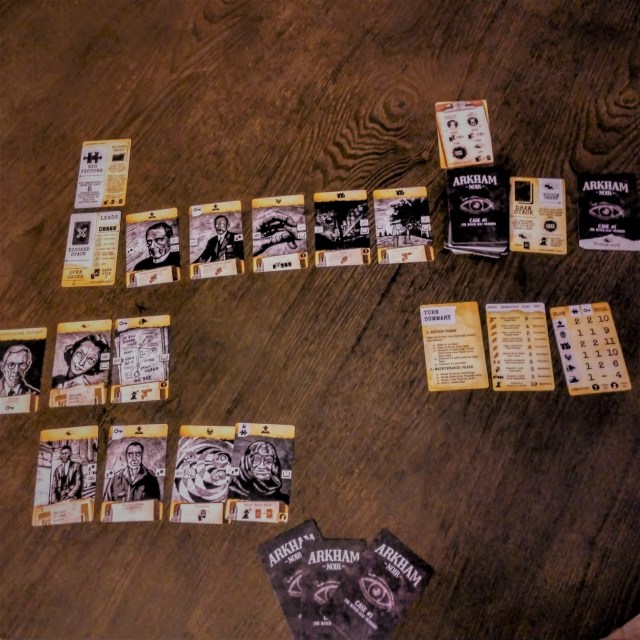
                                                        game

You start the game with two open cases and a hand of three cards. Every turn consists of an action phase and then a maintenance phase; play continues until one of the game end conditions is met.

On your turn, you take one action. Your action always starts with taking the first clue card in the “Leads” row. You then decide what to do with it; options include:

  • Put the card into your hand. This will allow you to use it at a later time, but you can only have three cards in your hand at any one time, so you might need to discard another card if you take this action.
  • Play the card to one of the open cases. You can only do this if a symbol on the left of the card you are playing matches at least one symbol on the right of the card you are playing it on. If the card has a lock, you must also have played a card with a key on it earlier in the case.

clue cards

As soon as you play the card you must resolve the effects, if any, on the bottom of the card. Some effects are good and some are not; some are mandatory while others are voluntary. They may cause you to draw or discard cards, take a penalty or perform a stability check. Also, if you play more than 7 cards to a case you will have to perform a stability check every time you want to add a card. To perform the Stability check you draw the top card of the draw stack. If the card has the stability icon in the bottom right corner (and only  that corner – the rules don’t specify this, but the designer has in a FAQ). you must place it in your stability penalty area; otherwise you discard it (more on stability penalties later).

  • Discard the card and play a card from your hand to one of the cases, following the same rules for playing a card in the bullet above.
  • Discard the card and close one of your open cases. In order to close a case you must have at least five different clue types (indicated by an icon on the top if the card). Ideally you will have at least one card with a puzzle piece icon on it; if you can remove this card and still have at least five different clue cards on your case you can score that card; five puzzle piece cards will win you the game.
  • Discard the card and pass.

Any time you discard a card you look at the card to see if it has a time penalty icon on the bottom right of the card; if it does you discard it to your time penalty area rather than the discard pile.

Once during the game you may use your Professional Contact card to take a special action; the card in case one lets you either play a lock card without a key card or exchange a card from your hand with one of the available clue cards.

Once you have taken an action you begin the Maintenance Phase. The following steps occur in order.

  • Check your Big Picture area. If you have five or more cards with a puzzle piece icon there, you win! The game ends immediately.
  • Check your Stability Penalty Area. If you have five or more cards in this area, you lose. The game ends immediately.
  • Check your Time Penalty area. If you have five or more cards in this area you must draw a new victim card and start a new open case below your current case(s); you also discard the Time Penalty cards. If you cannot draw a victim card, you lose.
  • Refill the Leads row by moving all cards to the left and then filling in any empty spots. If you ever run out of cards you must start a new case by drawing a victim card; if you cannot you lose. You would then shuffle the cards in your discard area and start a new draw deck.

The rules give you several suggestions on how to make the game harder or easier, by adjusting the number of cards in play or cards needed for win/loss conditions. I went with hard once. Once.

MY THOUGHTS ON THE GAME

Let’s start with the theme. As you can guess from the title, the game is based on the Arkham mythos; . Case #1 is based on a combination of several HP Lovecraft stories.  You don’t have to necessarily be a Lovecraft fan to enjoy the game, though. This game could have been made with a different theme, and the theme isn’t really integral to the game. As someone who likes the theme, it works well for me; I tell myself a little story in my head about my investigation  as I go along, but that isn’t necessary – you could just play this a hand/resource management puzzle without caring one whit if Cthulhu is involved or not.

The rules are clear and mostly complete; I was confused about when/how to count time and stability icons until I found a clarification on Boardgame Geek from the designer but otherwise was able to read the rules and play the game right away.

The game play itself works well. I don’t mind the occasional multi-player solitaire game, so a truly solitaire game is fine. The interactions between the cards are interesting, and trying to manage when and what type of card you can play without incurring a penalty is a fun puzzle. There is some luck involved, since you are reliant on random card draws, but it’s not a problem; after the first turn you can see what cards will be foist upon you well in advance, and while some cards might force a negative on you, you can also see that in advance. It’s all about balance.

I’ve only managed to win once, so it’s not too easy. You can make it harder or easier; my one win in my 5 plays was on one of the easier settings, but I look forward to winning on normal and then perhaps hard. I also so far haven’t found that they game loses replayabilty after several plays; since victims and clues come out randomly so far I haven’t felt I can see a clear path to victory, although I suspect that will eventually change.

This brings me to the one thing I don’t like –expansions are not readily available. A limited number were available through the designer’s Etsy shop, but they are gone now and not available anywhere else.  I enjoy the game and would purchase the expansions, which add complexity in addition to new cards, but it doesn’t seem I will be able to do that.

Thoughts from other Opinionated Gamers

Ratings from the Opinionated Gamers

I love it!  

I like it. Tery N.

Neutral.  

Not for me…


Posted in Reviews | 4 Comments

Larry Levy: Review of Gentes

  • Designer:  Stefan Risthaus
  • Publisher:  Spielworxx
  • Players:  2-4
  • Ages:  12+
  • Duration:  75-120 minutes
  • Times Played:  3

I have something of a love/hate relationship with the publisher Spielworxx.  On the plus side, they tend to release the reasonably heavy Eurogames that hit my sweet spot and their designs almost always include an interesting sounding mechanism.  On the negative side, though, their development isn’t always the best, their rules are frequently confusing, and the physical production of their games often manages to be both non-functional and unattractive at the same time.  So I find myself swearing off their titles from time to time, only to be lured in by the next game that sounds attractive.  Such was the case with Gentes.  So the question is, did the positives of this latest release overcome its negatives?

Rather than keep you in suspense, let me say the short answer is yes.  Gentes is an enjoyable game that packs quite a lot of decision-making into a reasonably short timeframe.  It won’t be winning any beauty contests, but the physical design is at least adequate.  It’s not a game I love, but I do like it and it’s one I can recommend to anybody looking for a punchy strategic title. Continue reading

Posted in Reviews | 1 Comment

CLAIM

CLAIM

Design by Scott Almes
Published by White Goblin Games
2 Players, 20 – 30 minutes
Review by Greg J. Schloesser

Shortly after discovering German-style games, I was introduced to the “trick-taking” game genre.  I did not grow-up in a card-playing family, so I had little exposure to traditional card games.  Thus, the trick-taking concept was new to me, and frankly, I didn’t understand it. The rule that required one to follow the lead card seemed restrictive, removing the ability to choose which cards to play.  As I gained more experience with the genre, I learned more nuances and began to understand and appreciate the trick-taking mechanism.

A recent development in the genre is the introduction of 2-player designs, a concept which initially perplexed me.  All of the trick-taking games that I have played up to this point were for multiple players, and I feared that the dynamic when playing with numerous players would be lost when only playing with two.

The first (and so far only) game in this relatively new 2-player genre that I have played is Claim by designer Scott Almes and published by White Goblin Games.  The game has a familiar fantasy setting wherein the king has died, and now five different races are vying for control of the realm.  The deck of 52 cards features goblins, dwarves, undead, doppelgangers and knights, with most groups having values from 0 – 9 (the knights range from 2 – 9).  The cartoon-like illustrations and card colors make it easy to determine the race of each card.

Continue reading

Posted in Reviews | Tagged , | 2 Comments
