Designer: Eric B, Vogel
Artists: Fred Hicks, Chris McGrath, Tyler Walpole
Publisher: Evil Hat Productions
Players: 1-5
Ages: 13+
Time: 30 minutes
Times played: 5, with copy and expansions purchased on Kickstarter
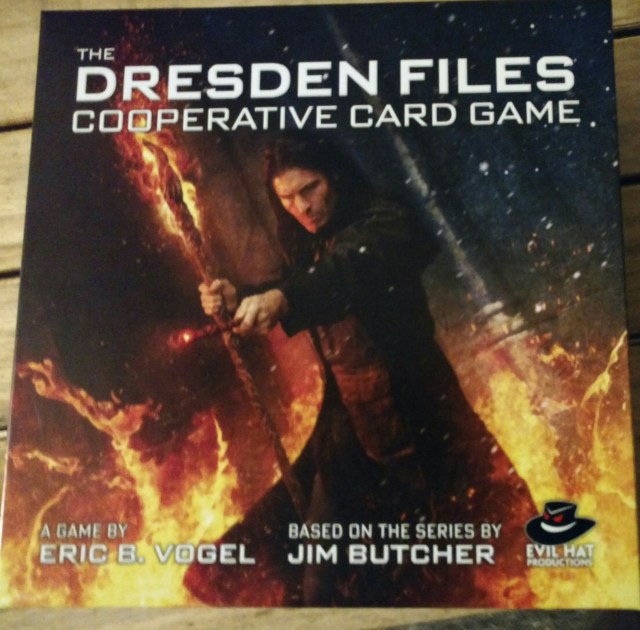
I usually avoid any game based on a movie or tv show. Countless times I’ve had well-meaning relatives give me such a game as a gift, thinking that since I like the movie/show and I like games that I’ll love it. With very few exceptions, I do not. The gameplay and mechanisms are not usually well-thought out and I find the theme is often pasted on. So, when a friend told me there was a Dresden Files Cooperative Card Game on Kickstarter, I was somewhat skeptical. As a big fan of the books I had to take a look, though, and after reading through the description I decided I would put aside my aversion and fund it. As it turns out, it was worth the risk.
For those of you who don’t know the books, the main character is Harry Dresden, a wizard/private investigator who solves supernatural mysteries. Harry works closely with a wide cast of characters that complement his particular brand of magic. There are 15 books in the series, as well as a short story compilation, graphic novels and a short-lived TV show.
In the Dresden Files Cooperative Card Game each player takes on the role of a character from the book (or two characters if you are playing 2-player); Harry Dresden must always be included in the game; other characters can be selected at random or chosen by the players. The base game comes with 5 character decks; expansion character decks are also available. (2 of my favorite characters weren’t in the base set, so I ponied up for the expansions as part of the Kickstarter).
You are playing against a scenario based on the books in the series; each scenario deck shares a title with a book and includes obstacles, advantages and villains that would be found in that book. 5 book decks come with the game; additional book sets are packaged with the expansion characters. In a clever twist you can also build your own scenario using a book deck called Side Jobs, which is the name of a collection of short stories that take place between the books in the series.
There is a game board on which you place two rows of the book cards; each row is numbered 1 through 6. The cards are laid out randomly in each row. A Showdown Card, which indicates some end-of-the scenario actions you can take, is put at the top of the board. Tokens representing Fate points, clues and injuries are placed in their respective spaces at the bottom of the board. There are also 8 Fate dice that are used to modify costs and effects of the character cards as well as affect the scenario cards during the last round of the game.

Each player draws a certain number of cards based on the number of players in the game. There is no automatic replenishing of your hand, so these are your cards for the game; you may have the chance to draw additional cards based on special abilities or when cards are resolved in the scenario. Players then decide how difficult they want the game to be; for an easier game more Fate points are immediately available and for a harder game fewer are available.
Each player also has two cards in front of them – A Stunt Card and a Talent Card. A Stunt Card is a special ability that can only be used once per game; a Talent Card is a special ability that can be used every time you discard a card.

The goal of the game is to complete as many cases from the scenario as you can while also defeating as many enemies as you can. There will be both obstacles making it harder and advantages to help you out; in addition, many of the cards are affected by or have an effect on other cards on the board. Players win if the number of solved cases is higher than the number of enemies left on the board.
On your turn you can take one of four actions:
- You can play a card from your hand. Each card in your hand has a specific purpose, stated on the card. Some are attack cards that do damage to enemies; others are cards that help you solve cases, overcome obstacles or take advantages. All cards have a range that tell you how far down the row of cards it can be used. Each card also has a cost; this cost is listed on the card and is paid from the available Fate points. If there are not enough available Fate points, you cannot play the card.
If the card you play solves an obstacle or takes an advantage, those happen immediately. If your card damages a foe or helps a case, damage/clues are added; once the required number is met the card is removed from the scenario and is placed in the discards (foes) or in your solved case file.
- You can discard a card from your hand; discarding allows you to move Fate points equal to the value of the card to the available pool. You can also use your talent when you discard.
- You can use your Stunt ability, which is available to you only once per game.
- You can pass; you must spend one Fate point (moving it from available to spent) in order to do this.
If at any point a player cannot legally take an action a Showdown is triggered; players may also choose to trigger a Showdown at any point if they feel that is their best option. At this point players can roll the Fate dice to try to solve more cases or defeat more foes; only cases/foes with clues/damage already on them can be targeted. The Showdown card indicates how you can spend available Fate points to improve your odds of success. At the end of the Showdown the players win if they have solved more cases than there are foes remaining on the board; if the number is tied or there are more foes Evil has won.
The game can easily be played as a one-off or with random set-up every time, but the rules provide for a campaign scenario as well.
The rules are very clear and include specific examples of game play as well as some card clarifications. For our first play we had the game set-up and were ready to play in about 15 minutes with no prior reading of the rules; it will be even faster to teach.
I really like this game. The designer has done an excellent job of incorporating the theme into the gameplay; it does not overwhelm the game, which could easily be played and enjoyed by those unfamiliar with the books, but it adds to the experience for those who are. While I am often nervous about cooperative games it is fine here because, while players can discuss what should be done, only you know exactly what is in your hand. In fact, the rules forbid you from saying exactly what you have – you can say you have a card that would do some damage, but not exactly what that card is or how much damage it can do – so you still have some personal control. Since you do not automatically refill your hand at any point, the puzzle of maximizing your choices with what you have when you start the game is an interesting one. I don’t love the random element of the Fate dice that affects how much a card will cost to play or what benefit it will have, since Fate points are a precious commodity (and because I only ever seem to roll minus signs) but it’s a minor dislike. The possible book card scenarios and character combinations will keep this game fresh and prevent it from having a replayability limit. All of these things plus the 30 minute time per game mean this will see regular play at my house.
OPINIONS FROM OTHER OPINIONATED GAMERS
I love it: Tery N
I like it
Neutral
Not for Me



