

Long ago there was Agricola. Since then, many nations have risen and fallen, many sets have been collected, many workers have been placed, and many VPs have been scored. Now, we have once again circled back to farming. I come to you with no less than three farming games in one post. Keymaster’s Harvest has you worker-placement managing your crops. Sea Cow Games’ Flock Together has you and your fellow chickens banding together to protect the farm from predators. NorthStar Games Studio has you planting crops in the mountains of Peru as you manage alpacas and the crop market to your advantage. If farming isn’t your thing, Keymaster also has a nice Parks: Roll & Hike sequel to their successful PARKS. NorthStar has a pattern-matching moon-collecting game Biomos and they were showing off their Evolution 2.0 style game, Nature, heading to Kickstarter in mid September.
Sea Cow Games
Flock Together


I was happy to see the 1-5 player co-op Flock Together appear in the exhibit hall after my last-minute interview from the end of Gen Con 2023. It’s been sent out to Kickstarter backers and is now in distribution. Flock Together is a chicken-themed cooperative adventure. Everyone plays as one of 11 unique chickens (with their own special powers) and they band together to ward off the invading predators (of which there are 10.) Over the course of three seasons, players repel predator attacks (using 2 of 8 possible actions per turn), and predators that aren’t dealt with will grow in power. Both the chickens and the predators are managed using cool, spiral-bound booklets. As players “level up”, all they have to do is turn the page. However, the bad guys also get to level up if they aren’t kept in check. The fancy chicken-die that looks like a chicken from certain angles was back, along with all the other nice bits. It is supposed to move along at a fast clip, clocking in at 25 minutes per player, even with all the leveling up and story progression.
Keymaster Games
Harvest
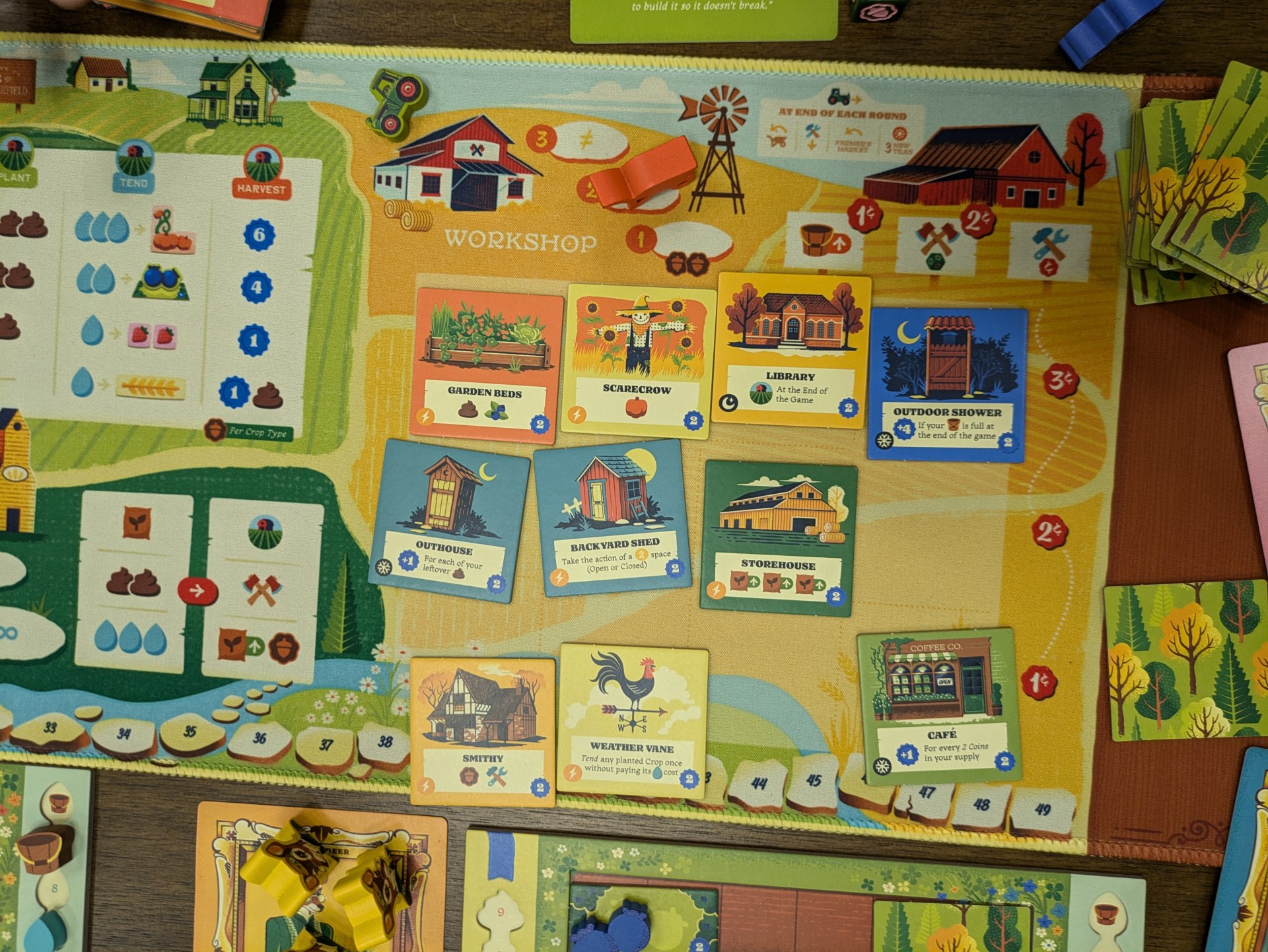
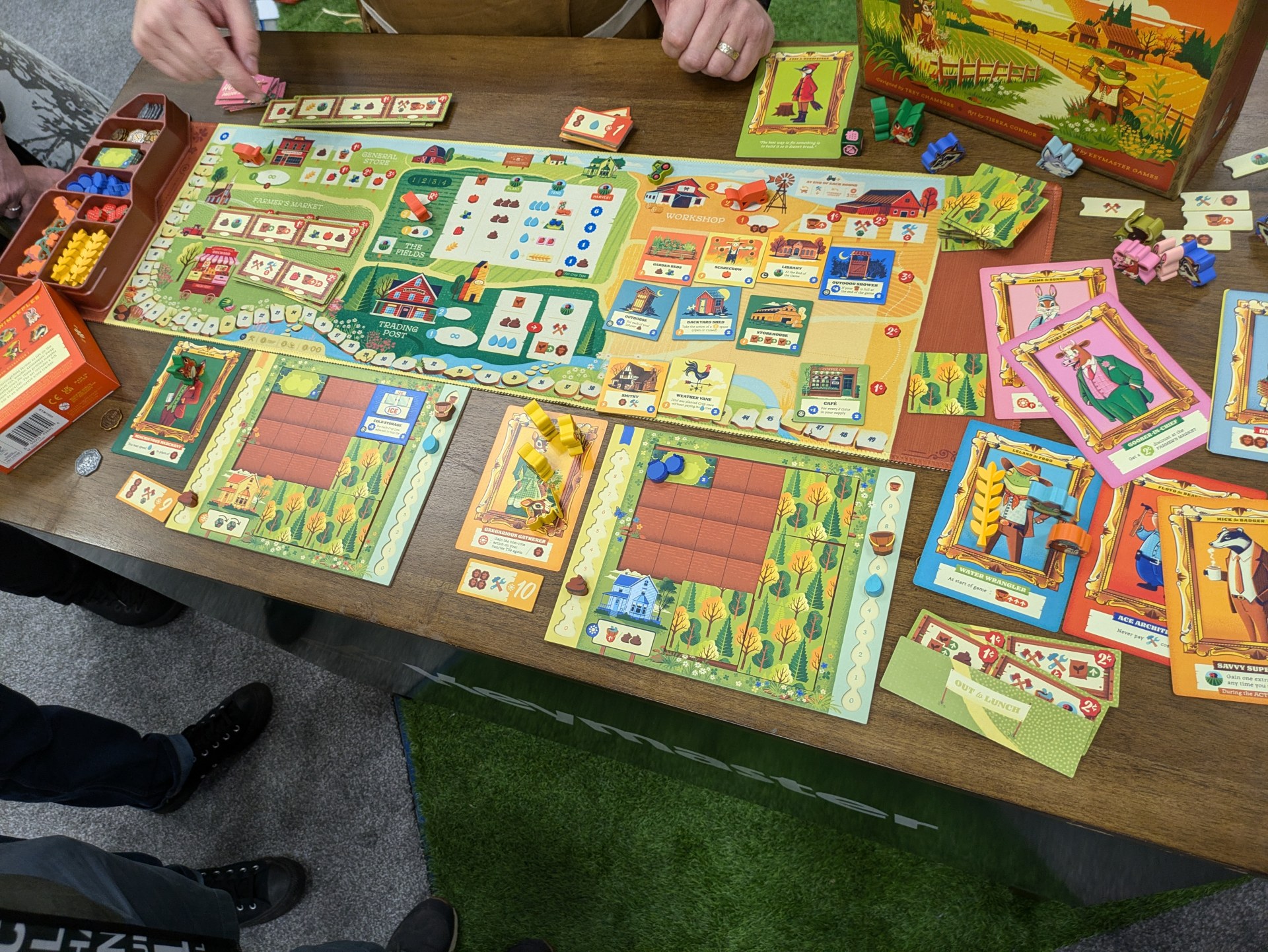
Another farming-related game, Harvest is a worker-placement game for 1 to 4 players. Played over four days (rounds) players choose when they wake up (player order, also tied to income) and then place their workers around the board. There are five main areas that are available, and most are slightly better for the first visitor of the round. You can get resources, plant things (points and money), build things (to get new or improved abilities), and if your opponents are screwing you over, you can go to the Trading Post and pay good money to do what they’re blocking you from doing. (If you want more details, read last year’s Gen Con overview) What grabs me about the game is the farming part. To farm, you first have to plant seeds, which need a bit of poo for fertilizer (you want to be organic, right?) You could then harvest, but what you really want to do is water your crops to help them multiply. You can double your crops by watering them, and since water is easier to come by than poo, it’s a good move if you have the space. After that, you harvest to earn points and money. The tricky bit is that all those crops take up space – space in the form of polyminos (Tetris-like) of various shapes and sizes.. What you plant and harvest will have to do with your personal strategy. Grain is cheap to plant (no poo required) but they’re huge and take up large bits of your farm area. Strawberries are tiny so they can multiply well if you start Tending in earnest. Blueberries actually form a little plant to make it easier to produce more berries in the future. Finally, there are the pumpkins. Pumpkins are huge L-shaped plants that take up quite a bit of space but score a crazy amount of points. As is the case with most games nowadays, it provides lots of starting options for variety. Every character (there are 8) has their own unique ability. Each farm board also has a bonus ability (4 double-sided boards for 8 different abilities.) Feel free to math that together for options if you wish.
Parks: Roll & Hike


I have not played the game Parks (reviewed by Joe H. here) but I’ve heard good things and I’m always game for a new roll & write due to their typically short playing time and ultra portability. I also like the outdoors (it’s green!) so Parks: Roll & Hike caught my eye. Here, players are along a path on a small map, filling out their journals as they go. The five dice are rolled and players take turns drafting them and crossing things off their journal (surprise – it’s a roll & write.) The journal is broken down into four main parts. The upper left is sort of a tech tree, completing areas here will let you fill in extra spots in certain situations going forward. The upper right has a spot to track sunsets (monies) and water drops (point progression). The middle right has four tracks (water, sun, pencils, and sunsets) that you can progress along left to right, earning bonuses as you go. As mentioned, the players will be moving a boot token along a central map, passing five (or six) tokens until they reach the end. The player who chooses the special orange die gets to claim the token. Once through the path, a sunset round is held. Exactly what happens will depend on what national park you’re hiking – as dictated by one of six different cards. After three rounds (sunsets) of play, players total up their points to find a winner..
Northstar Games Studio
Sacred Valley


Sacred Valley (out in stores now, 3-5 players) is another farming game but crops are now planted on higher and higher levels of the very cool, three level, shared mountainside. Players have four choices for their turn. Option 1 is to plant a seed on the cool terrace and then move their token up the market track based on the number of adjacent plants of the same type. At the start of the game, each player is only able to plant their particular crop. Option 2 is to cash out of the market track to score points. (Herein lies some strategy, it takes a turn to cash out so you want to wait until you’re high on the track but then you may lose out on value because you’re not allowed to exceed the maximum value on the track.) Option 3 is to purchase as much stuff as you want. This is really the “fun” option as you can buy crops (to plant later – but you can only store 3 in your reserve), get various technologies (like the ability to plant other kinds of crops), or buy a specialist. Specialists provide abilities like blocking someone’s planting meeple, moving an alpaca around on the terraces, or allowing a player to purchase and plant on the same turn. An important part of the game is managing the market and the hillside. Do you try to specialize and purchase the same plants as someone else, trying to piggyback on their efforts or do you plant other things instead just to wall off their growing field on the mountain?
Biomos


Biomos (out in stores now) is a puzzle-like game for 1-4 players. Each player has their own planet surrounded by an empty circle. Players take colored tokens and place them onto their planet in an effort to create a pattern matching one of the biome score cards in the middle of the table. You can add the token anywhere you want, but you can’t reorder the tokens already there. When a match is made, the player claims that card. Lower scoring cards are replaced, but if you claim one of the high value ones, they are not. There is a space on your planet card to place one token, making it into a moon. Moons serve as a point multiplier for similarly colored tokens on your planet. When everyone’s planet is filled (which happens on the same round since everyone has the same number of spaces) the game ends. There are ways for players to convert a colored token into another color, but this option is removed if playing the “family” version.
Nature


Nature has been the headline news for NorthStar Games studio lately. It is a revamp of their very successful Evolution game where players take control of a variety of animals and give them adaptations in order to gather (or kill) food in order to score points. Nature takes that formula and tweaks it a bit, most significantly it has been made a bit less “mean” in the predator/prey interactions. If a player’s species is chomped, they can keep the upgrades around for their next guy. If you’re unfamiliar with Evolution (or Oceans) players spend cards to create a species and then spend more cards to upgrade a species size, population, or grant it special abilities. The idea is to spiffy up your species so that it’s really good at eating/claiming food. The basic version of Nature (1-4 players) uses the same formula over four rounds. However, the games comes with five different modules that can be mixed or matched into the base game – increasing the number of rounds by one for each module added. These modules each consist of a deck of trait cards that is kept separate from the base trait deck. Thus, players can choose to draw from the base cards or from a specific module (or some from both.) In addition to the separate decks, adding a module will also change the game in some way. The Jurassic has lots of “meaner” traits, and to compensate all species have bigger bodies (body size is doubled during the game.) Flight provides defensive options, including the ability to migrate away to stay safe. The Rainforest has poisonous creatures (which are bad to eat), makes players placing their traits face-down (making them initially hidden), and also boosts population growth. The Tundra deck really restricts the availability of food but also gives animals the option to hibernate in order to feed again later. The final module in the game revolves around disaster cards – one is revealed each turn that should have fairly dramatic effects to the game state. The current plan is to release two more modules for the game each year, to keep the game fresh. Nature should go up on Kickstarter September 17th and arrive in stores in 2025.


