
Leaf It!
- Designers: Anja Wrede, Christoph Cantzler
- Publisher: Edition Spielwiese
- Players: 2-4
- Age: 6+
- Time: 10 minutes
- Played with review copy provided by publisher
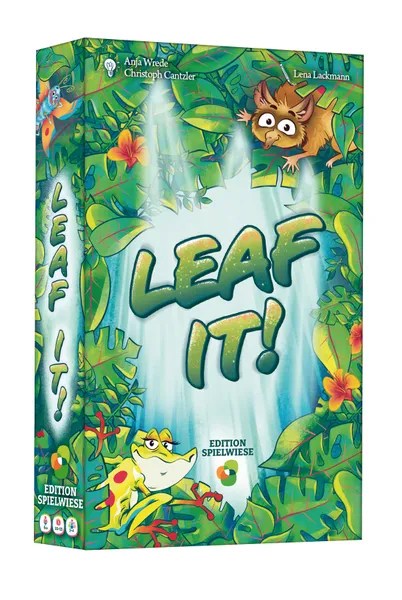
Don’t bring the canopy crashing down!
Dusk is falling in the rainforest, and the first sleepy forest dwellers are blinking from their hiding places. In Leaf It!, you must carefully feel your way through the foliage to build—and then dismantle—a wobbly primeval giant piece by piece.
Your goal is to collect as many sleepy, valuable forest creatures as possible. But beware: those who are too greedy will bring the canopy crashing down and hand valuable points to their opponents!
To start, open the box and put the bottom inside the top. Take a pair of cards for each long side and slide the cards between the boxes to form the support for the canopy. The rest of the cards are split up evenly between the players – as there are 36 cards left, it should always work out perfectly.
The game now plays out in two halves. In the first half, the players build the canopy by playing cards onto the structure. Then, in the second half, the tree is dismantled as players remove cards (and score points).

As you build the canopy, players will draw the top card from their deck, look at it and then place it on the tree. Each subsequent card must cover the animal of the card underneath it. Continue this until all the cards are placed onto the tree.
Then the players take turns to dismantle the tree. You can take any single card you like – but once you touch a card, you cannot change your mind. Place the removed card onto your score pile in front of you. If other cards fall down to the table (but the tree doesn’t entirely collapse), the fallen cards are collected, shuffled and placed face down and they are offered to players in clockwise order until everyone has collected one card. Any extra cards are simply discarded.

If the entire tree collapses, the game ends, the player who caused the destruction loses, and everyone else points their finger at them and laughs.
If all the cards are removed from the tree, the game also ends at this point, but now players will have to count their points to see who wins. Each animal is worth points equal to the number of red spots on them: 1 pt for a lemur, 2 pts for a moth, 3 pts for a frog. There is no tiebreaker.

My thoughts on the game
Leaf It! is a dexterity game that requires a very steady hand, good observational skills and some element of memory. There honestly isn’t much in building the tree – though the restriction of having to cover the previous animal keeps most of the animals hidden as the tree is deconstructed in the second half.

If a frog or moth is visible, it’s a no brainer, and the player will take that. Generally, if you can see the animal, it’s probably close enough to the top to take. Of course ,this isn’t always true – and you should always check to see how many cards you think are on top of the target one. Remember that once you touch a card, you can’t change your mind.
The overall structure is pretty flimsy as the whole tree is just held up with a pair of cards on each side. If you have to pull too hard to get your card, it’s likely that you’ll cause cards to fall down on to the table. Also, if you have to shake the tree a lot to get your desired card, you might reveal the edges of other animals – and then you’ll give the next player(s) some extra information for their turn. That being said, the coloring and patterns of the animals are well done so that they all kind of look like each other – so you’re never quite sure what an animal is if you can only see a small portion.
Leaf It! is a fun filler which anyone can play and enjoy. The rules are unbelievably simple and this game has been fun for everyone that I have shown it to.
Ratings from the Opinionated Gamers
- I love it!
- I like it. Dale
- Neutral.
- Not for me…


