
Ashes & Amber
- Designer: David Falla de Acebo
- Publisher: David’s Games
- Players: 1-4
- Age: 14+
- Time: 40 min/player
- Played with review copy provided by publisher
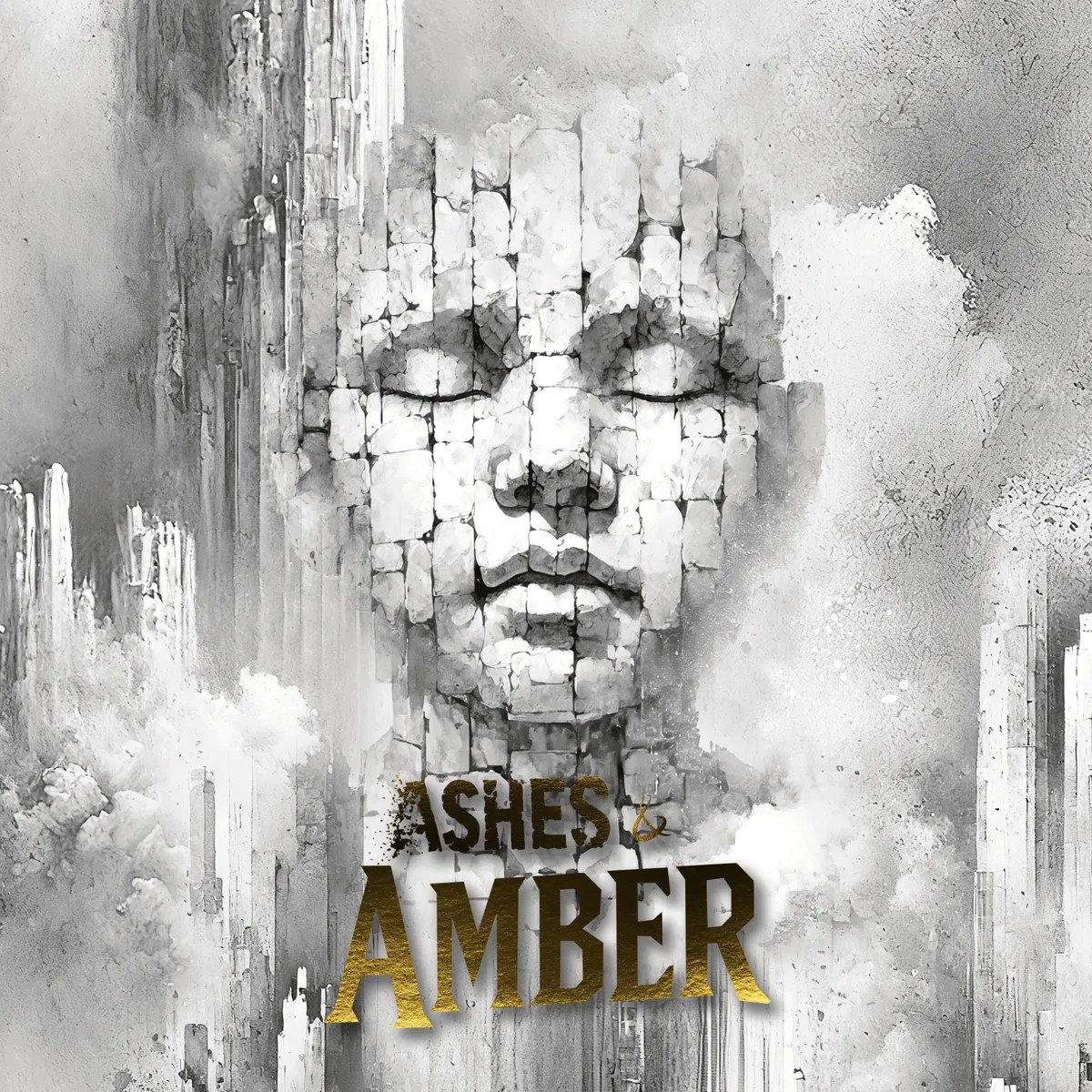
The inevitable will come. Cities will fall.
Yet from their ashes, you may rise again.
Plan carefully. Endure wisely.
Preserve what truly matters.
Will your civilization be remembered as the one that left its mark?
Ashes & Amber is a competitive civilization tableau-building card game where cities are living stacks of cards: expand them, protect them, and rebuild them after devastating catastrophes.
– Build cities as stacks of cards and activate the top cards
– Protect your valuable cards or see them burn when the catastrophes strike
– Raise Wonders to show the world your accomplishments
– Achieve greatness by saving your Amber to the end but beware when the major event is triggered
The game unfolds across five eras, Prehistory, Antiquity, Middle Ages, Age of Discovery, and Modern Era, one era per round. You build your civilization by creating cities. A city is a stack of cards, and only the top card can be activated. Players will use five different decks, one per era, for a total of over 700 cards. Each player also selects a unique personal deck, a Tribe, with asymmetric mechanics, which they will develop throughout the game. One card in particular is precious, your Amber card. You have it from the beginning, and it symbolizes the resilience of your people through time. If you protect it and shape your civilization wisely, your Amber card can become a major source of victory points in the final era, when humanity reaches its defining moment. You see this goal from the start and plan your strategy around it.
Player interaction is indirect, with players racing to claim cards from the shared display, from vital protection to powerful Ambition cards that shape the final score. The game features 19 unique Tribes, each with its own distinctive play style. Some encourage greater player interaction, others sacrifice a strong start for a spectacular finish, and others bend the rules in unconventional ways.
The game is played through five eras of human history: prehistory, antiquity, the Middle Ages, the Age of Discovery, and the modern era. If you are playing the advanced version, give each player a Tribe envelope (more on this at the end). Draw an Achievement card (used at the end of the final round) and place it on the table, under it the related Ambition cards, each with a Civilization card underneath. Three decisive moment cards are also placed on the table, with one being resolved at the end of each of rounds two through four.

Each player starts small – Their civilization is the area in front of them on the table where they will play cards. A city is a stack of cards with the bottom of each card remaining visible. Each player’s first city consists of an amber card with a fire card on top. Players also start with a project card; choosing one of two dealt to them. A project card contains an objective. If its objective is fulfilled when the game ends, you earn two additional victory points.
Throughout the game, you will gain utopia cards which also provide victory points. The winner is the player with the most VPs. This is a low-scoring game, and the winner will typically have between ten and 15 points. Interestingly, two Utopia cards can never touch in your cities; if this happens, one of the two touching Utopia cards is discarded.

At the beginning of each round, place the Timeline card for the era on the table. This will serve as a nice reference for the actions in this era. Get out the deck of cards specific for the Era. Place one resilience card per player and one fewer wonder card than the number of players. A random catastrophe card for the era is displayed. [If you have enough space on your table, the rules recommend placing the timelines, and resilience, wonder, catastrophe cards out for all 5 Eras in setup]. These Public cards have a cost in the upper left corner; usually requiring you to discard cards from your existing cities.
The Chronicle deck for the Era is shuffled and placed on the table. In the bottom right, you will see the resource icon: food, population, engineering, culture, or science. Cards may also have an action in the bottom left. Traits are seen in the bottom middle, these are used by certain Tribes. Finally, some cards have a larger action found in the middle of the card. You won’t be able to see this if the card is in a city stack, but that’s fine as you can only use the action if it is on top of the city (and thus you could read the action).
Each round follows the general pattern of: Income, Actions, Catastrophe, Decisive Moment/Achievement.
Income: If you have your amber card in your civilization, draw two cards. Then for each city you have, draw a number of cards equal to that city’s size, keep one and discard the others. There is a rule of four: you collect income from only four cities, starting with the smallest, and also, if a city is taller than four cards, you still draw only four cards from it, keep one, and discard the rest. Each round, even if you have more than four cities, your maximum income is six cards, two cards from your amber and up to four cards from your cities.
Actions: Players have the option to either Claim a Public Card or Take 1-2 Actions. This phase continues until all players have passed out of the phase.

To claim a public card (Resilience, Ambition, Wonder), pay the cost shown in the top left corner by discarding cards from your civilization, not from your hand. If you don’t have matching cards for the cost, you can add in Ash cards to help meet the cost. Play the claimed card immediately into your civilization as usual on the top or bottom of one of your cities.
If you choose to take actions, you have a number of options; you can repeat an action twice and you could choose to take only 1 action.
- Play a Card – When you play a card, take it from your hand and place it either on the top or the bottom of one of your cities.
- Exhaust a Card – Rotate the top card of one of your cities to perform the action shown in the middle of the card. You must be able to do all portions of the action. This card cannot be exhausted again this era. Possible effects include: creating a new city, move a card, drawing a card from the current era, taking a Utopia card and playing it to your cities, take an Ash card, take a Death card, remove a Death card, etc.
- Discard 2 Cards and Create a City – discard any 2 cards from your cities and then start a new stack with another card from your cities.
- Discard 1 Card and Move a Card – discard a card from your cities, and then move any other card to any position in any city
- Pass – When you pass, discard all your ash cards. They are temporary resources that should be used during the round. Once you have passed, you may not play again this round.

Catastrophe – This is when bad things happen. The effects of the Catastrophe cards are known from the beginning of the Era, so you will have had time to plan. Before resolving the Catastrophe effects, each player should note which of their cards are protected by Resilience cards and also decide if they want to trigger a larger Resilience action (which will sacrifice that card). Then, each player takes a Death card, playing it to one of their cities that doesn’t already have one if possible. Next, generally, all cards touching a Death card are turned to Ash. Finally, each Catastrophe then has a unique target effect for cards – again, all unprotected targeted cards are turned to Ash. You can target both Death and Ash cards with Catastrophe effects, and they simply remain as Death or Ash cards.
If a death card is still in your civilization at the end of the game, you must destroy one of your utopia cards, reducing your final score. Moreover, a death card is not a regular card, as it cannot be discarded to claim a card, for example. The only way to get rid of it is to use an effect: remove death.

Decisive Moment (occurs at the end of Eras 2, 3, and 4) – in turn order, each player resolves the action on the left side of this card, and then the leader(s) of the criteria on the right get to either take a Utopia card or 1 Project card. Project cards are end game bonus cards that score 2 VPs if you meet the criteria on them.
The round would now end. If you have a small table, you would now set up the next Era. The Start Player token has likely moved around during the turn, and whoever has it starts the next Era. If you currently have the Start Player token and claim a Public Card, return the token to the public area. When any other player next claims a Public card or passes, they take it. If you are playing with Tribes, leave out any unclaimed cards.

In the final round, there is neither a Catastrophe nor a Decisive Moment. Instead, there are Achievement and Ambition cards. The Achievement triggers as soon as the last Ambition is claimed. Remember that beneath each Ambition card is a Civilization card. To claim an Ambition, you must claim both cards in the stack, which means paying the cost of both (a total of three cards from your cities). It is also important to remember that the resolution of the Achievement does not end the game – the game still continues until all players have passed in the Action phase of the 5th era. If the achievement triggers, players will score Utopia cards per the criteria. However, if all players pass (to end the Ear) before all Ambition cards have been claimed, players must discard all Project cards, and thus these will not score.
At the end of the game, each Utopia card is worth a point, each Death card is a negative point, and each satisfied Project card is worth two points (assuming you haven’t discarded them). The player with the most points wins. Ties broken in favor of the player with the most Project cards.

OK, now let me talk a bit about the Tribes – this is the advanced module which gives the player one of 19 Asymmetric Tribes – consisting of four numbered Tribe cards and a fire card. Whenever you play a card, instead of playing one from your hand, you may choose to play the next card from your tribe. However, tribe cards must be played in order. You must play card one before card two, and so on. Whenever you play a tribe card, you also choose which side to play as have different effects on each side. Tribes are essentially a technology tree, and they are all highly unique. Some encourage greater player interaction, others sacrifice a strong early game for a spectacular finish, and others bend the rules in surprising ways. Each tribe also has its own distinct art style to reflect its unique gameplay.

The game can also be played solo with only a few modifications (such as using one Wonder card in each Era). In this version, the solo player goal is to claim the Ambition card in Era 5 and then score 15 VPs. Additionally, the player must be able to execute the left part of each Decisive Moment in the game, and the player ignores the right half of that card.
My thoughts on the game
I will say that Ashes & Amber starts out looking a bit intimidating. There are 700 cards in the box, they all look different, and there are all sorts of actions to consider each turn. Once you dive into the rules though, it’s actually kind of amazing how simple the game actually is. The whole game simply revolves around building cities – generally free to play cards from your hand to your cities – and then simply manipulating those cards.

Anytime you want to spend resources, you simply discard cards from your cities. A lot of the cards in the box are simple resources – they have unique illustrations and flavor text; but all you really need is the resource icon in the corner. The action cards, especially in the 4th and 5th eras, can seem convoluted – but they are really just combinations of the basic actions: move, create cities, take/remove a Death, etc.
Thus, cards can really be looked as being a currency of sorts. As long as you keep your Amber, you’ll get a minimum of 4 cards in income; and you can never get more than 6. But each extra card is crucial as it will provide either a resource or a needed action or perhaps both. If you still have your Fire, you also get a “free” Ash card each turn; and this can be a nice way to get a discardable card…

But in the end, once you learn the game, it’s actually so elegant and simple. Build up your cities by playing cards, then manipulate the stacks of cards to get them arranged how you want. Deal with catastrophes and fight for the decisive moments bonus, and then repeat.
Figuring out the rhythm of the game with the Catastrophes is key. Each Era, some of your cards will be targeted per the rules of the Catastrophe. Death and Ash cards can be targeted, and they do not change. If you target an unprotected card, it burns – but it will turn to Ash and that Ash will persist until the end of the next Era’s Action phase. Thus, while you might lose the resource or action on the card, the Ash card is still quite useful as it can be discarded as a wild card – and many Claiming costs use wild cards.
The Decisive Moments also cause further burning/discarding of your cities, but with the possibility of gaining Utopia cards. All of these are known at the start of the game, so you should plan accordingly. More importantly, the final Achievement (and the bonus Ambition cards that come with it) are also known from the start. They can be of varying value, and each is unique, so you have all game to plan for them – noting that this means both planning what cards you need in your city as well as possibly planning for turn order in that pivotal final round.
Ambition cards are very important, and players will likely need to plan ahead for these. First, they need to all be claimed in order for Project cards to score. If your strategy is heavily reliant on Project cards, you might need to take multiple Ambition cards to trigger the scoring. The powers on the Ambition cards are also very strong, and there is often a race to claim them. Finally, don’t forget that the Achievement is triggered as soon as the last Ambition card is claimed; if you sense that your opponents aren’t ready for it, you could pip them by triggering the Achievement earlier than they expect.

As the Ambition cards are present from setup, you have all game to plan for them. They can be variable in their scoring. In a recent game, we had one card that scored 4 VP for completion while the other scored 1VP per set of things that could be discarded. And, remember that each comes with a backup card that simply scores 2VP for discarding your Amber. Our game ended up being decided by the 2VP swing in Ambition cards as the winner won 11-10. There was some thought (see below) that this was a huge card and may have decided the game. I agree that it did, but it was also something that both players knew at the start, and as such, it wasn’t a twist of luck but rather a failure on my part to plan for the final round accordingly.
When I started playing Ashes & Amber, I spent a lot of energy trying to protect all of my cards. This typically might mean discarding three or more cards to claim a Resilience card. This could then be used to permanently protect whatever card is beneath it. While I now have a protected card, the cost of 3 cards is pretty high. Alternatively, I could have left those cards in my city – and while I might then have cards successfully targeted by the Catastrophe; they still can help me in the next Era to pay for costs – for cards that perhaps are more powerful/useful than the earlier Resilience card. Further, cards in later Eras are simply stronger (more resource icons, better actions, etc) – so there are plenty of times that I’d just as soon have an older card burn to discard its Ash to get something better.

One other thing you can use those cards for are Wonders. Wonders are one of the main ways to generate Utopia cards, and they are able to be activated each round. So… the sooner you have one, the more times you can activate it. Of course, given the high cost, you’ll need to figure out how to survive after using so much of your resources in an Era to gain said Wonder. Also, once you get the Utopia cards, you’ll have to do a bit of juggling to make sure that two of them never touch each other lest you destroy one!
Thematically, the cards take your through the five different eras – in part due to the different distribution of resource icons and action effects in the different decks. In the first Era (Prehistory), the cards are mostly resources and the most simple of actions. This feels like a good representation of Neanderthal life (or whatever species lived then). As you move forward, the actions get more complex. When you hit Era 3 (the Middle Ages), many of the cards cause you to take on extra Death cards. Given the history of the Black Plague, this also feels right. And, just like in real life, as time moves on, discoveries such as Medicine, Vaccines and Lysol help you remove Death from your cities. (I don’t think there is actually a Lysol card, but who knows).
I also like the way that you can use the Ash from previous Eras to power the next Era. You’ll likely burn a lot of cards to Ash as a result of the Catastrophes. Don’t forget that you don’t discard your Ash until you pass out of the Action phase on the next Era. Thus, you’ll have plenty of Ash cards that you can use to pay costs for actions in the next Era.

If you add the Tribes in, they are a nice but non-mandatory addition. They can give you a personal tech tree to work through, and they definitely offer unique strategies – but they are not necessary for victory. I have played a game where I managed to play all 4 Tribe cards and devoted my entire game to the strategy presented with those cards; but I have also played a game where it never made sense to even play the first Tribe card.
The rules are pretty solid, and they made it easy to learn the game. If you have questions in the midst of the game, the publisher website does have an AI bot set up to help answer your questions. (I have no idea whether it’s just reading the rules and answering, or if it has some insider information for FAQs, etc). https://davids.games/ask/
Each game should play out different as there are so many different things in the setup which can change. In each era, there is a wide selection of Catastrophes, and you have different targeted cards for each. There are also a number of Decisive Moments, so you will have different contests each game. Finally, there are 8 Achievements, each with its own rules as well and different Ambition cards that go with it. And then, to top it all off, you can add in one of the 19 Tribes for a possible extra set of strategies to pursue.
Game length so far has been as advertised, about 40 minutes per player once you have experience – I’d say closer to an hour a player for a first go. The first two eras (especially in a solo game) blow by in an instant – now taking less than 5 minutes total. The cards are mostly resources and the actions are simple. The later rounds definitely have a lot more thought required, and it will take time to figure out all the card interactions. In the multiplayer game, you can save a little time – as soon as the active player chooses to do actions (not claim cards), the next player should be able to start their turn or at least start their planning.
Once cards are played in the personal area, there’s nothing that other players can do about it. The interaction in the game is indirect. There is timing/competition for the Wonder and Resilience cards in claiming. There is a contest for the Decisive Moments scoring criteria as well. But otherwise, players are doing their own thing in their own space.
Finally, I’ve had extensive email conversations with the designer as I’ve been playing the game, and I would like to excerpt one of his emails to me – giving a very detailed answer to the question of: “What if we want to jump in as beginners with all the modules”? Below is his answer, and I think some new gamers may find it helpful:
For a first game with Tribes, I’d say the three most obvious choices are this trio:
The Industrialist People
The Expansionist Nation
The Humanist Folks
They are symmetrical and similar in how much they encourage players to explore and exploit the game’s underlying systems, but they do so along three orthogonal axes: city creation, movement, and balance.
What I like about them for a first game is that players don’t necessarily need to fully commit to their Tribe’s strategy. Even if they don’t find or exploit the most powerful combinations between their Tribe cards, the individual powers can still be useful locally: “This is simply a useful ability I can develop to help me right now.” So they add another strategic layer without requiring players to understand the whole Tribe from the beginning.
For the fourth Tribe, there are several interesting choices depending on the player:
Primi Scientiae: For the curious, tech-oriented player. They let you draw cards from the future, which gives a nice “what am I going to discover?” feeling.
Gifted: A good choice for players who immediately try to bend or exploit the core systems of a game. Their first Tribe cards are powerful, but the later ones are harder to play well.
House of Sleight: Pushes the exhaust mechanics of the game toward their limits. Fun and tricky.
Explorers: Quite versatile, with some harsh decisions around whether or not to flip Tribe cards you’ve already played.
Mercari: Very interactive and negotiation-based. Fun with the right group, although it will increase the playing time.
Hazari: For someone who enjoys the more chaotic side of randomness. They play with drawing cards and uncertainty, while still giving you some control over the input of that randomness.
So if I had to choose exactly four for your Tuesday group, I’d probably go with Industrialist + Expansionist + Humanist + Primi Scientiae.
One warning if you do decide to use Tribes in the very first game: I’d expect it to take longer than 40 minutes per player if everyone tries to solve every strategic and tactical problem the game throws at them. There are claimable cards to evaluate, different Catastrophes to anticipate, several ways to secure first-player position, decisions about when to trigger Achievements, and then the Tribe layer on top of all that.
I’d encourage everyone to go with the flow, especially for the first game. Accept that some cards are going to burn and that you won’t optimize everything. And I’d absolutely allow backsies if someone accidentally burns a card they suddenly realize was important. :)
I’d also suggest avoiding cards with a crack icon for the first game. Those tend to be trickier to play well and are better once everyone has a better feel for the system (especially some of the more… extreme… Tribes, like the Warmongers). I’d also avoid the Achievement and Catastrophe marked with a little diamond icon, as those are from the Land expansion.
For the Achievement, I’d recommend We Go to Mars, We Choose Peace or We Are in Harmony for a first game. It gives everyone a clear objective to play around while they’re still discovering how the different systems interact.
One small thing that can also make the game flow faster: during a round, the next player can start their turn as soon as the previous player has decided whether or not to claim. You don’t need to wait for the claim or the previous turn to be completely resolved.
I’ve now played the game six times – three solo, 2p, 3p, and 4p. It has been quite enjoyable at every player count, though I will say that the scoring goal for the solo game has been extremely far out of my reach (15 Utopia points). I have set a personal goal of 10, and I have only achieved it once so far! It did take me about 3 games to get a good feel for the overall flow of the game, but it was a very enjoyable learning curve, and this is one Spiel title that I’m sure goes straight into the permanent collection.
If you’re at SPIEL – you can check out the game at David’s Games, 4D-125
Thoughts from other Opinionated Gamers
Jonathan F.: This is an intriguing game, because the flow is somewhat like a competitive Daybreak. Each city is a column of cards and they can usually be added on the top of the column or the bottom. In addition, the arc of the game is deeply connected to the theme, making it more than just a setting for an abstract card placement/tableau builder.
I was impressed by the clean rules that effectively fit on the player aid. How you take those one or two actions each turn is important and the sequence of how you take the two can affect the race to get the communal cards. The game does have some stalling moves, but more often you want to do both actions on your turn rather than only one.
It is a low scoring card game, so plays that earn Utopia cards feel huge. Card synergies are part of the game and another player might draw cards that mesh better than yours to score the open scoring cards. From my one play, 2 players seems awesome, but I am not sure a four player game would be similarly satisfying.
Ratings from the Opinionated Gamers
- I love it! Dale Y
- I like it. Jonathan F. (strong like)
- Neutral.
- Not for me…


