
Devious
- Designer: Glenn Cotter
- Publisher: Smirk & Dagger Games
- Players: 2-6
- Age: 10+
- Time: 20 minutes
- Amazon affiliate link: https://amzn.to/4fAQQXY
- Played with review copy provided by publisher
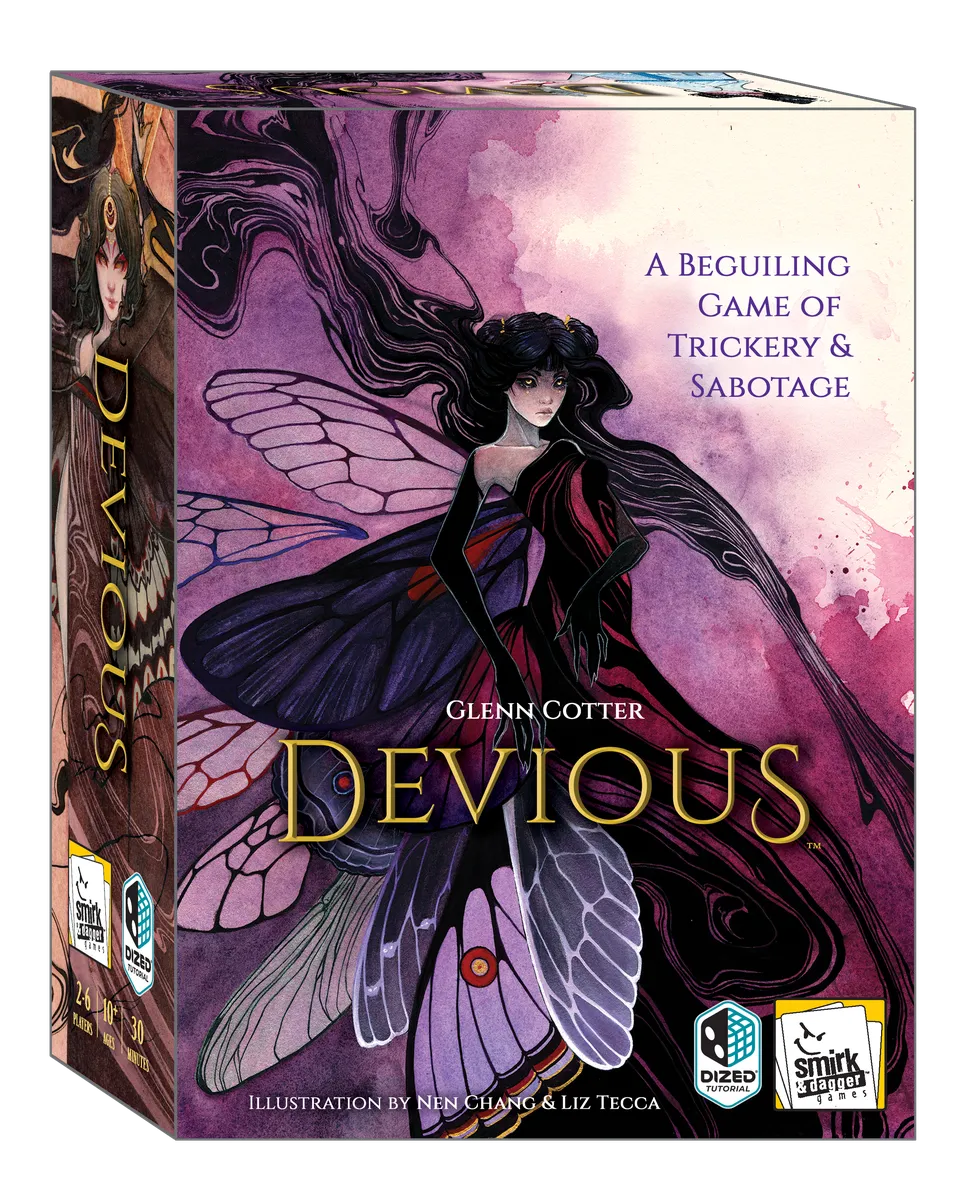
Devious is an anti-set collection card game. Build the strongest faerie alliance over five rounds and claim the crown. To do so you must play and hold in your tableau a single faerie from each of the faerie tribes, of the highest rank possible. But be wary, a second faerie of a given tribe negates your score – and more than two plunges your score into the negatives. Seek only the highest ranking faerie from each tribe for the strongest alliance possible. But each tribe has a unique power and the ability to manipulate faeries from around the table, including your own. Gaining the upper hand will be both chaotic and devious.

To set up before the game, players decide which six faerie tribes to use in the game from the 13 suits included in the box. They can be mixed and matched so game play varies from game to game. Each suit has 2 copies of ranks 1, 3 and 5 and 3 copies of ranks 2 and 4. Each suit also has a unique power, different from all the other Fairie types.

To start the game, each player is dealt 3 cards, and all players secretly and simultaneously choose two of these to keep – when all have chosen, these are placed face up on the table in front of each player. Note that Faerie powers do not activate in this setup round. The unchosen cards are discarded facedown.
The Direction of Play cards are shuffled and one is discarded. This stack of 5 cards will determine the order of play in each of the five rounds of the game. The direction shown on this card will also break ties if needed for the round.

In each round, all players are dealt three cards. But interestingly, they are not yours, they are your opponents. You look at them, decide the order in which to stack them – and therefore in which order your opponent will later encounter them, then pass that stack in the direction of play. Likewise, you’ll receive your stack in the same way.

Then look at the top card of the three-card stack and announce your intention to keep the card for your tableau or discard it, hoping for a better card your opponent may have buried deeper. If you choose to keep, discard the remaining stack of cards, without seeing them. If you choose to discard, look at the second card and choose to keep or discard. If the first two are discarded, the third card MUST be played. Did your opponent trick you into playing the worst card at the bottom of the stack? Was the best card the first card, which you discarded?
Once everyone has chosen their faerie card for the round, they are played in order of their Rank. Players all hold up a number of fingers equal to the rank of the card they kept. The highest Rank plays their card into their tableau and executes the faerie’s ability. If there is a tie, start with the Start Player and proceed in the order of the round card; the first tied player reached goes first.
Some Faerie Powers are only important for scoring purposes at the end of the game. Others have effects that target one or more faeries in play. A cunning player may choose to pass on a high ranking faerie for an ability that is more powerful when played later.
The six fairie powers suggested for the starting game are:
- Ancients – Dismiss a Faerie from any tableau
- Beguilier – Take a Faerie from an opponent’s tableau and add it to yours
- Benefactrix – Take a Faerie from your tableau and add it to any opponent’s
- Changeling – Exchange one of your Faeries with an opponent’s – but they must be of the same rank
- Noble – Ignore normal scoring; at the end of the game score your highest Noble regardless of the quantity you have
- Wayfarer – All players pass their lowest rank Faerie in the direction of the round.
The played card is placed in the tableau of that player – cards of the same suit should be stacked on top of each other so it is easy to see how many cards a player has in each suit. The player who resolved the last card in the round becomes the start player for the next round.

After the fifth round, players score each faerie suit in their alliances:
- 1 card of a Tribe: Score its Rank (from 1 to 5, depending on the card).
- 2 cards of the same Tribe: Score 0 points.
- 3-4 cards of a given Tribe: Lose points equal to the highest Ranking faerie in the Tribe.
- 5 or more cards of a Tribe: Score the summed value of all the fairies in the Tribe.
Note that some Fairie types say “ignore normal scoring” on them – and with these types, you instead follow the rules as on that card.
The player with the highest favor score wins. Ties broken in favor of the player with the most Fairies in their tableau.

Then, for the next game, change the faerie bands in the deck, with their own unique powers for a new challenge and constant variety in play. The rules have a number of suggested sets for more directed interaction or you can use the Randomizer cards to choose any 6 from the full set.
My thoughts on the game
So, at my Gen Con quick pitch meeting, I was intrigued from the start about an “anti-set-collection” game. That’s not something you see too often! Here, you definitely want no more than one card of each type due to the scoring rules. Of course, the actions on the cards can be really useful, so there is some interesting hand/tableau management issues to puzzle through as you play Devious.
I really like the push your luck / screw your neighbor concept used here. There is a fair bit of psychological warfare going on with the passed stacks of cards. Sure, sometimes it’s hard to do much if two cards simply don’t work for your opponent – but if there is any grey area in the cards, it can make for some difficult decisions on whether to take a mediocre card now or hope for something better on the next flip.
Also, as you immediately discard the unchosen cards if you take an early card, you also deprive yourself of some information as you’ll never know what those cards were. If you’re holding out hope for a specific card, you might want to see as many cards as possible!
As far as the timing goes, there can be a bit of management in choosing when to take specific cards. As you generally only want one of each type, you might want to pass on an action that you really would prefer to take at the end of the game! Or… it might be worth taking zero points or even negative points for that type in order to use the action multiple times. Of course, all of that depends on whether or not you get that type of card passed to you at all! This issue might also sway your decision on which cards to start the game with.
The game is lightning fast. You start with 2 cards in your tableau and then there are only five short rounds. While there can certainly be some angst-y moments as you decide to keep a card or discard to flip up the next one, this game really shouldn’t take more than 15 minutes. But in that short while, be prepared for some interesting decisions and an outcome that is usually in doubt until the last Faerie action round.
Ratings from the Opinionated Gamers
- I love it!
- I like it. Dale Y
- Neutral. Steph, John P
- Not for me…
Amazon affiliate link: https://amzn.to/4fAQQXY


