
Oasis: New Life on a Distant World
- Designers: George Feledichuk, David “Duvey” Rudow, Leo Taylor
- Publisher: The Op Games
- Players: 1-5
- Age: 10+
- Time: 45-60 mins
- Amazon affiliate link: https://amzn.to/4wKaSou
- Played with review copy provided by publisher
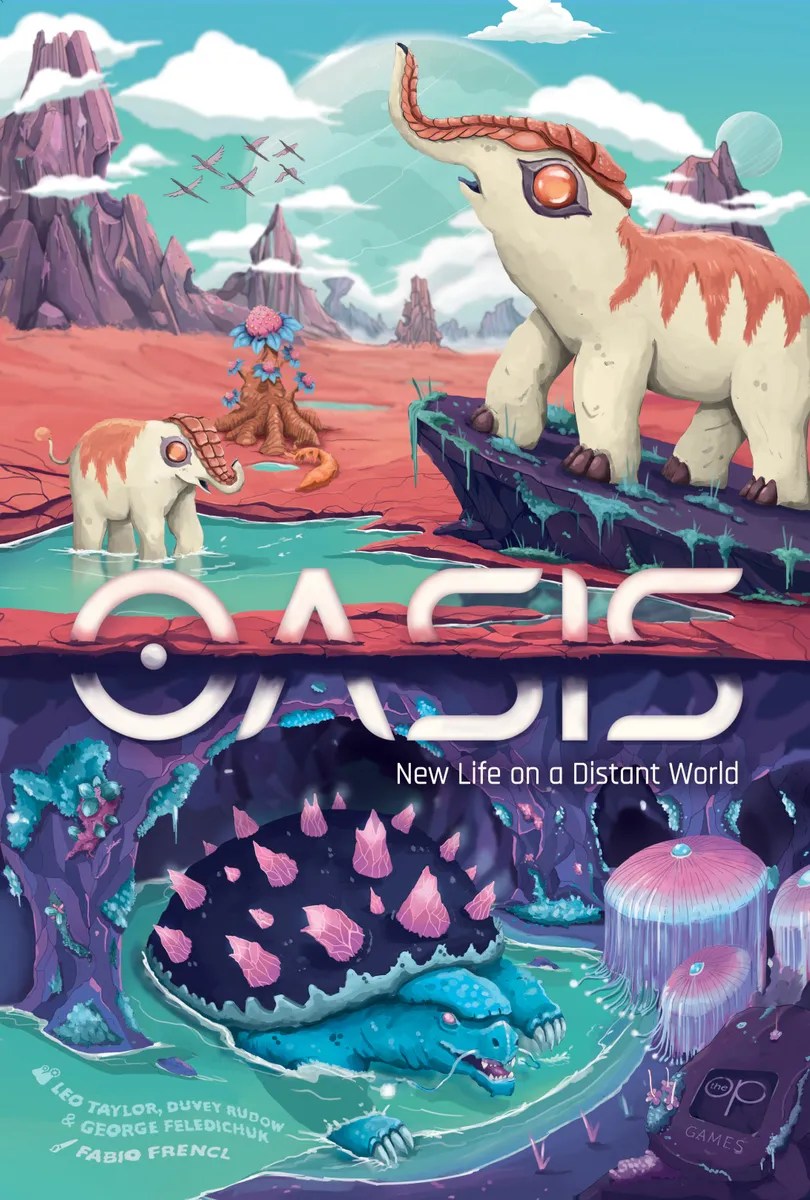
Cultivate a vibrant biome where the circle of life fuels the ecosystem’s survival! In Oasis: New Life on a Distant World, you embody the forces of nature on this primal planet, shaping the planet’s biodiversity by guiding the life cycles of its many bizarre species. Your goal is to cultivate a balanced, vibrant biome where the circle of life fuels the ecosystem’s survival Timing is key, however, as the annual floods will wash away plants and animals below the floodline at the end of each round. You must manage your hand of cards and maximize your actions to outplay your opponents and build the most dynamic and highest-scoring biome.

The game board is placed on the table and the Surface and Subterranean decks are placed in the corresponding slots. 7 Surface cards are drawn to form a Migration deck, and the top 3 cards are laid out to form the Migration row. The rest tiles are placed on the board. Each player gets a Biome board, a score keeping dial and a starting hand of 6 cards.
The game takes place over three rounds, each of which represent one year, and at the end of each round, underground water reservoirs overheat and will flood the bottom half of your Biome player board, washing away any lifeforms that remain.

On a player’s turn, there are three possible options: 1) Play a Card, 2) Discard to Cycle out, 3) Pass.
To play a card, you choose any card from your hand or the Migration Row on the table and place it on an empty space on your Biome board.
Subterranean cards are played to the bottom row of your board, and they have an optional action on them which is resolved when the card is initially played. Note that each board also has a wild Subterranean space in the center of their Biome board. Each Subterranean card has an imprint on it (which tells you what sort of lifeform it can support).

Surface cards are played in the top row, and they have imprint requirements at the bottom which must be seen on the Subterranean spaces below in order for it to be played. These cards also have an optional action on them which is triggered when first played. Note that you only need to meet the Imprint requirements when you first play the card.

To discard and cycle out, you first discard a card from your hand and then you cycle out a card from your Biome – that is remove it and place it in the discard pile. This is the only way to remove cards from your board during this phase of the game. If the removed card has a Cycle Out effect on it, resolve it at this time.

To rest, you take the topmost Rest tile from the stack on the board. The first player to pass in each round will also be the starting player in the next round. If you have any Rest effects on your cards, they happen now. As stated on your tile, you will be able to keep some Subterranean cards in the Flood; more cards if you pass earlier. You then draw 5 cards into your hand from either deck, discarding down to 8 after drawing.
The year ends when all players have passed. Trophies are awarded to the player who has the most of each of the three basic types – by counting the number of imprints on their cards as well as Imprint Tokens that have been gained along the way. Each trophy scores 5 points immediately. Interestingly, ties are given to the player who currently has fewer points.
Then the flood comes, and cards will Flood effects are triggered. Based on their Rest token, some players may be able to optionally keep one or two cards, but the rest of the Subterranean cards are discarded and removed from the game.
Play three rounds and then move to endgame scoring. Points are scored from the Rest Token taken in the final round as well as from the Imprint token area, scoring 1 point per token as well as points for completed rows and columns. The player with the most points wins, and ties are broken in favor of the player with the most Biome tokens on their board.
My thoughts on the game
Oasis: New Life on a Distant World is a game where players have to make the most of their cards each round. There is a bit of a mini-game in figuring out how to play the Subterranean cards needed to allow you to play the Surface cards that you want.
Each round, you get a hand of at least 5 cards, but don’t forget that you also have access to the seven cards in the Migration Row. Almost every card does multiple things for you, with actions that come into effect when played and then varying actions on playing, discarding, resting or being swept away in a flood. So, you’ll have plenty of options to consider – the catch is how to make the most of them.
In Oasis, you’re not only concerned about playing cards but also discarding them (or letting them get flooded). You have a fairly limited number of spaces to build up (5 below and 4 up top) – so you’ll need to remove/discard some cards as you go in order to have space free to build more cards. Some of the cards will even reward you for removing them (and it’s really hard to say no to a 6 point bonus for removing something).

Speaking of cards, it’s definitely best to make sure that you draw well in the game. As mentioned before, you start with up to 5 new cards each round as well as access to the Migration row. If you really want to chain together a lot of actions, it helps to be able to draw more cards. Of course, if you don’t start with any cards that provide drawing actions, you might be out of luck. At least the game will give you one measly point per turn after you pass when everyone else is continuing to play.
The graphics are fairly well done, though my groups have had some issues with the similarly colored Imprint icons. The three trophies only go to the three basic imprints, but yet there is a light green color that looks almost dead on the real green basic color. We mis-scored the trophies occasionally because it’s unfortunately very easy to mistake those two icons. It seems that this could have easily been avoided by simply choosing a different color.
The rulebook seems to have everything in there, though a couple of questions could only be answered via captions in the examples – not the best place for rules IMHO. (i.e. do the pre-printed Imprints on the middle space on the bottom row count towards Trophies). Also, I think the player aid has a typo as it says Trophies go to the player with the most Imprint Tokens, but the same example shows that Card Imprints also count.

When we first read the rules, we thought the game would go quickly, but once we learned how to cycle through cards and to use the cards from the Migration row, the game definitely takes all of the 45 to 60 minutes that it suggests. For me, this is a touch on the long side, but I feel that if the game were shortened any, there would be a high risk of not having enough cards to have a meaningful round – and that would be unfortunate in a game with only three rounds. It already seems to happen to at least one play each 4p game I’ve been in based on the random draw of cards…

For players that like cardtastic combo play, Oasis is worth a try. You’ll have plenty of different cards to try to play and combine on your Biome board, and hopefully you’ll have the most points at the end!
Ratings from the Opinionated Gamers
- I love it!
- I like it. Dale Y, John P
- Neutral.
- Not for me…
Amazon affiliate link: https://amzn.to/4wKaSou


