
Kano
- Designer: Angel Pintero
- Publisher: Matagot
- Players: 1-4
- Age: 12+
- Time: 35 minutes
- Played with review copy provided by publisher
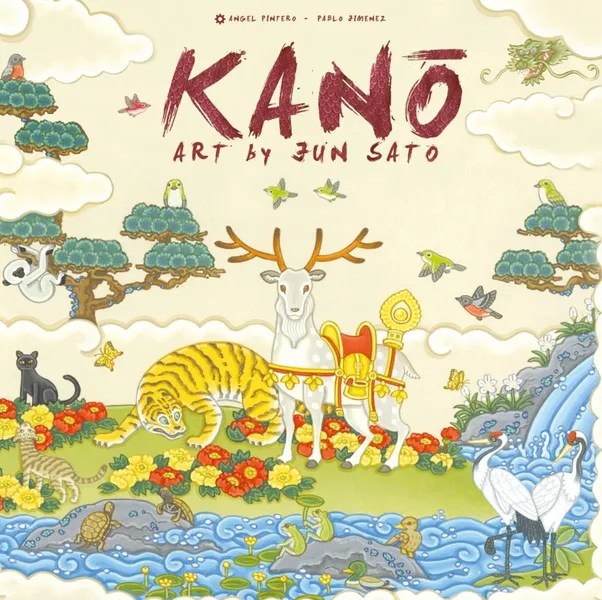
In Kano, 2 to 4 players compete to create their own Emakimono—traditional Japanese painted handscrolls—by skillfully arranging vibrant paint pots. The game elegantly blends tactical resource management with spatial optimization as players navigate a shared central mat to collect the pigments needed for their masterpieces.
Gameplay Mechanics: Precision and Patience
Each turn, artists must make meaningful choices to fill their scrolls:
- Manipulate the Palette: Players may swap adjacent paint pots on the central mat to set up the perfect move.
- Pigment Collection: You must take at least one paint pot, but may take several if they are the same color and adjacent in a single row or column.
- The Rule of Gravity: When placing paint on your board, pots always “fall” to the lowest available space in a column, requiring careful planning to form specific patterns.
- The “Dry Paint” Limit: Artists must be efficient; if you end a turn with more than four visible paint pots on your board, the excess must be converted into “Cloud” tiles, which fill space but score no points.
Achieving Prestige
Once a pattern is formed, players replace their paint pots with beautiful Artwork Tiles. Points are awarded based on the complexity of the creations:
- Standard Artworks: Larger pieces earn higher scores, with 3-space artworks yielding 7 points.
- Personal Masterpieces: Players hold secret Masterpiece cards worth a significant 12 points each upon completion.
- The Shogun’s Demands: Common “Red” and “White” goal sheets provide shifting objectives every game, rewarding those who can adapt their style to meet specific artistic requirements.
The game reaches its climax when one player completely fills their board, triggering a final round of scoring to determine the Master Artist.
The main board is placed on the table, and one red goal sheet and one white goal sheet are chosen for the game. Each player gets an empty player board, a reference sheet and 1 sun tile and 1 moon tile. Each player also gets 2 Masterpiece cards at the start of the game, one of which is kept. The first player fills the palette with random paint pots from the bag.

A player turn includes these phases:

1] Pass the bag of paint pots to the player to your left

2] Optionally swap any two orthogonally adjacent paint pots
3] Claim at least 1 paint pot, but you can take any number of same colored pots that are adjacent in a row or column.

4] Add the paint to your board, following normal gravity rules so that all pots go as far to the bottom as possible. A free pain pot can be replaced by one of the pots just taken this turn.
5] Create artworks – if you exactly match the paint pot pattern for a painting, you can remove the pots and place the painting chit on your board. If it is a Masterpiece, you place it, then draw two new Masterpiece cards and choose one to keep. Note that you must match exactly; some artworks allow mirroring or portrait/landscape positioning, but the rest must match exactly.
6] Dry Paint limit – you can only have 4 visible paint pots at the end of your turn. If you have more, you must replace the excess with cloud painting chits (which do not score at the end of the game).

If a player has filled in all the spots on their board, they announce this fact and the current round is completed so that all players have the same number of turns. The game is then scored.
- 12VP per Masterpiece
- White Goal sheet – 3 to 7 VP depending on how many criteria you meet
- Red Goal sheet – up to 30VP based on how many different artworks you painted that were on the goal sheet
- Score each individual artwork, 1/3/7VP for 1/2/3 space paintings
- 3VP if you have filled your board completely
The player with the most points wins. Ties broken in favor of the player with the most different types of Art.
My thoughts on the game
Kano is a game I first played in April 2025 – and while that prototype version has changed a bit into its final form – it is one that I have been wanting to play again since that first game. Thanks to the gorgeous art, the game is just so beautiful on the table, and there is a solid game underneath as well!
The resource management part of the game is a challenge. You are limited to drawing one color at a time from the display, and only from a single row/column. You’d obviously like to draw as many paint pots as possible – to give you the most options of where/what to build; but you’ll be subject to what is available on your turn. Also, as all the painting options except for your masterpiece card are known; players might be able to play defensively and prevent you from taking the color that you most want.

Thus, while you’ll be developing a plan for your next turn, you should also try to determine what your backup color(s) will be. After all, it may be worthwhile to change your plans if you’re able to get your mitts on more paint pots. You can’t be too greedy, as you have a limit of 4 unused paint pots on your board each turn – if you have more, you have to turn the extra into clouds which are not worth any points and eat up your valuable space.
I will say that it’s important to stress to newbies that the order of the paint pots cannot be altered – there is a definite left-right or up-down fixed relationship for the paintings. Yes, some can be rotated and some can be mirrored, but you can’t use every possible permutation of the pots to paint things.

As the game goes, you’ll be dropping paint pots into your area and then converting them into paintings. You’re rewarded for each particular painting, but you’ll definitely have to remember about the red and white scoring criteria. In general, the red one has a much higher potential for scoring, so I generally try to focus on that, and then figure out the white one if possible near the end of the game.

I still very much enjoy this game, and now that I’ve had a chance to play the final version, everything just works so well. The art on the pieces is gorgeous and the paint pots have a very pleasing solid-ness to them. All of the chits are neatly organized into the vac tray which helps for both gameplay and storage. I can see myself playing this a lot in the coming months.
Thoughts from other Opinionated Gamers
Doug G (Garrett’s Games Podcast): Shelley and I LOVE the look of this game, and as Dale says, there’s a solid game underneath the sheen. There’s straightforward game play and interesting decisions for drafting paint pots, and it’s important to remind first time players that not every combo works in each configuration. We love it and it’s staying on our shelf. We discussed the game on Episode 1060 of the podcast, and also have a YouTube review at www.youtube.com/@garrettsgames
Ratings from the Opinionated Gamers
- I love it! Dale Y, Doug G.
- I like it. Steph
- Neutral.
- Not for me…


