
 Those of you who’ve followed my writing and social media posting over the years know I have a very special place in my heart for the Disney theme parks… and, prior to becoming the guy who turns a certain shade of green on particularly twisty rollercoasters, I was happy to explore amusement parks like Cedar Point, Kings Island, and Magic Mountain.
Parallel to that is my love of a long lineage of amusement park building computer games – the original wonder that was Rollercoaster Tycoon (plus all of the reboots and expansions), followed by the much more robust Planet Coaster and over the last year or so, the amazing Planet Coaster 2. (You do NOT want to ask me about the park I’m building – it’s the rough equivalent of asking a D&D player about their character.)
 The search for a really excellent theme park board/card game has been less successful.
- I enjoy Joe Huber’s Scream Machine – but until it gets a reprint, the graphic design of the prototype was loads better than the published version.
- The Rollercoaster Tycoon board game has all kinds of weird thematic issues (why are we competing for customers but working together to build the park?!) but it is a decent family game.
- Unfair (and the expansions) have a lot of game stuffed into the box – but it can be a particularly mean “take-that-y” experience, which isn’t always a crowd pleaser.
- Adlung Land is clever and a very good game – but it would benefit not being shoehorned into a small card box.
- Coney Island – despite being designed by Michael Schacht – just fell flat for me.
- I’ve already made my irritation with Carnival very clear.
- Dinosaur Island: Rawr’n’Write focuses on building/drawing your own Jurassic Park, which is very cool. I’ve had a lot of fun soloing the game – but it hasn’t got as many positive reactions as a multiplayer game.
- Disney’s The Magic Kingdom Game is a family game with lovely 3D bits… and nothing more.
- I’m still waiting for Eric Burgess to finish designing his Theme Park game. 🙂
Yes, I know there are a lot of other theme park games out there – this isn’t an exhaustive list.
The theme park game that’s most likely to get to my table right now is Tenpenny Parks – and that gets us past the proverbial Main Street of my autobiographical musings to the hub of my review. (OK, I promise to cut back on the Disneyland metaphors starting… now.)
Tenpenny Parks was designed by Nate Linhart – and as far as I can tell from BoardGameGeek, it’s his first published game. The splendid look of the game is a credit to Vincent Dutrait (whose style I recognize from Heat: Pedal to the Metal and The Lord of the Rings: Duel for Middle-earth). It’s published by Thunderworks Games – who are better known for their World of Ulos games (Roll Player, Cartographers, Roll Player Adventures, Stonespine Architects, etc.) but have done a nice job with thematic games like Cape May and Tenpenny Parks as well.
Tenpenny Parks: The Base Game
Before play begins, each player receives $7, 3 hidden goal cards (they discard one before play begins), and then they draft a starting board on which they place little wooden trees on each tree location.
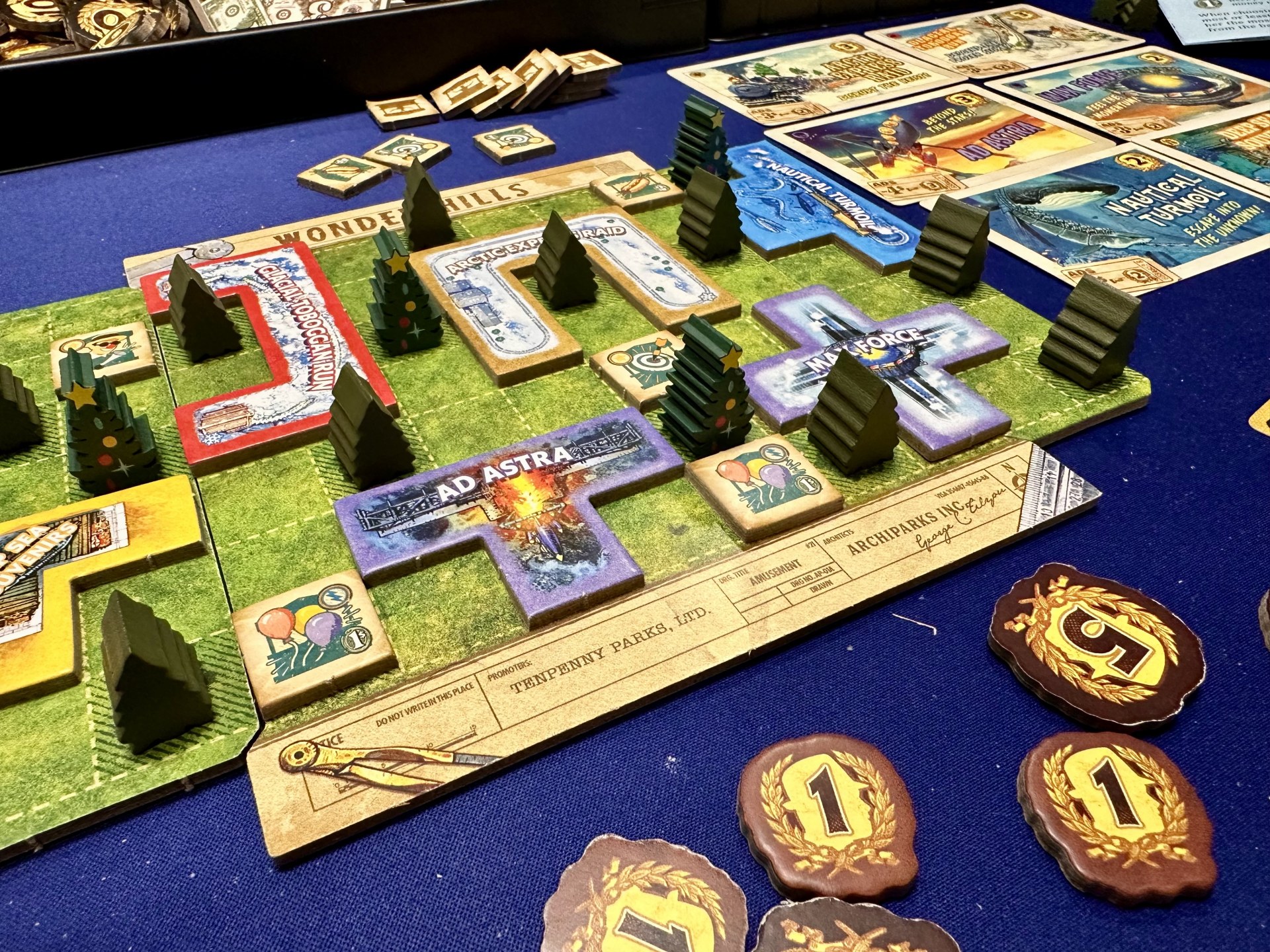 Over five rounds, players will work to build their amusement park on a wooded piece of property, choosing wisely how to clear trees (or work around them), expand the boundaries of their land, and increase the Thrill, Awe, and Joy their guests experience when enjoying their masterpiece.
Each round begins with players receiving income: a base income of $3 + any income from shops you’ve built + any income from concession stands you’ve added to your park.
Odd digression: I want to say “thank you” to the good folks at Thunderworks Games for just deciding not to mess with making the dollar amounts “realistic” – it is much easier to play the game without a bunch of extra zeroes. Besides, the estimate for the recently built TRON coaster at WDW’s Magic Kingdom is $300,000,000 – making the $ parallel to reality would mess up the clean graphic design of cards and tokens.
After income, each player in turn assigns one of their three workers to the board. There are ten possible positions:
- Six different card stacks of attractions to purchase
- Five different themes for rides and shows
- One stack of shops
- Only a single worker can visit each of these stacks each round
- The Banker – gives the player $2
- The Arborist – lets the player remove two trees from their board
- The Realtor – allows the player to buy an extension to their land for $3
- The Contractor – lets the player add a concession stand to their park
When a player takes an attraction or concession stand, the corresponding tile needs to be placed in their park. Tiles cannot be placed orthogonally adjacent to each other – they can be completely separate or touch on the corners. They also cannot be placed on trees.
Once a tile is placed, the player get the requisite bumps on the Thrill, Awe, and Joy tracks indicated by the card or tile, then flips the card over to its billboard side and places it in their play area.
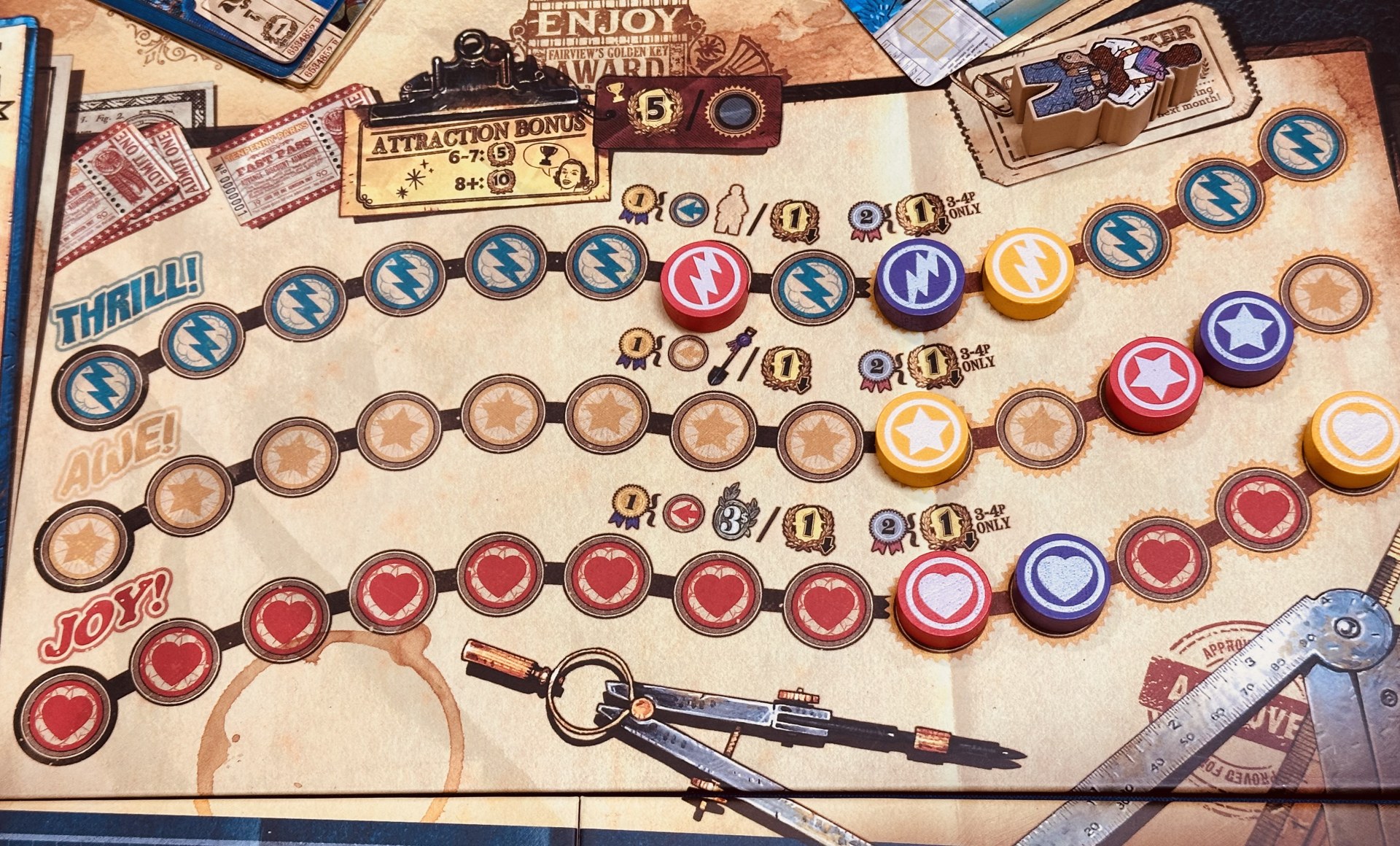 After all the players have placed their three workers, the bonus phase occurs. Each of the tracks is evaluated and the player highest up on the track can either move a step back and get the track-specific award or simply remain where they are and take a single guest point. The rewards are:
- Thrill track: take an extra worker for the next round
- Awe track: become first player in the next round
- Joy track: get $3
In three and four player games, the second place player on each track receives a guest point.
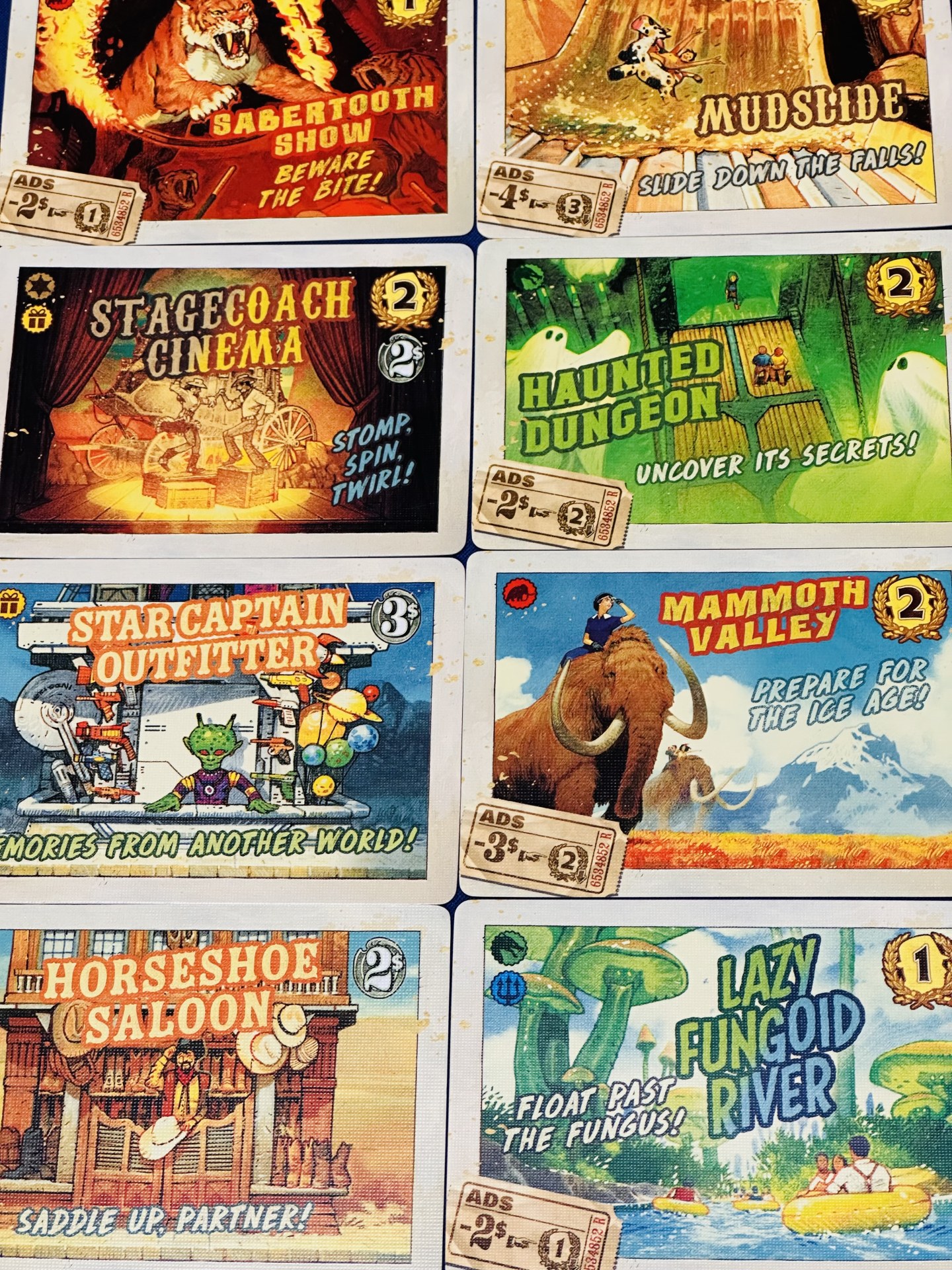 Following those choices, players can spend cash on hand to advertise their rides. Each attraction generates some amount of guest points if the owner ponies up the proper amount of dollar bills.
Finally, the round ends with a cleanup phase. New concession stands are set out and the start player turns the merry-go-round to change the cost of the attractions.
At the end of five “months” (rounds), the player with the most guest points wins the game. You count your collected guest points, the guest points on each of your attractions, any completed goal cards you received at the beginning of the game, and special point rewards for reaching a threshold on the tracks as well as building 6+ attractions.
I glossed over some of the details in recounting the basic structure of the game… but I wanted to point out how easy this is to teach. (That is NOT the same as “easy to play well” – but we’ll get into that when I get to my own impressions of the game.)
- Shops count as attractions… but they don’t award guest points or bumps on the tracks. They create income – which can be very helpful.
- Certain squares on each piece of land have track icons that are triggered when you place an attraction on top of them.
- If the leading player in the Awe track does not take the starting player shovel, they give the shovel to the player on their right.
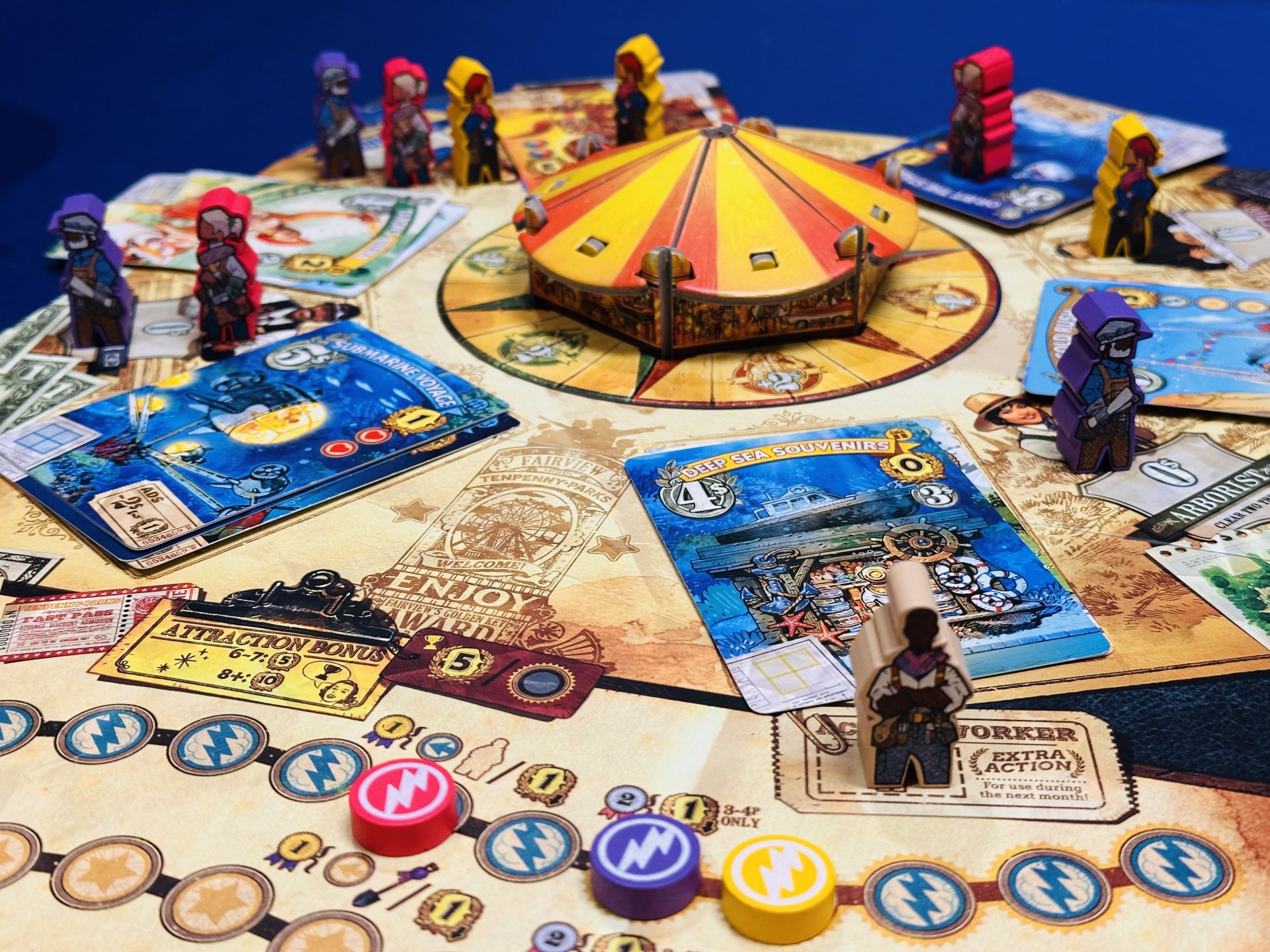
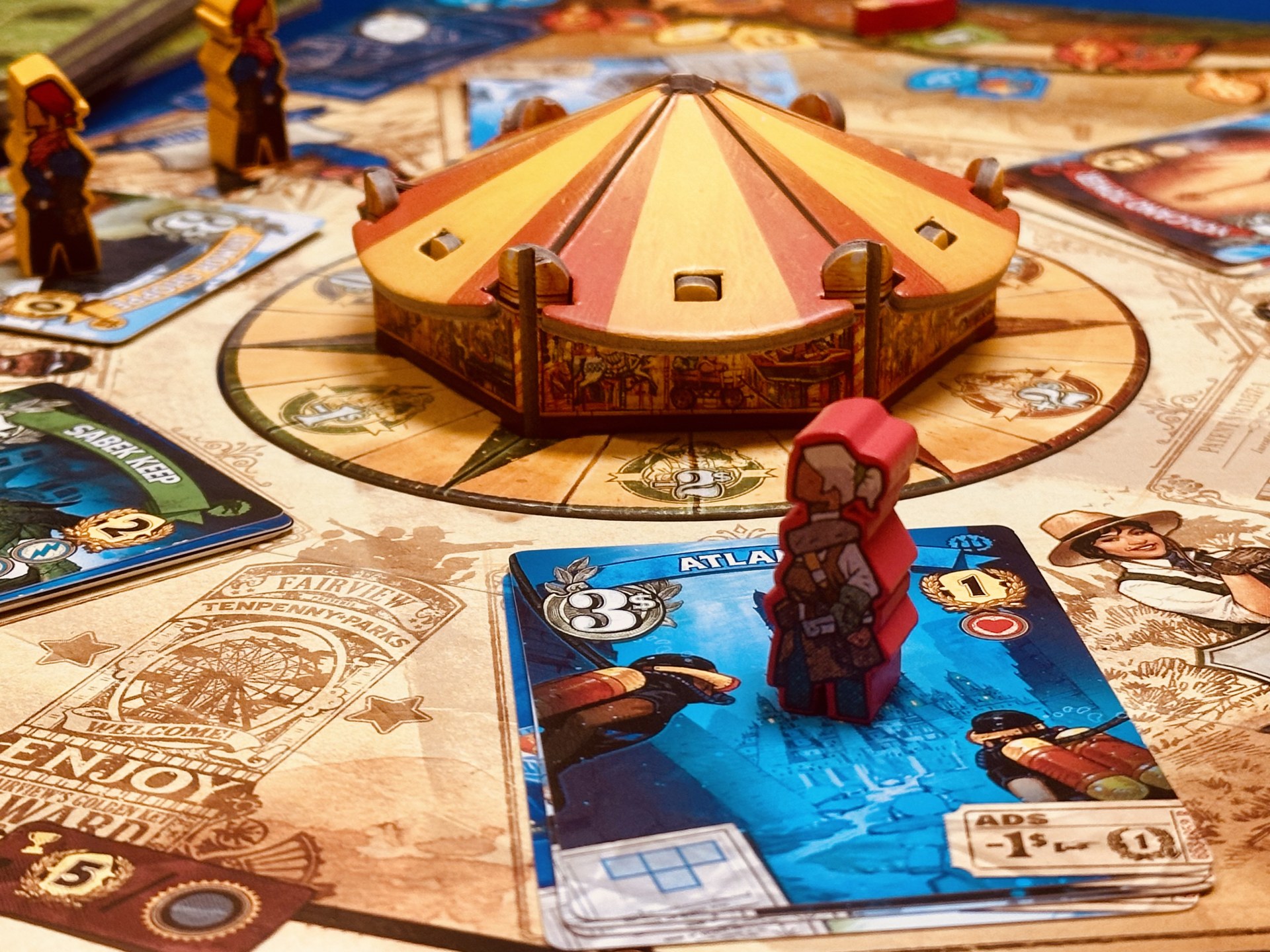
- The merry-go-round in the middle of the game board is not just for looks – it has six sections which correspond to the six decks of attractions. Each section has a modifier to the cost of the attraction in that section: -$2, -$1, $0, $0, +$1, +$2.
- The start player must change the orientation of the merry-go-round.
My Thoughts on Tenpenny Parks (base game)
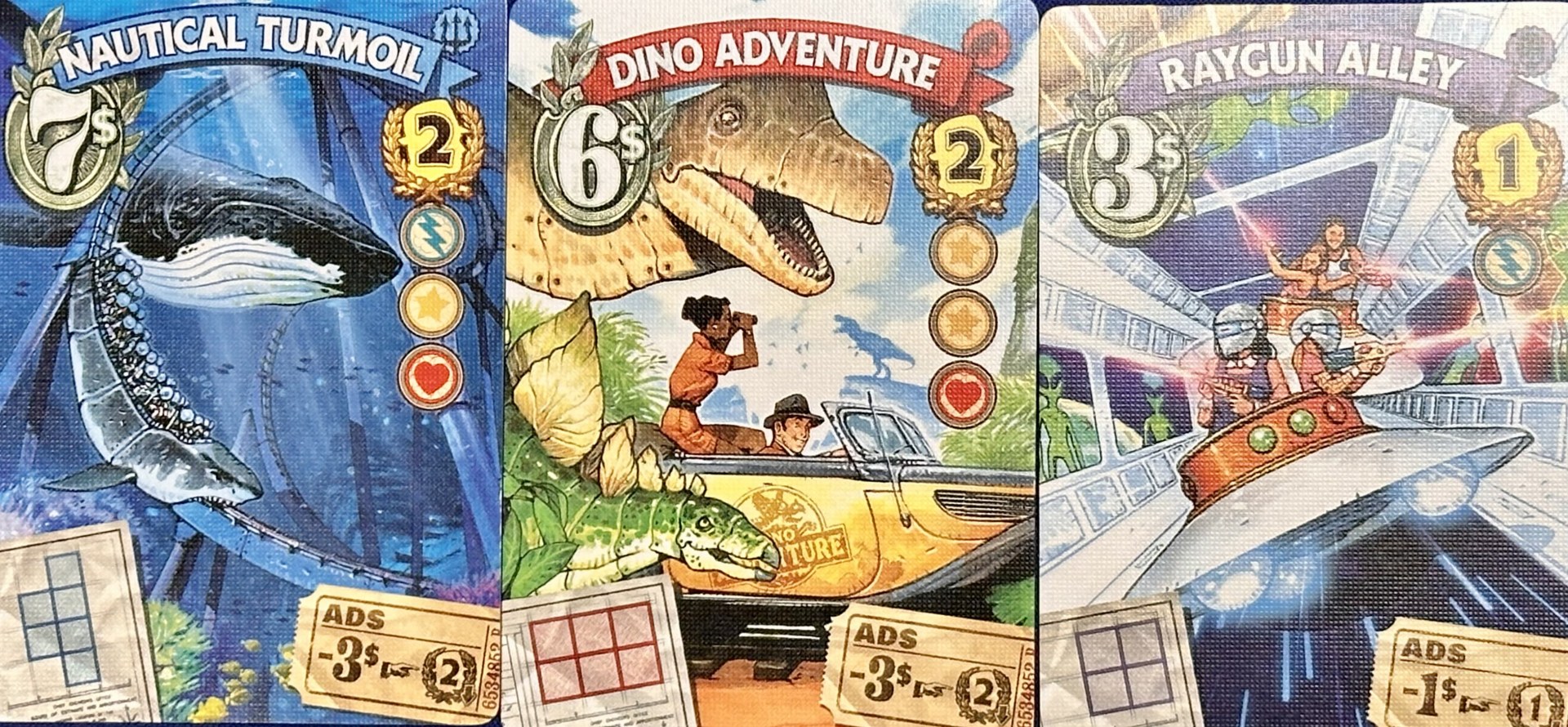 Tenpenny Parks is not complicated – it’s a relatively straightforward worker placement game with some important tile-laying elements. You have 15 “moves” to accomplish your objectives – and the best moves can be countered by other players, often inadvertently. The need to have multiple plans in play as well as thinking carefully about how you’re trying to arrange your park is what draws me back into this game each time.
Honestly, the production of the game is a huge selling point as well. The cardboard pieces are chunky – which includes the land and expansion land boards. Dutrait’s art style is perfect for this game – and the iconography is clear and easy to follow. There’s even a bit of 3D toy love thrown in with merry-go-round rising up out of the board.
There are two gripes with the game that don’t seem to bother me. Some folks have felt that the merry-go-round makes it difficult to see the discounts on the wheel – but if you can see one of the price hikes or discounts, you can figure out where the other ones are without having to see it directly.
The other gripe involves how the start player shovel moves if the leading Awe player decides not to take the shovel. My experience is that holding first position has advantages and disadvantages. The first player gets to set the merry-go-round and purchase first… but the final player gets to decide which tracks to challenge on by buying an attraction or building a concession stand.
Playing time is 10-20 minutes per player. An experienced group of four can finish Tenpenny Parks in about an hour. The solo mode works nicely as well, though it’s pretty swingy due to its dependence on what cards are available for purchase.
I bought the base game not long after it was released… and I’ve found it an enjoyable game to play at all player counts (1-4 players). I find myself working to get my park up & going while doing as little damage to the surrounding forest as possible – and having fun doing it.
Would it work with non-gamers? I think it could – my younger son calls these kind of games “high gateway” games. In other words, there’s a little more going on than Ticket to Ride or Azul, but it’s still within the range of folks who are willing to stretch a bit. (The very well written rulebook coupled with Dutrait’s gorgeous art definitely would help.)
Tenpenny Parks: The Mini-Expansions
There are two mini-expansions for the game: Fast Pass and Fairview Challenges. I’d be the first to acknowledge that a number of mini-expansions are just discarded bits of the original game design – but it doesn’t feel like that is true for either of these.
Fast Pass simply adds four tokens to the round/month tracker on months 2-5. The tokens are a bonus or discount for the first player to choose that particular space in that month.
- The Banker – gives the player $4 (instead of the normal $2)
- The Arborist – lets the player remove four trees from their board (instead of the normal two trees)
- The Realtor – allows the player to buy an extension to their land for $1 (instead of the normal $3 cost)
- The Contractor – lets the player add a concession stand to their park with a bonus bump on any one of the tracks
It would be easy to assume that the first place player would jump on this advantage – but by doing so, they would lose the chance to purchase a discounted attraction since they were the ones who could manipulate the merry-go-round.
I like how the Fast Pass expansion gooses the game without taking over gameplay.
The same is true for Fairview Challenges – it adds public goal cards to the game. Having more ways to score guest points leads to interesting decisions. Sometimes the best decision is to ignore one more goals – your workers and hard-earned cash are worth more spent in better places.
Neither mini-expansion overwhelms the game design or adds a large addendum to the rules – I’m happy to play with either or both in the game.
Tenpenny Parks: Winter Lights & Spooky Nights Expansion
The first of two “real” expansions is the holiday themed Winter Lights & Spooky Nights. Just as the Disney parks have holiday celebrations (Mickey’s Not-So-Scary Halloween Party, Mickey’s Very Merry Christmas Party, etc.) and Universal has their Halloween Horror Nights (that’s a big fat “no” for me), the Tenpenny Parks universe has them as well. Each module adds its own holiday flair, appropriately themed attractions, and lovely wooden bits to the game.
Winter Lights
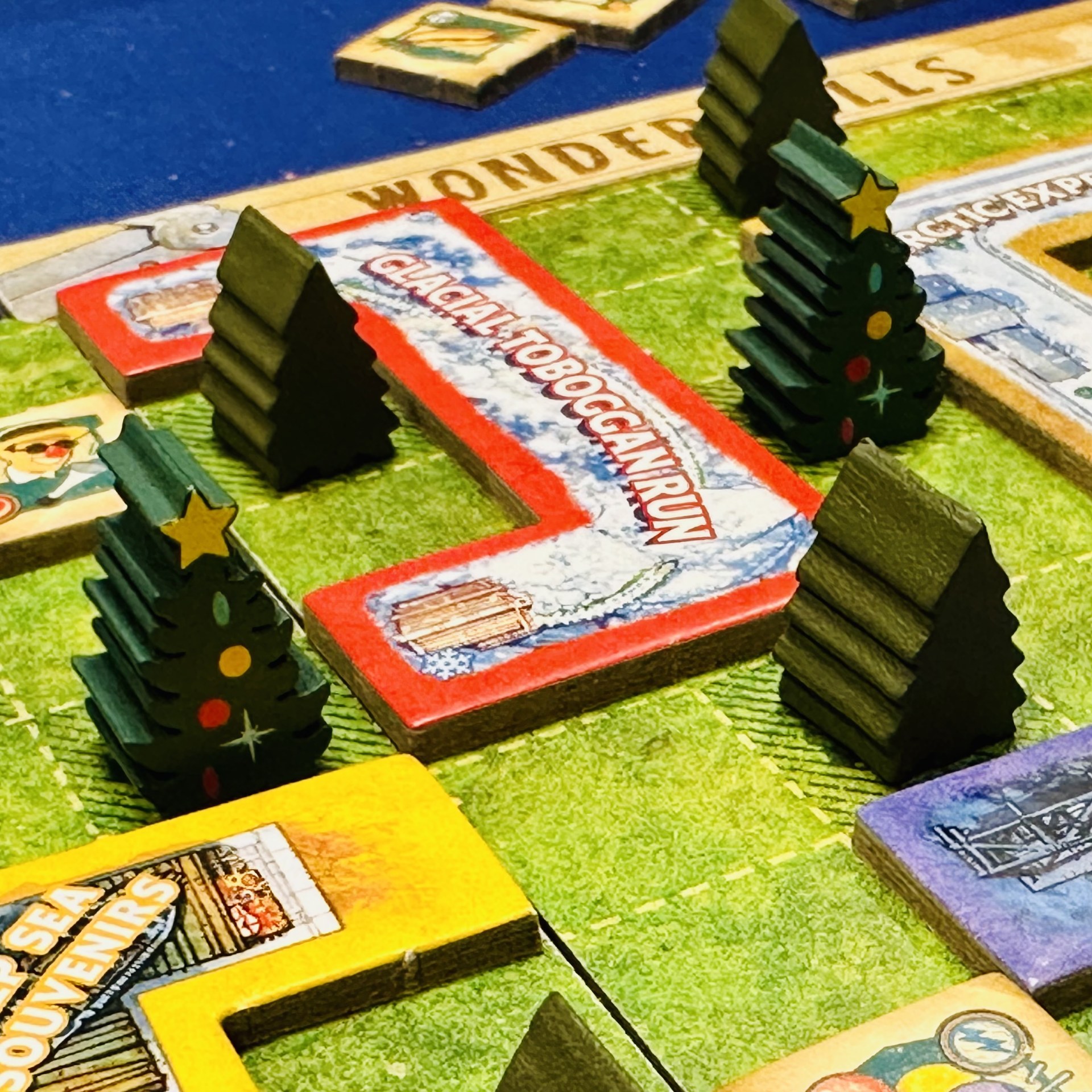 Along with the holiday-themed attractions, Winter Lights adds a fourth track to the top of the board – Cheer. Each player has a Christmas light bulb that moves forward on the track every time they build an attraction with a cheer icon or place an attraction next to a Christmas tree in their park. There are various rewards for moving up the track, including the very St. Nick friendly “give another player a single bump on an emotion track.”
Players begin the game by replacing two of their regular trees with Christmas trees… and any time they expand their park, they may substitute one regular tree with a Christmas tree. Once placed, Christmas trees cannot be removed – that wouldn’t be very jolly, would it?!
Finally, the farthest player along the Cheer track gets a guest point during the bonus phase of each month/round.
Spooky Nights
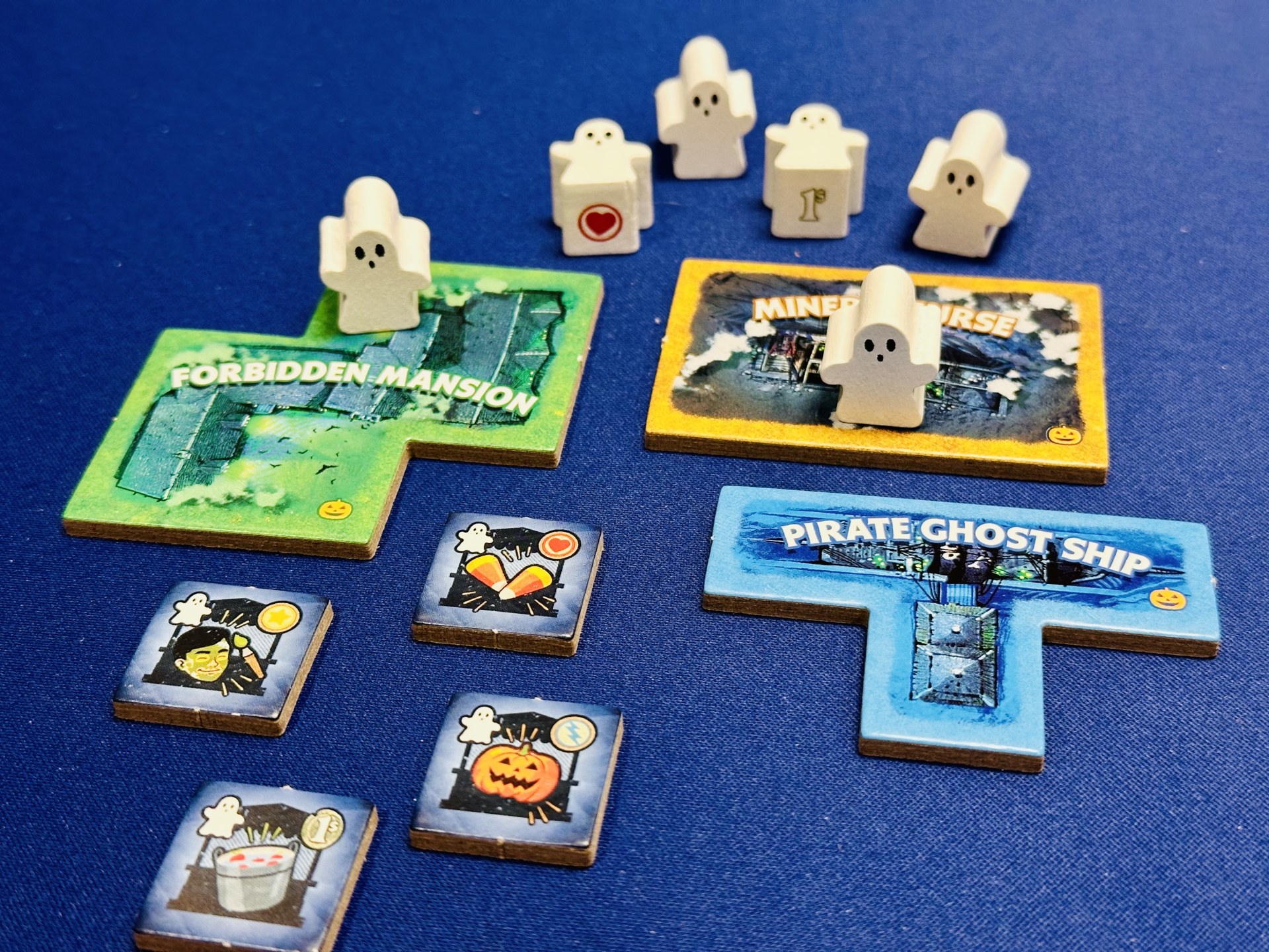 Spooky Nights is a bit more involved than Winter Lights. This module adds Dark Concession tiles and ghost markers in addition to special spooky attractions.
When players take a Dark Concession or build an attraction with a ghost icon on it, they take one of the ghost figures, revealing the potential reward on the bottom of it. (They don’t receive the reward when they take it.) Ghost markers are also placed on the +$1 attraction each round.
During the Advertising phase of each round, players can assign their ghosts to haunt attractions in their park – no more than one ghost per attraction! (These are evidently anti-social ghosts.) If a player pays to advertise at a haunted attraction, they get the reward on the ghost there as well.
Both expansions reward careful planning – the early placement of the Christmas tree is key, as is hanging onto enough cash to advertise if you’re collecting ghost friends. You are able to play with both expansions in – but I haven’t tried that. Yet.
I love the cute bits and the variety that this expansion adds to the game – but I don’t think it is a necessary expansion unless you are playing a good bit of Tenpenny Parks. Now, I’m glad I have it – so your mileage may vary.
Tenpenny Parks: Innovation Expansion
 The second “real” expansion is the most gamer-friendly of the bunch… and I’ll get this out of the way right now: I think it is a worthy addition to the already solid base game.
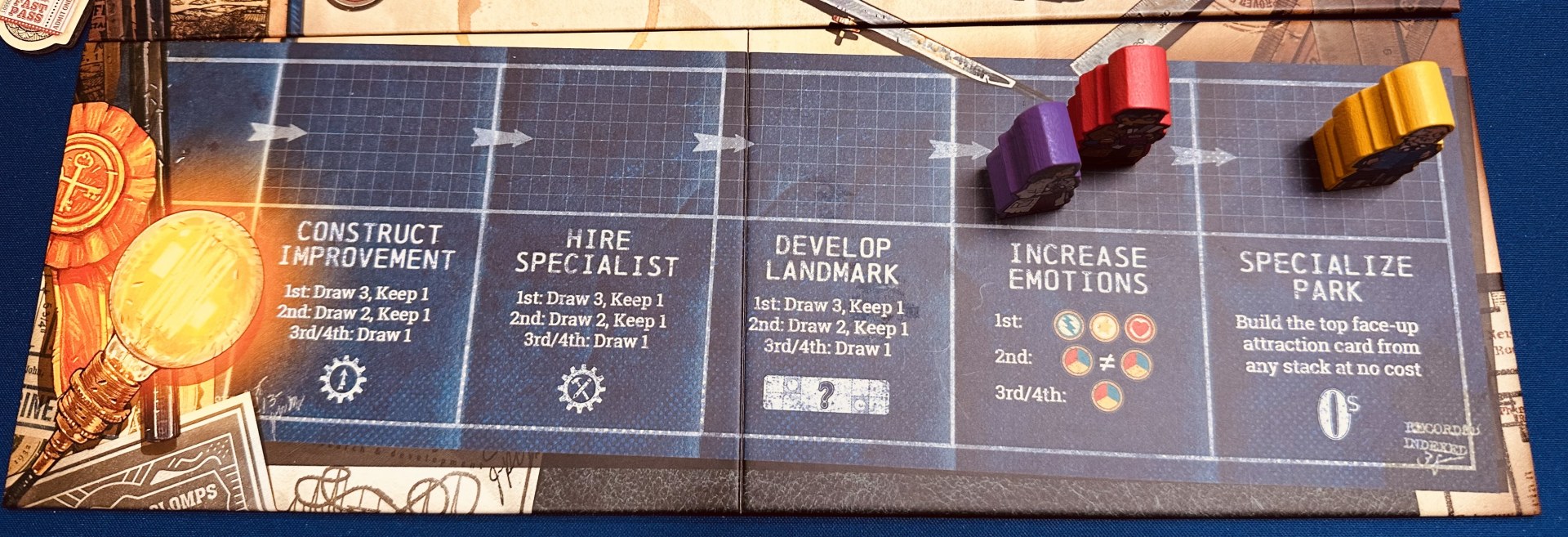
In Innovation, each player receives a researcher figure who is moved along the Innovation board. This is an additional action during the worker phase – instead of assigning a worker, you can move your researcher forward and claim the appropriate innovation:
- First month – a park Improvement that gives you some kind of scoring bonus
- Second month – a Specialist who gives you a unique ability
- Third month – a free Landmark expansion board to add to your park (that has some kind of limitation when building on it)
- Fourth month – a bump on one or more tracks
- Fifth month – a free build of an attraction
Timing is everything for your researcher – the first one to advance gets the top three cards/boards of the stack and chooses one of them. The second researcher to arrive takes the top two cards/boards and chooses one. The third and fourth researchers simply get the top of the stack. (In the case of the fourth month, the early bird gets the worm better track bumps.)
Innovation also adds new property boards with additional bonuses and pitfalls as well as attractions with two theme types.
For me, this expansion does exactly what I want an expansion to do – add a simple element to the game that expands what I can do without bigfooting the solid base game. Taking advantage of the Improvement and Specialist can alter your gameplay and your score.
Tenpenny Parks: Collector’s Edition
The Collector’s Edition storage system gives you a nifty way to put all of these expansions into a single box. Even prior to adding the expansions, the base game filled the entire box with baggies, so a storage solution was a welcome addition to the franchise. I especially like the tray for money tokens, trees, and guest points.
Part of the Collector’s Edition is also the premium upgrade bits – most of which you can see in the pictures in this review. There’s a bag for concession stands, screen-printed wooden figures and emotion markers, and some extra trees.
Finally, the Collector’s Edition includes all four expansions – the two mini-expansions and the two “real” expansions. If you’re interested in the Collector’s Edition (or even just the base game), you can check it out at Thunderworks Games site.
If anybody is hanging around Nashville and wants to learn how to play, I’m ready and willing to get Tenpenny Parks to the table!

Ratings from the Opinionated Gamers
Tenpenny Parks (base game)
- I love it! Mark Jackson
- I like it.
- Neutral.
- Not for me…
Winter Lights & Spooky Nights (expansion)
- I love it!
- I like it. Mark Jackson
- Neutral.
- Not for me…
Innovation (expansion)
- I love it! Mark Jackson
- I like it.
- Neutral.
- Not for me…


