
Upside Town
- Designer: Quentin Quek
- Publisher: PlayByDesign
- Players: 1-4
- Age: 12+
- Time: 25-40 minutes
- Played with review copy provided by publisher
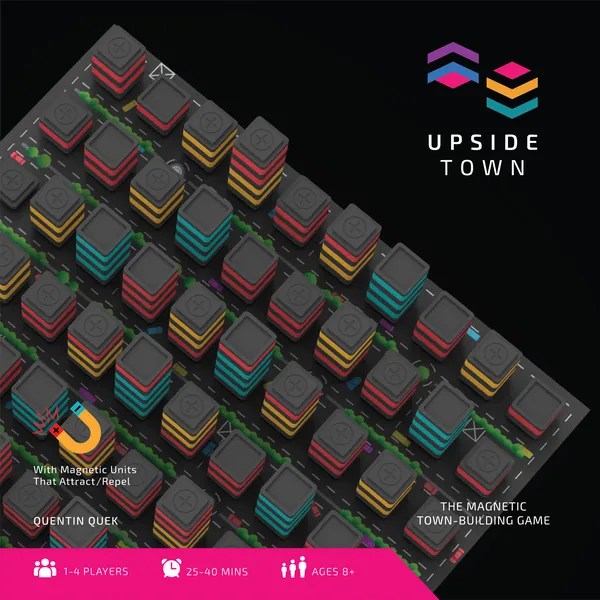
In Upside Town, buildings rise rapidly from modular pre-fabricated units, but constructing the skyline is no simple task. Single-level units can be stacked freely but they are slow to build. Double and triple-level units, however, obey strict rules: they (magnetically) repel units of their own kind, above or below. These unique constraints create a constant puzzle of balance and strategy as players rush to fulfill and chain multiple city contracts to shape the skyline of Upside Town.
Upside Town is the first-ever boardgame to feature a new Magnetic Polarity game mechanic, where the orientation and polarity of building units matter. Throughout the game, players need to plan and build based on how units magnetically attract or repel each other. With immaculately well-designed and produced game components, Upside Town is a tactile and refreshing gaming experience for families, casual and serious gamers alike.

To set up the game, give each player a building board – this has five sites on which to build buildings. Players start with 2 Single buildings and 1 Double building. These are stored in the storage card (total capacity of 4 buildings). Each player also gets two Town View cards, one of which is kept. Create the 2 tiers of contract cards for your player count, and then make a market of four of each. If you choose to play with the expansion, draw one of each of the three types of endgame bonus cards and put them in the display as well.

On a turn, the active player will take 2 Main Actions as well as any free actions they like. The Main Actions are:
- Take – take a Single piece from the supply and store it in your storage
- Upgrade – turn a Single into a Double or a Double into a Triple in your storage
- Split – turn a Double into 2 Singles or a Triple into a Double+Single
- Build – build any number of units from your storage to your board. Note that Doubles cannot be built on another Double, and Triples cannot be built on another Triple. Singles will always work as they have one of each polarity
- Demolish – remove the top unit(s) on a single building and return them to the supply. You can completely remove a single building with this action
- Gain – take one contract card from the display or the top card from either deck. Immediately replenish the display. You only have room for 3 contract cards underneath your building board.

The Free actions include:
- Fulfill – show that you have buildings that match the pattern on one of your cards; take any bonuses shown at the top (building pieces or free construction tokens), and then flip the completed card into your score pile.
- Use free Construction token – spend the token to take a free Build or Demolish action
The game continues until either of the Contract decks is depleted. Finish the current round and then play one more. After that, each player adds up the points shown on their completed contracts and Town View card. If you have played with the Special Projects Expansion module, also score the three extra cards if you meet the criteria on them. The player with the most points wins, ties broken in favor of the player with the most Tier 2 Contracts completed.

My thoughts on the game
Upside Town is one of those games that just clicks. Literally. There is something just so satisfying to hear/feel the building pieces attach together as you build up your buildings. It is a solid contract fulfillment/pattern building game, but the beautiful magnetic pieces take it to the next level.

The magnets are more than just a gimmick though – they actually affect the gameplay. There is no sadder feeling than to take a Double piece and try to stack it upon another Double – only to feel the physical repulsion of the pieces due to the matched polarity. You can’t make a mistake here – physics won’t let you!
Keeping an eye on the polarity is a big part of the game here. You can always use single pieces as they have one of each polarity – but if you’re trying to expand quickly, this will take you many turns given their smaller size.
As you go through the game, you’ll want to try to choose contract cards that are similar – with any luck, you’ll be able to chain together a number of build and/or destruct actions to allow you to complete multiple contracts in a turn. Being efficient in your building modification is the biggest key to success IMO.

Once you are familiar with the game, you can add in both the Town View cards as well as the three end-game bonuses; and each adds a small extra layer of complexity that help the game feel a bit more challenging. For veteran gamers, you can probably go ahead and add these in from the start, and you’ll see the game in its best form right off the bat – don’t worry, you’ll be able to handle it!
The components are just great. The building pieces are solid and, as I mentioned earlier, they do connect with a satisfying click. Further, the magnets are strong enough that you’ll get a noticeable push when you try to connect two pieces of the same polarity. The box insert is made up of lots of cardboard, but they separate all the bits nicely and allow for easy storage. Overall, everything is very well thought out and presented.

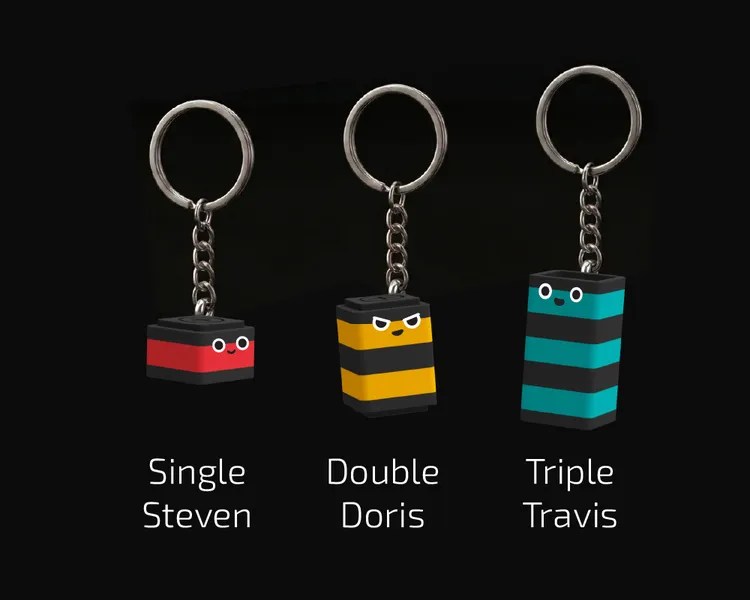
Upside Town is a game that attracted my attention due to the gimmick of the magnetic buildings, but it is the gameplay itself that will keep it coming to the table. For now, it’s being made by the designer’s own publishing company, though I could certainly see bigger players being interested in it. It will debut at Spiel in Essen in 2026, and you can check it out there! From what I’ve read, you’ll also have access to these adorable building piece keychains!
Thoughts from other Opinionated Gamers
Alan H: I played the prototype at UKGE and had a good chat with the designer. His background in design spills over to the game. As Dale notes, the presentation is excellent and the surprise you experience when trying to place a piece that won’t work is amazing. Definitely a huh? moment. Then you realise what’s going on. The other aspect that works well is that you can only demolish one unit at a time, so planning from one contract to the next is something you need to consider when constructing the first building. My games have never lasted more than 30 minutes, so it’s an excellent end of evening finisher.
I’m now looking forward to Quentin’s next game about town development using the same magnetic elements that debuted in this game.
Ratings from the Opinionated Gamers
- I love it! Dale Y, Alan H
- I like it.
- Neutral.
- Not for me…


