We’ve got all the themes you could ever want covered in today’s 138 Games article. You could play a card game about recycling or a board game about superheroes. You could try to efficiently provide electricity to cities across the country or feed polyps to your parrot fish. And lastly you could connect cities with train routes. These are your 2003 and first batch of 2004 games that everyone needs to try sometime.
– R-Eco –
Nathan Beeler: Even though I generally agree with what they’re saying, games with a message usually send me running in the opposite direction. Save the real whales? Yes, sir. Sign me up. But save cardboard whales? Yawn. Can’t we race them across the pacific instead? Harvest them and trade their bones for untold riches? Or maybe just blow them up for the sheer spectacle? To me, games should exist to be fun,  and that’s it. So I can be an uncaring and unfeeling bastard with regard to game themes. In fact, when I get a sense that a game was invented merely to preach a message, any kind of message, I believe it has to try that much harder to impress me. R-Eco, a little card game that rewards recycling litter that you collect, while allowing – but severely punishing – the dumping of that trash on the side of the road, seems pretty clearly to have a well intended agenda. And yet the game itself not only overcomes this handicap, by my way of thinking, but I think it rises to the “must play” heights of the other games on this list.
Mechanically, it’s a fairly simple game. I won’t bore you with all the details (this time), but for a short and easy to grok filler, there is still a lot to consider. On your turn you always pick one of the four types of recyclable material cards from your hand to deliver to its corresponding recycling center. With that limited decision you’ve basically got to weigh the short and long term rewards and penalties to your score, the potential for setting up others to score, the effects to your hand size, and the make-up of the cards you’ll have for the next turns. Those cards you get from each recycling center are face up and known in advance, so everyone can see what the possible implications will be to your future decisions, and can plan for that. Consequently, the game rewards paying attention to other players’ turns and somewhat tracking what they’ve taken. Another consideration is that you may choose to recycle some but not all of a type from your hand. Keeping cards back may help you score that type again later, but it’s dangerous because you also have strict hand limit of five cards. Going over the hand limit is possible, but overfilling your virtual collection truck comes with the aforementioned severe penalty. The question of whether to consume a pile of cards that makes you dump your load or not leads to a lot of strain (and a lot of hilarious potty humor in my circles).
Yes, it’s a card game. Yes, there is some luck. But like all great card games, players have more control than the cards do. R-Eco’s clean design and delicious agony make it an essential gaming experience, despite its feel good message.
Rick Thornquist: I first experienced R-Eco when I was given a pile of Japanese games at Essen. The other games were good, but R-Eco stood out. It’s one of those beautifully designed games that has very few mechanisms and that’s all it needs. There’s luck, there’s strategy, and there’s much moaning and groaning at twists of fate. One of the best light card games.
Continue reading →
Like this:
Like Loading...

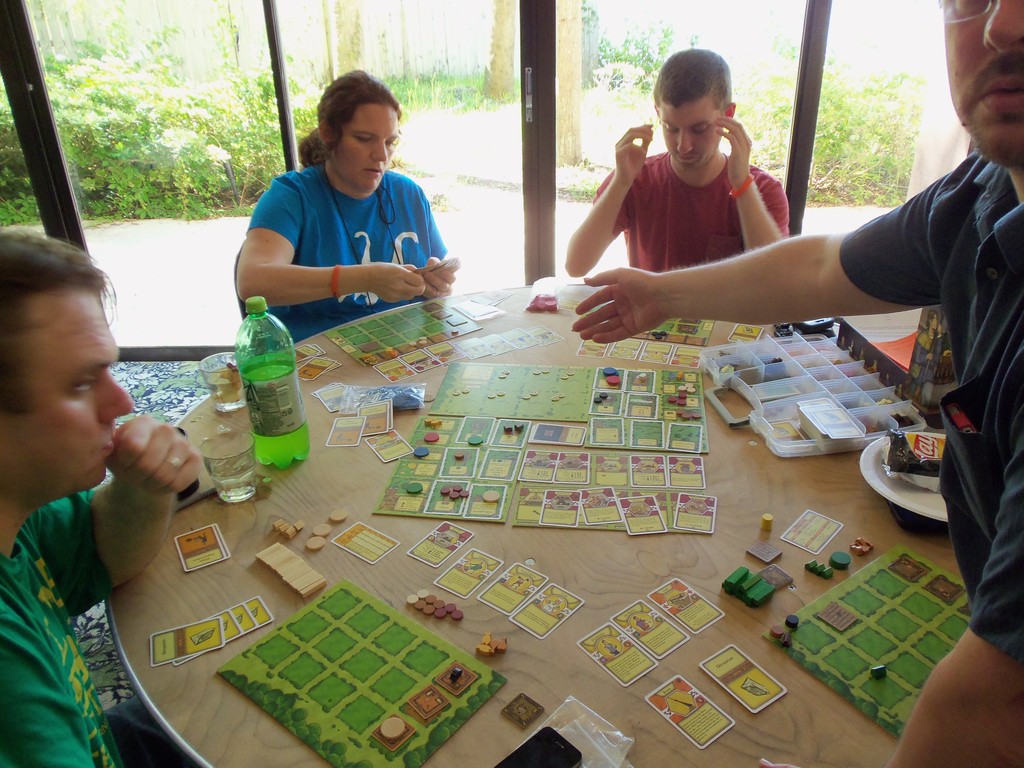
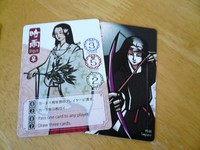 usually not my thing. Sentinels wasn’t bad but it seemed overly long and there didn’t seem to really be that much interaction in our game amongst the heroes.


Preview: Princes of the Dragon Throne
Designer: Fred MacKenzie
Publisher: Clever Mojo Games
Ages: 13+
Players: 2-4
Time: 90+ mins
Previewed by Matt Carlson
Prototype copy provided by Clever Mojo Games
Games played: 4-5 partial and full games
I recently had the privilege to evaluate a prototype of a game that is currently up on Kickstarter for production. I was able to play a few games (one or two initial games with minor rules mistakes) and have been able to put together this preview (I do not consider my evaluation sufficient for a full, “official” review.) Princes of the Dragon Throne (on Kickstarter until early July) uses deckbuilding mechanics as the core driving force behind an area-majority game. Each turn, players use their hand of cards to gain resources or place their supporters onto the game board. Resources are spent to gain more powerful cards. Supporters on the board are used to claim guilds for short-term benefits and allow placement of dragon lord tokens in a central dragon clan area-majority location. At the end of the game, just about everything scores in an area-majority fashion. While I find the game has a bit of a slow start, it transitions into a fairly interesting mashup of El Grande with deckbuilding mechanics. Unfortunately, the game doesn’t quite reach a must-buy rating from me, as my few early plays seems to indicate there are fewer valid overarching strategies within the game than first appear. Continue reading →
Share this:
Like this: